

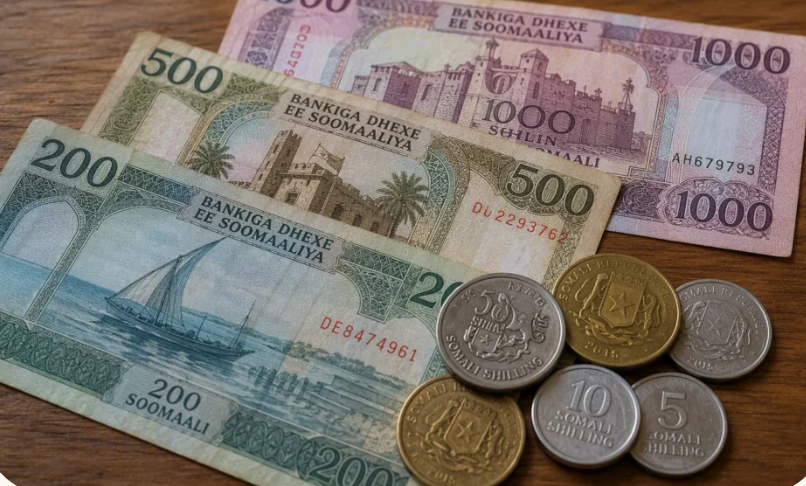

Somalia’s plan to introduce new banknotes under a fixed exchange rate system is an important step towards restoring the country’s national currency.
However, the initiative must be supported by strong financial safeguards, credible monetary policies and public confidence to ensure that the new Somali shilling retains its value over time.
Following remarks by Finance Minister Biixi Iimaan Cige on the currency replacement plan, the proposal deserves broader consideration beyond the printing and circulation of new banknotes.
Its success will depend on the country’s ability to maintain monetary stability, protect foreign exchange reserves and establish confidence in the institutions responsible for managing the currency.
Somalia has not issued a new official national currency for more than three decades, while the economy has become heavily dependent on the US dollar.
Reintroducing the Somali shilling would therefore represent more than a technical exercise in currency production. It would involve rebuilding trust in the country’s monetary system and restoring the role of the national currency in everyday economic activity.
One important consideration is the establishment of a Currency Board Arrangement (CBA). Adopting a fixed exchange rate alone does not guarantee that the new currency will remain stable.
A credible system would require a strong legal and financial framework ensuring that the money issued is backed by sufficient foreign exchange reserves.
One proposal worth examining is maintaining reserves equivalent to between 100 and 110 per cent of the monetary liabilities covered by the arrangement.
The government must also explain how the proposed fixed exchange rate will be determined. The value assigned to the new shilling should not be based solely on political decisions or official preference.
Instead, it should emerge from a technical assessment of market exchange rates, purchasing power, wages, commodity prices and the condition of the banking sector.
Setting an unrealistic rate could undermine confidence and create pressure on the currency from the outset.
Protecting foreign exchange reserves will be equally important.
Funds set aside to support the new currency should be legally protected and kept separate from resources used to finance government expenditure, meet political commitments or rescue commercial banks.
Clear restrictions and regular oversight would help prevent the reserves from being diverted away from their primary purpose.
The independence of the Central Bank of Somalia is another essential condition. The institution must have the authority to manage the currency framework without political pressure to issue money that is not adequately backed by reserves.
Strong legal provisions should also prevent the government from directly financing its expenditure through the creation of new currency.
A separate financial safety mechanism should be considered to address emergencies in the banking sector.
Under a strict Currency Board Arrangement, the monetary authority has more limited capacity to act as a lender of last resort than a conventional central bank.
This makes it important to establish a dedicated facility that could help address serious liquidity shortages and financial emergencies without undermining the currency’s reserve backing.
Transparency and accountability will also determine whether the public trusts the new monetary system.
The Central Bank should regularly publish reliable information on foreign exchange reserves, the volume of currency in circulation and the extent to which available reserves cover monetary liabilities.
During the initial implementation period, weekly disclosures could help strengthen public confidence. Independent audits would provide an additional layer of oversight and credibility.
International experience offers useful lessons.
Hong Kong, Bulgaria and Estonia have operated currency board arrangements that demonstrate how a fixed exchange rate framework can contribute to monetary stability when supported by strong legal institutions, adequate reserves and disciplined financial management.
Argentina’s experience during the 1990s, however, illustrates the risks of relying on a fixed exchange rate without sufficient fiscal discipline and a resilient banking system.
The country’s currency peg eventually collapsed amid mounting economic and financial pressures, demonstrating that an announced exchange rate cannot, by itself, guarantee long-term stability.
For Somalia, the central debate should therefore extend beyond the question of when the new banknotes will be printed and introduced into circulation.
The more important issue is whether the country can establish the financial institutions, safeguards and economic discipline needed to protect the currency.
Ultimately, the success of the new Somali shilling will be measured not by the number of banknotes issued, but by whether it can maintain its purchasing power and earn the confidence of Somali households, businesses and financial institutions in the years ahead.