

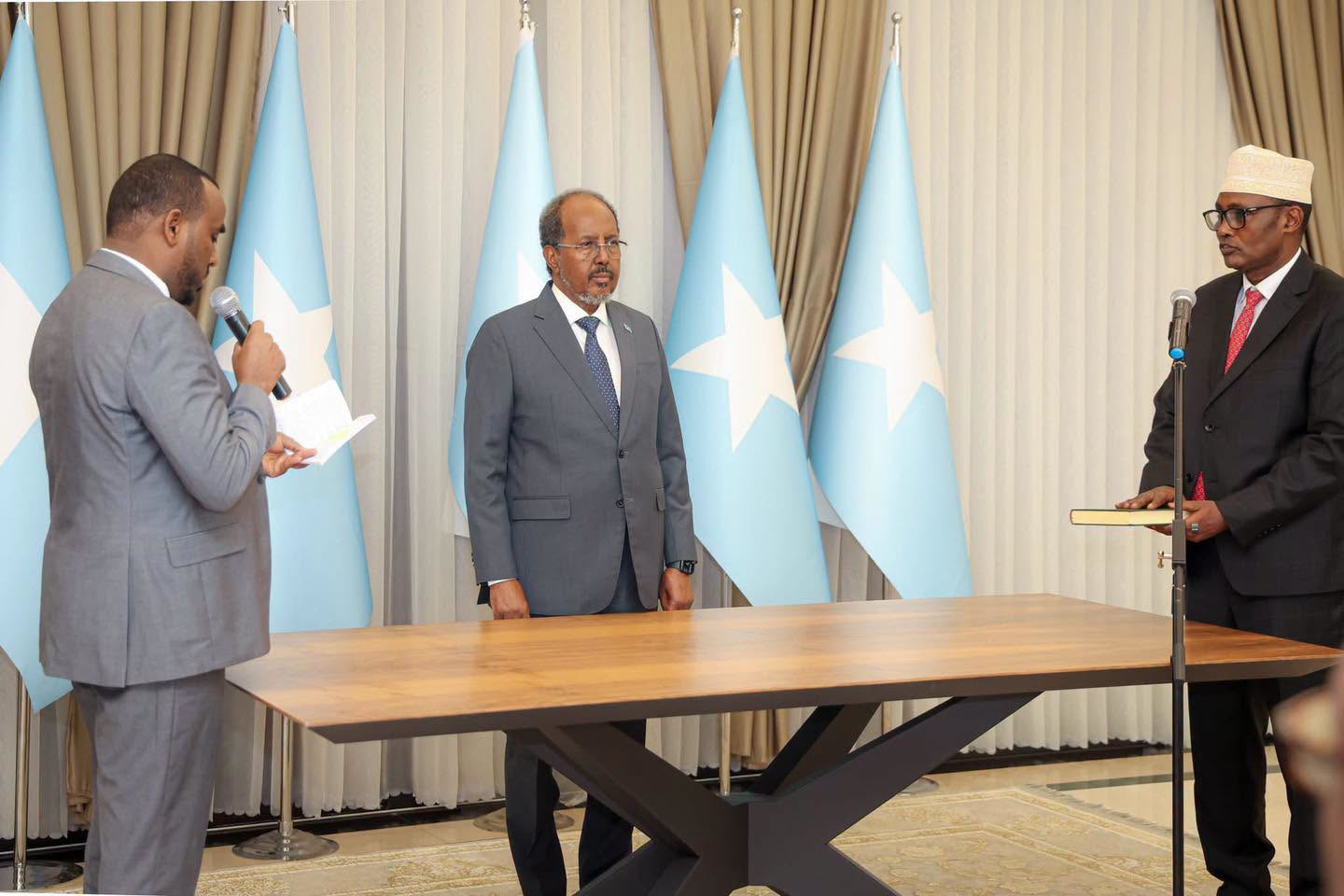

The swearing-in of Somalia’s newly appointed Supreme Court Chief Justice, lawyer Ibrahim Idle Suleiman, has triggered fresh legal and constitutional questions, coming amid an unresolved dispute over the removal of his predecessor, Dr Baashe Yusuf Ahmed.
President Hassan Sheikh Mohamud attended the inauguration ceremony at the Presidential Palace in Mogadishu.
The event was also attended by the Speaker of the House of the People, the Prime Minister, members of both parliamentary chambers and the Minister of Justice.
However, the ceremony took place after the Supreme Court issued a statement on November 5 rejecting Baashe’s removal and declaring the decision unconstitutional.
The conflicting developments have raised questions about the president’s appointment powers, the role of the Judicial Service Commission, parliamentary approval requirements and the legal validity of the new chief justice’s swearing-in.
Hassan Sheikh removed Baashe from office on November 4 and appointed Ibrahim Idle Suleiman as his successor. The Presidency said the decision followed complaints concerning judicial administration, transparency and the need for reforms within the justice system.
However, the presidential announcement did not provide detailed information about the specific allegations against Baashe or publish documents demonstrating that the constitutional procedures for his removal had been followed.
Ibrahim Idle Suleiman previously served as chief justice of the Supreme Court from 2011 to 2018, before being succeeded by Baashe.
His return to the position comes at a particularly sensitive time, as the Supreme Court is dealing with disputes over constitutional amendments and the terms of Somalia’s federal institutions.
The main legal question concerns whether the president can appoint the Supreme Court chief justice independently or whether the process requires the involvement of other constitutional institutions.
In its response to Baashe’s removal, the Supreme Court cited Articles 135 and 138 of the revised Constitution adopted in 2026.
According to the court’s interpretation, Article 135 requires the Judicial Service Commission to nominate the chief justice, followed by approval from both houses of Parliament before the president formally confirms the appointment.
Article 138, as cited by the court, establishes a separate procedure for removing the chief justice. It requires a recommendation from the Judicial Service Commission and approval by a majority of both parliamentary chambers sitting jointly.
If these provisions govern the current appointment, it is necessary to establish whether the Judicial Service Commission formally nominated Ibrahim Idle and whether both houses of Parliament approved his selection.
The Presidency has not, in the information made public so far, provided detailed documentation confirming that all these stages were completed. This has left the appointment process open to legal scrutiny.
The controversy is therefore not simply about the individual selected to lead the Supreme Court. It concerns whether the constitutional process was followed and whether the institutions assigned specific responsibilities under the Constitution were involved.
It is also important to distinguish between the authority to appoint a chief justice and the authority to administer the oath of office.
Both actions must have a clear legal basis, and the participation of senior government officials in the ceremony does not, by itself, establish that all constitutional requirements were met.
On November 5, the Supreme Court declared Baashe’s removal unlawful, arguing that the president could not dismiss the chief justice unilaterally without following the constitutionally prescribed procedure.
The court also noted that the dismissal occurred while it was handling a case filed by former president Sheikh Sharif Sheikh Ahmed challenging constitutional amendments and decisions affecting the tenure of federal institutions.
The ruling created an unusual situation in which the Supreme Court rejected the removal of its former chief justice while the Presidency proceeded with appointing and swearing in a replacement.
This has raised questions about who currently has legitimate authority to lead the court and how decisions issued by the competing sides will be recognised.
The Federal Government has rejected the Supreme Court judges’ position.
The Office of the Attorney General argued that the court’s decision lacked a proper legal foundation, raising questions about how the panel that considered the case was constituted and the absence of the dismissed chief justice from the proceedings.
The result is a direct disagreement between two competing legal positions: the Supreme Court maintains that Baashe’s removal was unconstitutional, while the government disputes the validity of the judges’ decision.
Resolving the dispute will require a recognised legal process capable of clarifying the competing claims and preventing state institutions from operating on the basis of contradictory decisions.
The leadership dispute is also closely connected to the wider constitutional and electoral crisis.
In another ruling issued on November 5, the Supreme Court said the 2026 constitutional amendments could not be applied retrospectively to extend the mandates of incumbent federal institutions.
The court called on political leaders to reach agreement on an electoral framework within 30 days and directed that elections be held within 90 days.
Its position rejected the Federal Government’s argument that the constitutional changes allowed the president and Parliament to remain in office until 2027.
That ruling helps explain why the Supreme Court leadership dispute has implications beyond the appointment of a senior judicial official.
The underlying constitutional case concerns the future of Somalia’s political leadership, the electoral process and the legal status of federal institutions.
The continuing confrontation could weaken public confidence in the judiciary, particularly if rival officials issue competing decisions while claiming authority over the country’s highest court.
It could also encourage political actors to use judicial rulings to reinforce their respective positions, making a negotiated resolution more difficult.
There are further concerns that prolonged institutional conflict could disrupt government administration and affect the work of security agencies at a time when Somalia continues to face security challenges and the fight against Al-Shabaab.
The Federal Government, Parliament, judicial institutions and political stakeholders now face the challenge of resolving the dispute through constitutional procedures, clarifying the authority of the Supreme Court leadership and preventing the disagreement from deepening divisions within the country’s institutions.