

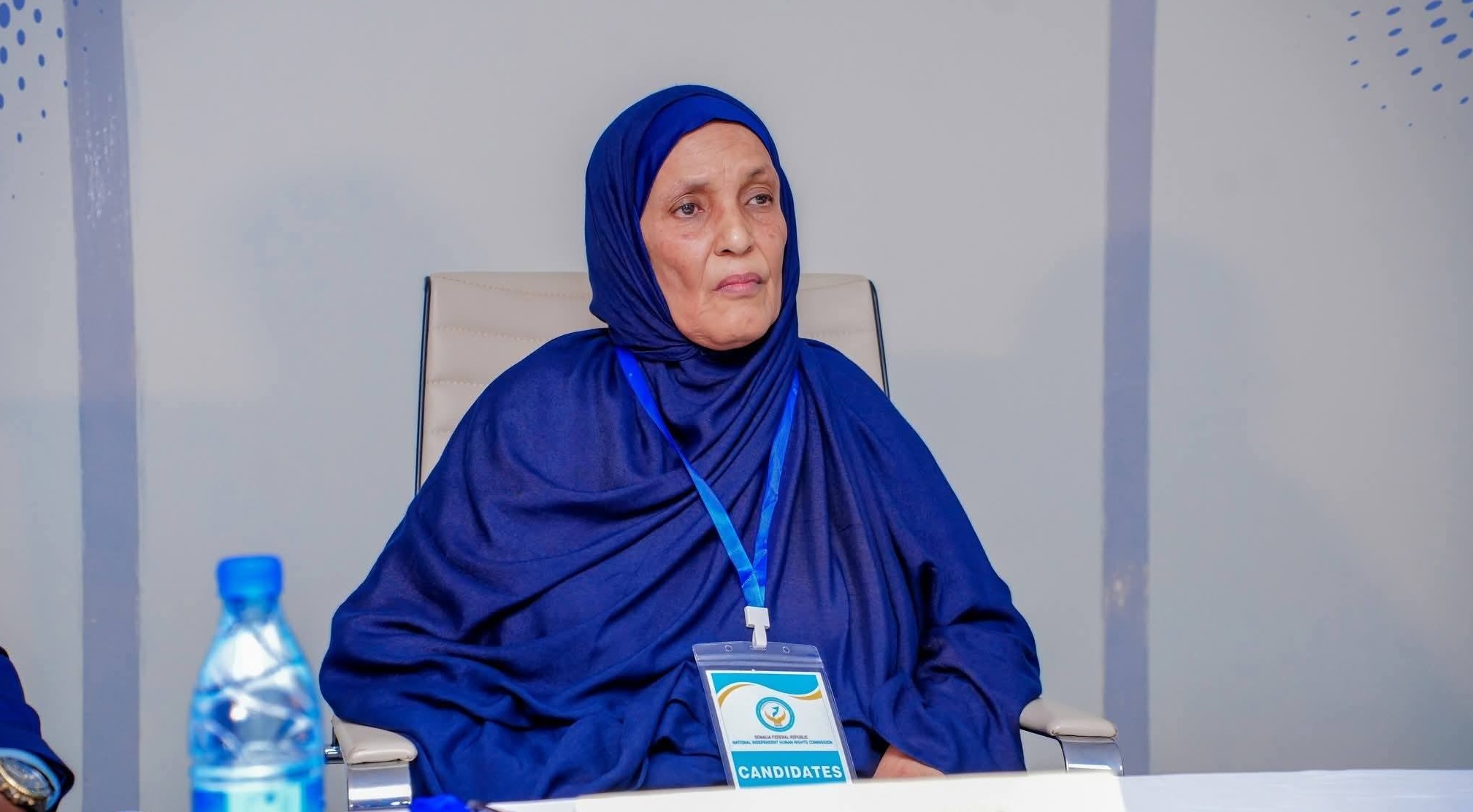

MOGADISHU, Somalia (KAAB TV) — Members of Somalia’s disputed Human Rights Commission on Wednesday, 4 February, announced the selection of Dr. Maryam Qasim Ahmed as chairperson, a move that has drawn strong criticism from civil society groups and regional administrations.
The commission was formally announced in early July 2025 by the Ministry of Women and Human Rights, but local human rights organizations—including the Somali Journalists Syndicate (SJS)—have rejected its legitimacy, describing it as “an attempt to whitewash human rights abuses in the country.”
Regional states Puntland and Jubaland boycotted the formation of the commission, calling it a unilateral decision linked to the federal government’s broader and controversial constitutional amendments.
According to sources familiar with the process, the selection of Dr. Maryam Qasim was influenced by Prime Minister Hamza Abdi Barre, who is alleged to have close personal and family links to some of her children.
The Prime Minister has previously expressed political positions aligned with Islamist movements such as Hamas militant group, and analysts note that several senior Somali officials are linked to Damu Jadid (Al-Islah), a group associated with the Muslim Brotherhood.
Speaking to the media after her selection, Dr. Maryam Qasim Ahmed said she had not actively sought the position.
“I was elected while in my hotel room. I did not even campaign,” she said.
Dr. Maryam previously served as a minister between 2012 and 2014 and is currently an advisor to the Minister of Higher Education. She is also the head of Damu Jadid’s women’s wing. She hails from the Barawe/Haatimi clan and is reported to have strong family ties within federal government institutions.
Concerns Over Independence
Civil society groups have raised serious concerns over the independence and credibility of the commission, noting that almost all of its members are current government advisors or civil servants, despite the body’s mandate to monitor and document human rights violations by state actors.

Of the nine commissioners, seven are currently on the government payroll as advisors, while two have held ministerial positions.
The commissioners are:
- Farhan Mohamed Jimale – Prime Minister’s spokesperson, from the Hawadle/Hawiye clan.
- Ahmed Sheikh Hamza Abshir – Advisor to the Speaker of Parliament, formerly linked to the National Electoral Commission office in Baidoa; from Rahanweyn/Harin.
- Ali Mohamed Elmi – Advisor to First Deputy Speaker Sadia Haji Samatar; from Daarood/Leelkase.
- Omar Abdulle Alasow – Former AMISOM/ATMIS advisor, close associate of President Hassan Sheikh Mohamud; from Hawiye/Abgaal/Waceysle.
- Maryam Qasim Ahmed – Chairperson; former minister and current government advisor; from Barawe/Haatimi.
- Fadumo Abdiqani Yusuf – Employee at the Attorney General’s Office; from Daarood/Warsangali; reportedly a leading candidate for deputy chair.
- Mohamed Osman Mohamud – Advisor to President Hassan Sheikh Mohamud; from Dir/Surre.
- Mohamed Harun Mohamud – Advisor to the Ministry of Women and Human Rights and the only commissioner with a disability; from Dir/Isaaq/Ciidagale.
- Mumino Sheikh Omar – Former State Minister of Justice and Constitutional Affairs, currently an advisor at the Ministry of Justice; from Rahanweyn/Tunni.
Sources within the commission say that at least four members are now opposing Dr. Maryam’s leadership and have questioned several appointments she made following her selection as chairperson.
The developments come amid growing international concern over Somalia’s human rights record. In October, Somalia supported a move to end the mandate of the UN Independent Expert on Human Rights, a position established in 1993.
The UN Human Rights Council Resolution 57/27, which terminated the mandate last year, was widely viewed by rights groups as an effort to curb international scrutiny of ongoing human rights violations in the country.
“Somalia stands at a fragile and decisive moment,” said Isha Dyfan, the Independent Expert on the human rights situation in Somalia, in November, as she presented her final report on Somalia to the UN General Assembly in New York.
“Despite progress in governance, human rights, and institution-building, insecurity, political tensions, humanitarian crises, and climate shocks continue to threaten these gains. Somali civil society, women, journalists, and human rights defenders remain inspiring—but they cannot advance peace and rights alone,” she added.