


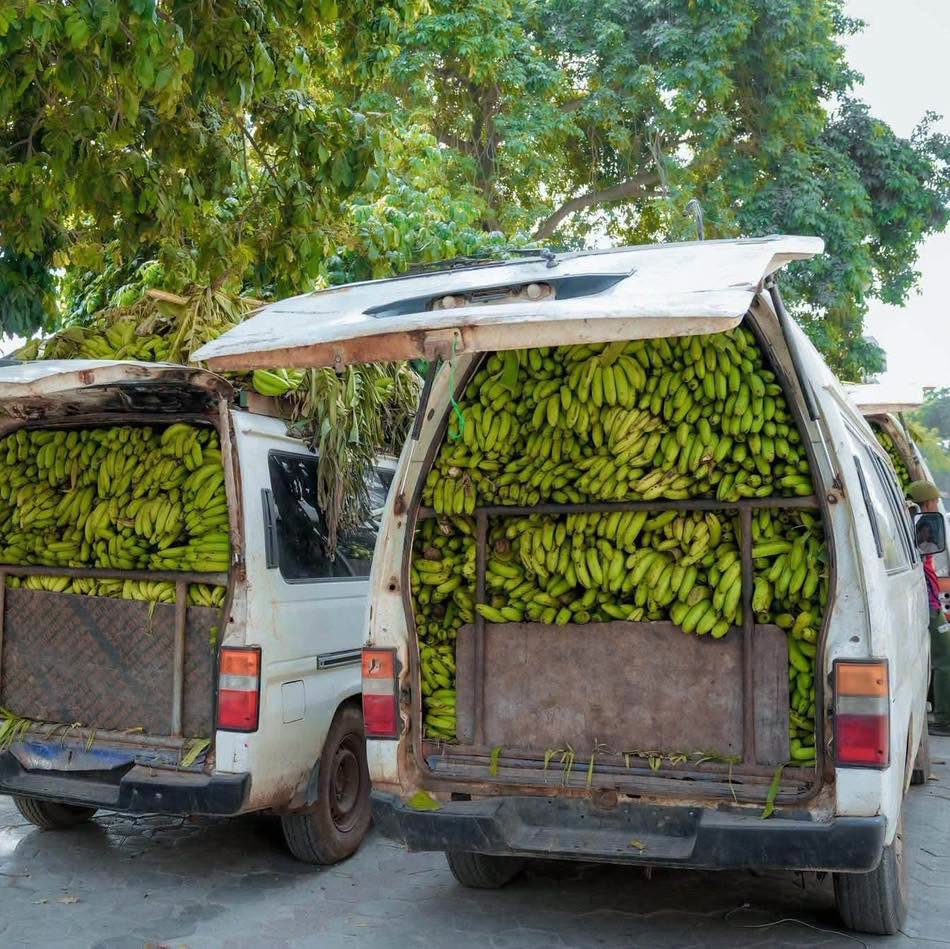


Somalia’s caretaker Minister of Agriculture and Irrigation, Mohamed Abdi Hayir Maareeye, has raised concerns over the heavy charges imposed on trucks transporting bananas from southern agricultural regions to Mogadishu, saying some drivers are forced to pay as much as $300 per vehicle.
The minister said the payments are placing a significant financial burden on traders moving produce from Lower Shabelle, one of Somalia’s main agricultural regions, to markets in the capital.
He noted that the amount collected from a single truck can sometimes approach the total value of the bananas it carries when sold in the market.
Maareeye appealed to those operating illegal roadblocks to stop imposing such charges on commercial vehicles. He urged them to abandon the practice altogether or, at the very least, reduce the amounts demanded from traders.
His remarks have renewed attention on the difficulties facing Somalia’s agricultural supply chains, where informal payments, security checkpoints and multiple taxation demands increase the cost of transporting locally produced goods.
Bananas are among Somalia’s major agricultural products, with much of the supply reaching Mogadishu from farming communities in Lower Shabelle, particularly Janaale, Bulo Mareer and surrounding areas.
Traders transporting the fruit must navigate several checkpoints along the routes connecting these agricultural centres to the capital.
Some checkpoints are reportedly operated by armed groups and local militias, while others are associated with government security forces and official taxation arrangements.
Traders complain that repeated payments along the same route significantly increase transport expenses and reduce the profits available to farmers and businesses.
The financial consequences can extend beyond the traders themselves. When transporters are forced to pay hundreds of dollars in additional charges, businesses may pass those costs on to consumers through higher market prices.
This can make locally produced food more expensive for households in Mogadishu.
The complaints also raise questions about the distinction between legitimate government taxation and unlawful collections at roadblocks. Although the state has the authority to impose taxes under the law, such charges should be based on clear regulations, collected through authorised institutions and accounted for transparently.
The fact that the complaint has been raised publicly by a senior federal government official makes the issue particularly significant.
It highlights the gap between the government’s stated responsibility to support domestic agricultural production and the difficulties farmers and traders continue to face when moving their goods to market.
The problem is not new. A 2024 report by Somalia’s Ministry of Agriculture documented an assessment of illegal checkpoints, security posts and taxation points along routes used by vehicles transporting agricultural produce from Lower and Middle Shabelle to Mogadishu’s Bakara Market.
The ministry’s findings indicated that unregulated payments and roadblocks increased transport costs, delayed deliveries and caused financial losses for farmers and traders.
The ministry said the findings were submitted to the National Security Council, after which a high-level committee involving relevant security agencies and government ministries was appointed to address illegal checkpoints and improve coordination of the taxation system.
The continued complaints suggest that the measures have yet to resolve all the problems facing agricultural transporters.
Maareeye’s latest remarks therefore raise questions about the implementation of the recommendations and whether the responsible institutions have effectively addressed the practices identified in the earlier assessment.
Somali farmers already face a range of challenges, including insecurity, poor road infrastructure, limited access to water, high production costs and difficulties reaching profitable markets.
Additional payments imposed during transportation further reduce their ability to compete and earn a sustainable income.
The issue also has implications for the competitiveness of domestic agricultural production.
Imported bananas are available in Mogadishu’s markets, while local farmers must contend with transport charges and security-related obstacles before their produce reaches consumers.
A report published in July 2026 highlighted the difficulties facing banana farmers in Janaale and Bulo Mareer, including roadblocks, multiple payments and insecurity. It also noted that imported bananas continued to reach markets in the capital.
This raises an important economic question: how can Somali farmers compete with imported produce when locally grown bananas incur substantial additional costs before reaching the same market?
The federal government is now under pressure to respond to the minister’s concerns by investigating the checkpoints along the routes linking Lower Shabelle to Mogadishu.
Such an effort would need to establish who is collecting the money, which payments have a lawful basis and what action should be taken against those imposing unauthorised charges.
Addressing the problem would require more than public appeals. It would involve enforcing existing regulations, coordinating security agencies, eliminating illegal collections and ensuring that legitimate taxes are applied consistently.
For Somalia’s agricultural sector to expand, farmers and traders must be able to move their produce to market without facing arbitrary charges at every stage of the journey.
Reducing these costs would not only support domestic producers but could also help improve food affordability and strengthen the country’s agricultural economy.