


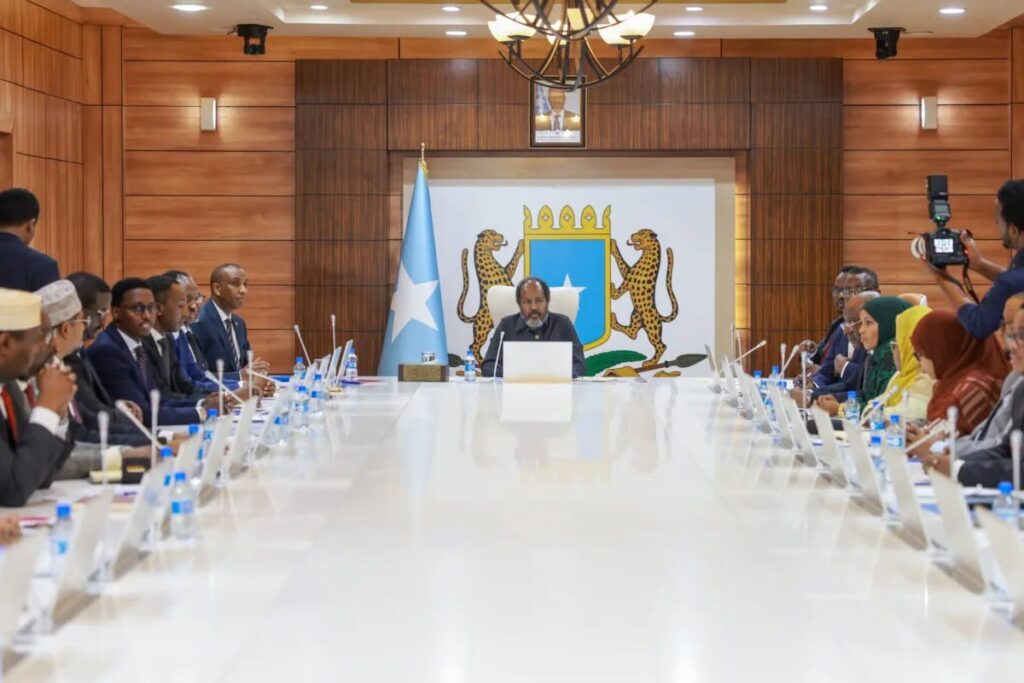


New information has emerged about the Federal Government of Somalia’s proposed electoral framework, with preliminary reports indicating that the Council of Ministers is expected to consider a draft law governing the allocation of seats in the Federal Parliament under a closed-list electoral system.
Under the proposed arrangement, political parties would prepare and submit lists of their parliamentary candidates, with seats allocated to individuals according to their position on the lists.
This would give political parties considerable influence over who enters parliament.
The system differs from a direct candidate-based election, in which voters choose individual candidates. Under a closed-list model, voters would primarily cast their ballots for political parties, while the parties would determine which candidates occupy the seats they win.
According to preliminary information, the draft legislation is expected to be presented first to the Council of Ministers before being forwarded to the Standing Committee of the House of the People.
The end of this week has been mentioned as the anticipated timeframe for the initial discussions.
If confirmed, the proposal could reignite a political debate that featured prominently during Somalia’s 2019–2020 electoral preparations, when President Hassan Sheikh Mohamud was among the politicians who strongly opposed the closed-list model.
In May 2019, the Council of Ministers approved an initial electoral bill based on Proportional Representation through a Closed List system.
However, a parliamentary committee reviewing the legislation subsequently removed that arrangement, and an alternative framework was adopted under which individual candidates competed for seats.
A renewed move towards closed-list elections would therefore raise questions about the political leadership’s changing position, particularly within Villa Somalia, and why a system that previously generated significant controversy is now reportedly being considered again.
The debate is unfolding amid a broader political and constitutional dispute over the mandates of federal institutions and the framework for Somalia’s next elections.
On November 5, 2026, the Supreme Court issued a ruling addressing the terms of federal institutions and called on political stakeholders to reach an agreement on an electoral framework within 30 days, with elections to be held within 90 days.
Meanwhile, political talks scheduled for mid-November failed to get underway after opposition leaders demanded international mediation and guarantees to ensure an inclusive and credible dialogue.
The proposed closed-list legislation could become another major point of contention between the government and opposition, particularly as both sides remain divided over the electoral process and the country’s political future.