

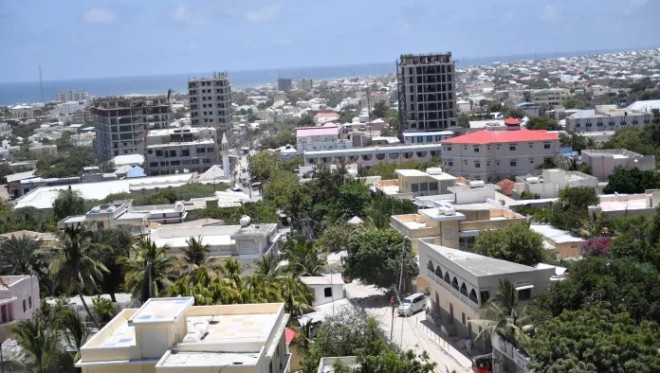

The Somali government has warned that buildings, rocks and other obstructions placed on Mogadishu’s natural rainwater drainage channels are blocking water flow, which could increase the risk of flooding as the country prepares for the Deyr rains and the anticipated effects of El Niño.
The warning came out of a meeting held to discuss the situation following recent rains in Mogadishu and preparedness for the rains ahead.
The meeting took place at the headquarters of the Somali National Disaster Management Agency (SoDMA), with the government and various stakeholders discussing how to reduce the impact of flooding.
SoDMA has in recent weeks stepped up its preparedness plans for the 2026 Deyr season, saying climate forecasts indicate risks linked to heavy rainfall and the effects of El Niño.
The agency has also called on the public to clear and open drainage channels to reduce flood risk.
The Mogadishu meeting was chaired by the Minister of Interior, Federal Affairs and Reconciliation, Ali Yusuf Ali Hoosh, and was attended by officials from the Federal Government, the Banadir regional administration, religious scholars, civil society and business owners.
The Minister of Environment and Climate Change, Bashir Mohamed Goobbe, said rocks and other obstructions placed around the road connecting Mogadishu Airport and the Turkish Embassy are blocking the natural channels through which water previously flowed.
The minister said the problem needs urgent action, since blocked drainage channels could cause rainwater to pool in neighborhoods and areas where people live.
According to the minister, an earlier flood in that area caused two deaths.
He also warned that if the water channels remain blocked, the situation could affect nearly 40 families living there.
Bashir Gobbe called for the rocks and other obstructions blocking the water channels to be removed or reorganized, so that water has a safe path to pass through
He also stressed the importance of finding a solution to the problem while protecting nearby buildings and sites, without blocking the natural pathways through which water flows.
The Deputy Governor of Banadir region for security and political affairs, Mohamed Ahmed Diriye Yabooh, said the regional administration is carrying out efforts to clear standing water from some of Mogadishu’s major roads.
Yabooh said the measures currently being taken are temporary, noting that the biggest problem is that buildings and various obstructions have been placed in areas where water previously used to flow.
According to him, hospitals, universities, government agencies, private facilities and individuals have all, in various locations, put up buildings or obstructions that cut off the water channels.
“If the water had been allowed to follow its old path, it would not have pooled in those places,” Yabooh said.
These remarks show that the Banadir administration links Mogadishu’s flooding problem, in part, to blocked drainage channels and changes made to the natural way water used to pass through the city.
The warning comes as Somalia prepares for the 2026 Deyr rainy season.
On September 1, SoDMA issued a report on preparedness for the impact of El Niño, specifically noting the October, November and December period.
The agency also held a national conference in Mogadishu focused on preparedness for the Super El Niño 2026, attended by the Federal Government, federal member states, humanitarian agencies and other stakeholders.
Similarly, SoDMA conducted awareness activities in recent weeks in areas near Beledweyne, urging the public to open and clear drainage channels and emergency routes to reduce flood risk.
The government is also carrying out efforts to strengthen early warning and disaster forecasting.
SoDMA and other agencies have launched an initiative in Mogadishu to strengthen early forecasting of disaster risks, particularly those that could cause displacement and emergency situations.
This matter could be important for Mogadishu, which has in the past faced flooding and standing water on roads, particularly during periods of heavy rain.
The chairman of the Hormuud Salaam Foundation, Abdullahi Nur Osman, told the meeting that specific planning and funding are needed to prepare for the expected rains.
He also suggested that SoDMA become the lead agency providing climate-related warnings and disaster data, so that the public and various agencies can access unified information about upcoming risks.
Meanwhile, it is anticipated that if heavy rains fall on Mogadishu, blocked drainage channels could further increase the areas where water pools, particularly locations where buildings and new roads have altered the natural drainage pathways.
The warning that emerged from the meeting shows that the government wants action taken on the drainage channels before heavy rains cause new flooding.
The problem is that once water accumulates on roads and in neighborhoods, it can be difficult to remove quickly, which can affect traffic flow, homes, business areas and essential services.
Officials are therefore insisting that the water channels be opened, the obstructions blocking the flow be removed, and a permanent plan be put in place to manage rainwater.
With the Deyr rainy season and El Niño-related risks expected, early preparedness, clearing of drainage channels, and timely warnings are becoming important factors in reducing the impact of flooding in Mogadishu.