




Relations between Somalia and the United Arab Emirates have shifted considerably over the past decade, moving from close cooperation to an increasingly strained diplomatic relationship.
Disagreements over security arrangements, strategic ports, regional influence and Somalia’s sovereignty have become major sources of tension between Mogadishu and Abu Dhabi.
President Hassan Sheikh Mohamud, who previously described the UAE as an important partner in Somalia’s recovery and development, has recently adopted a much more critical tone towards the Gulf state.
His latest remarks reflect the depth of the disagreement and raise questions about the future of bilateral relations, the withdrawal of Emirati security assistance and the extent to which the dispute has affected Somalia’s access to financial support.
During Hassan Sheikh’s first term as president, between 2012 and 2017, the UAE maintained a significant presence in Somalia. Its involvement included military training, support for security institutions, port investments and humanitarian assistance.
The Somali administration at the time sought closer relations with Gulf countries, while Abu Dhabi emerged as one of its important partners.
The relationship suffered a major setback in 2017 following the diplomatic crisis involving Saudi Arabia, the UAE and Qatar.
Somalia declined to take a clear side in the dispute, a position that created friction with Abu Dhabi and affected relations between the two governments.
Tensions escalated further in April 2018 when Somali security forces seized an Emirati aircraft at Mogadishu’s international airport carrying $9.6 million in cash.
The UAE said the money was intended to support Somali security forces, while the federal government said the circumstances surrounding the shipment required investigation.
The incident was followed by the suspension of the UAE’s military training programme in Somalia.
Relations began to improve after Hassan Sheikh returned to the presidency in May 2022. Rebuilding ties with Abu Dhabi became part of his diplomatic agenda, leading to renewed contacts and cooperation in security and economic affairs.
In January 2023, the two countries signed a security and defence cooperation agreement intended to support military training and Somalia’s campaign against Al-Shabaab.
Hassan Sheikh subsequently described the UAE as an important partner in the country’s efforts to restore stability and strengthen state institutions.
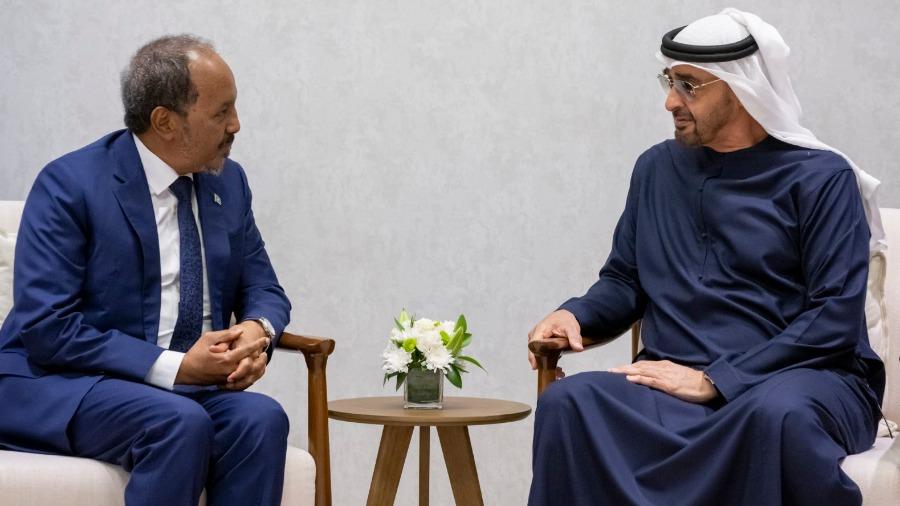
The renewed engagement was reflected in high-level meetings, including discussions with UAE President Sheikh Mohamed bin Zayed Al Nahyan.
During a visit to Abu Dhabi in March 2025, Hassan Sheikh met Emirati leaders, with both sides expressing an interest in expanding cooperation and maintaining their longstanding relationship.
However, the rapprochement began to unravel towards the end of 2025 and into early 2026. Disagreements emerged over the UAE’s relations with Somaliland, Puntland and Jubaland, as well as its involvement in strategic port and security arrangements.
The federal government accused Abu Dhabi of reaching agreements with regional administrations without consulting Mogadishu.
Somali officials argued that such arrangements undermined the authority of the federal government and raised questions about who has the constitutional responsibility to manage the country’s strategic assets and foreign relations.
The issue of Somaliland became particularly sensitive after Israel announced its recognition of the territory in December 2025.
Mogadishu expressed concern over the implications for Somalia’s unity and territorial integrity, while the UAE’s longstanding involvement in the port of Berbera became part of the wider diplomatic dispute.
Further tensions followed reports that Aidarus al-Zoubaidi, leader of Yemen’s Southern Transitional Council, had travelled through Berbera in January 2026.
The Somali government raised concerns about the reported use of Somali territory and airspace without authorisation from the federal authorities.
On January 12, 2026, Somalia’s Council of Ministers announced that it was cancelling all agreements between the federal government and the UAE.
The decision covered cooperation in ports, security, defence and relations with government institutions. Mogadishu said the move was prompted by what it described as interference in Somalia’s sovereignty and national unity.
The affected arrangements included agreements relating to the ports of Berbera, Bosaso and Kismayo, alongside security and defence cooperation.
Puntland, Jubaland and Somaliland rejected the federal government’s decision, arguing that Mogadishu could not unilaterally terminate agreements they had signed directly with the UAE.
The disagreement highlighted the continuing dispute over the division of powers between Somalia’s federal government and regional administrations.
One of the immediate questions following the decision was whether the UAE had also withdrawn its financial assistance to Somalia.
Abu Dhabi has supported the country through several channels, including military training, security assistance, humanitarian programmes and development projects.
These forms of support, however, have operated under different arrangements and should not be treated as a single financial package provided directly to the federal government.
In February 2026, Somalia’s Foreign Minister, Abdisalam Abdi Ali, said the UAE had suspended its security assistance following the cancellation of the bilateral agreements.
He indicated that much of the support had been directed towards Somalia’s security institutions.
There has been no sufficient official confirmation, however, that the UAE has completely ended all humanitarian assistance and development projects in the country.
The suspension of security cooperation therefore should not automatically be interpreted as a complete withdrawal of every form of Emirati support.
The dispute became more public on November 17, 2026, when Hassan Sheikh delivered a televised address strongly criticising the UAE.
He accused Abu Dhabi of interfering in Somalia’s domestic affairs, contributing to political divisions and supporting security forces and facilities operating outside the country’s national security framework.
The president also challenged arrangements involving the ports of Berbera, Bosaso and Kismayo, arguing that strategic national assets should not be governed through agreements that lack the approval of the federal government.
Despite his criticism, Hassan Sheikh said Somalia was not opposed to maintaining friendly relations with the Emirati people.
He indicated that dialogue remained possible if future relations were based on mutual respect, equality and recognition of Somalia’s sovereignty.
The question of whether the UAE has lost confidence in Hassan Sheikh’s administration remains difficult to answer. There has been no formal public announcement from Abu Dhabi stating that it has withdrawn its confidence in the Somali president.
The available developments instead point to a broader disagreement involving political authority, security interests and economic influence.
Somalia’s position is that agreements concerning ports, security and foreign relations should be handled through the federal government.
The UAE, meanwhile, has maintained longstanding relationships with different Somali administrations, particularly in areas where major commercial and strategic ports are located.
Its ties with Somaliland, Puntland and Jubaland have consequently become a source of concern for Mogadishu, which views some of these arrangements as bypassing federal institutions.
The UAE has yet to provide a comprehensive public response to all the allegations made by Hassan Sheikh. At the same time, a previous joint statement by the UAE and the African Union reaffirmed support for Somalia’s sovereignty and territorial integrity.
Such diplomatic positions need to be considered separately from the competing accusations surrounding the current dispute.
The deterioration in relations presents challenges for both governments. For Somalia, the dispute underscores the importance of developing a consistent foreign policy and establishing clear procedures for negotiating agreements involving strategic infrastructure and national security.
The federal government will need to address its concerns through diplomatic engagement with Abu Dhabi while seeking a political understanding with regional administrations over their authority to enter into external agreements.
Without greater coordination between Mogadishu and the federal member states, disagreements over foreign partnerships could continue to complicate Somalia’s relations with regional and international actors.
The UAE and other foreign partners, meanwhile, face calls to respect Somalia’s sovereignty and federal arrangements and to ensure that their cooperation does not deepen existing political divisions.
Ultimately, the future of Somalia-UAE relations will depend on whether the two governments can address their disagreements through dialogue and establish a framework for cooperation that recognises Somalia’s constitutional institutions and national interests.