


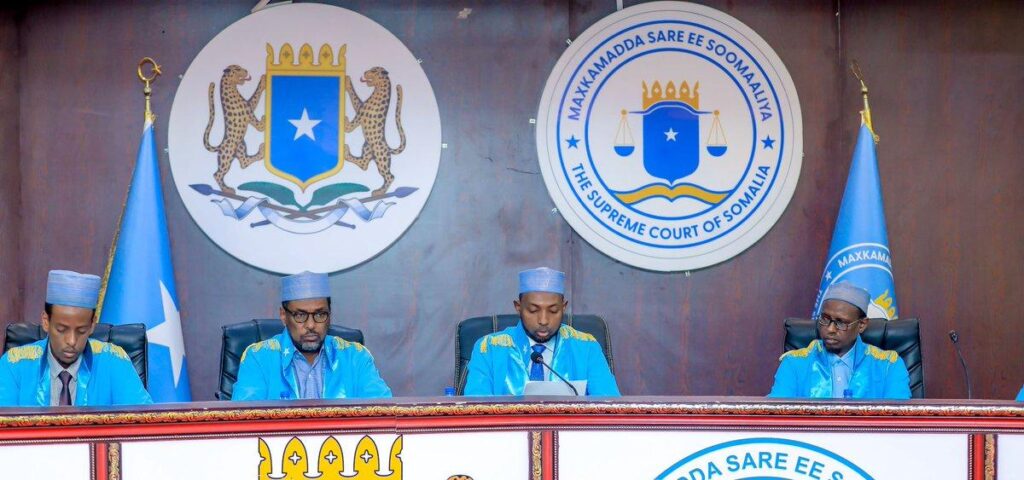


The Facebook page of Somalia’s Supreme Court has become inaccessible, raising concerns about public access to official judicial information at a time of heightened political and constitutional tensions.
The page had been a major channel for publishing the court’s statements, rulings and decisions, including recent orders concerning the implementation of the country’s amended constitution.
However, the Supreme Court’s account on X, formerly Twitter, remains active, with its previously published content still available.
The Supreme Court’s Facebook page played an important role in communicating with the public, providing citizens, journalists and other observers with updates on judicial proceedings, official statements and court decisions.
In recent days, the platform had been used to share information related to the constitutional dispute between the federal government and opposition groups.
Its disappearance could make it more difficult for members of the public who rely on Facebook to access official information from the judiciary.
The development comes shortly after the Supreme Court issued a landmark ruling on November 5, 2026, stating that the constitutional amendments extending the terms of federal institutions did not apply to the current presidential mandate.
The court said President Hassan Sheikh Mohamud’s term had ended in May 2026.
It also called on political stakeholders to reach an agreement on the electoral framework within 30 days and organise elections within 90 days.
In a separate but related decision, the court rejected the removal of Chief Justice Baashe Yusuf Ahmed, ruling that the action against him was unlawful.
The decisions have further intensified tensions between government institutions and fuelled debate over judicial independence, constitutional authority and the president’s powers.
Although the Facebook page is currently unavailable, the Somalia Supreme Court account on X remains operational and continues to provide access to the institution’s published information.
The platform therefore remains an important channel for citizens, media organisations and others seeking updates directly from the country’s highest court.
The court’s official communication channels need to be clearly identified to prevent confusion and ensure that the public does not mistake unofficial accounts for authorised sources.
No official explanation has so far been provided for the disappearance of the Supreme Court’s Facebook page.
Several circumstances could account for its unavailability. Meta may have restricted or suspended the page, its administrators could be experiencing technical or account-access problems, complaints may have been filed against the page or its content, or the administrators themselves may have changed its status.
However, none of these possibilities has been independently confirmed.
The disappearance of a social media platform used by a national judicial institution raises broader questions about public access to official information and the transparency of government institutions.
At a time when Somalia is facing a major political and constitutional dispute, reliable access to judicial decisions and official statements is particularly important in preventing misinformation and competing interpretations of court rulings.
The incident also highlights the need for public institutions to maintain several channels for communicating with citizens rather than depending heavily on a single social media platform.
The Supreme Court is now expected to issue an official statement explaining why its Facebook page is inaccessible and whether the interruption is temporary.
Clarification is also needed on whether Meta took action against the account, whether the page was voluntarily suspended or whether technical problems are responsible.
If the page cannot be restored, the court will need to inform the public of alternative official channels through which its rulings, statements and other judicial communications can be accessed.