

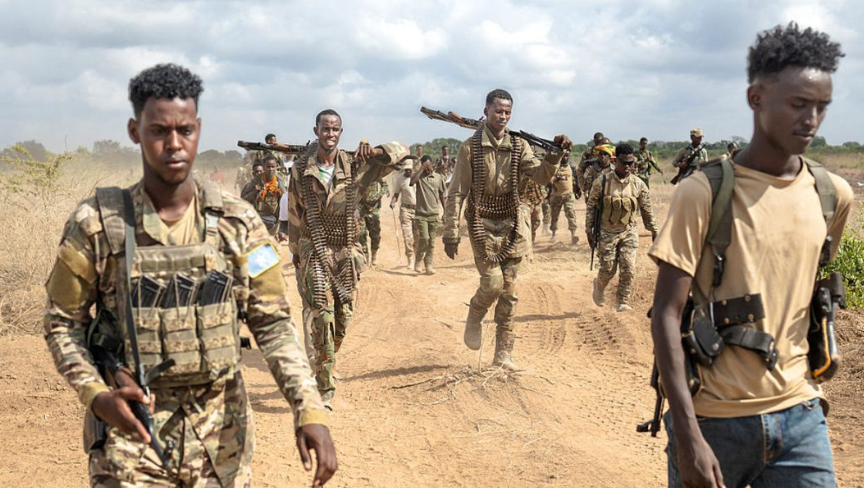

Somalia’s federal government says security operations over the past five years have returned more than 55% of territory previously controlled by al-Shabab and Islamic State (ISIS) militants to government authority, restoring freedom of movement and administration for at least 1.5 million people.
National Security Adviser Aweys Haji Yusuf Ahmed announced the figures during the 2026 Global Security Forum in Doha, Qatar, where he outlined the government’s progress in combating armed groups and addressing wider security threats in the Horn of Africa.
“Reflecting on security efforts in Somalia over the past five years, the operations conducted have resulted in the return of more than half of the territory once held by these groups to government control,” Ahmed said.
He also claimed that measures taken by the government had reduced militant financing by 35% and lowered attacks linked to armed groups in major Somali cities by approximately 89%.
However, he did not provide supporting data or explain the methodology used to calculate the figures, which could not be independently verified.
According to Ahmed, military operations have weakened the armed groups and enabled authorities to re-establish government administration in areas previously under militant control.
He said the gains formed part of a broader effort to improve security and prevent armed groups from regaining lost ground.
The adviser also warned that Somalia’s security challenges have regional implications, pointing to the links between militant activity, organised crime and instability across the Horn of Africa.
He called for closer cooperation among regional governments, particularly in counterterrorism operations, intelligence sharing, border protection and efforts to disrupt transnational criminal networks.
“Somalia remained committed to working with neighbouring countries and international partners to prevent armed groups from exploiting regional security gaps,” he added.
Somalia has launched successive military campaigns against al-Shabab, with support from local forces and international security partners.
The offensives have sought to recover territory, disrupt militant networks and strengthen the federal government’s presence in affected communities.
Despite these operations, al-Shabab remains capable of carrying out attacks against security forces, government institutions and civilians, while ISIS maintains a presence in parts of the country, particularly in Puntland’s mountainous areas.
Regaining territory has also presented authorities with the challenge of maintaining security after military advances.
Establishing effective local administrations, restoring essential services and protecting communities from retaliatory attacks are important to preventing militants from returning.
The government’s latest figures therefore offer an official assessment of progress in the campaign, although independent data would be needed to establish the scale and durability of the reported territorial gains and reductions in militant activity.