


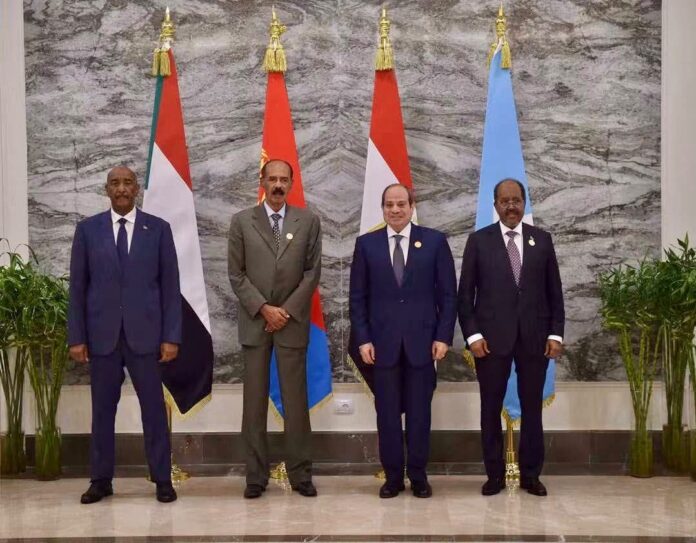


The Presidents of Somalia, Egypt, Eritrea, and Sudan held a four-way summit in El Alamein, Egypt, addressing the regional situation, Red Sea security, the Nile River, and the enhancement of political and economic cooperation among the four nations.
The summit, held on October 4, 2026, was attended by Hassan Sheikh Mohamud, Egyptian President Abdel Fattah El-Sisi, Eritrean President Isaias Afwerki, and the Chairman of Sudan’s Transitional Sovereignty Council, General Abdel Fattah al-Burhan.
During their meeting, the leaders emphasized the critical importance of preserving the sovereignty, stability, and territorial integrity of regional states, while also stressing the necessity of avoiding internal interference in national affairs.
A key provision of the communiqué focused specifically on Somalia, with the four nations reiterating their support for the unity and sovereignty of the Federal Republic of Somalia.
They also rejected any measures undermining Somalia’s unity and sovereignty, specifically noting the issue of Somaliland’s recognition.
This outcome stands as a major diplomatic milestone for Somalia, as the Federal Government has consistently cautioned against any actions it views as infringing upon the nation’s unity and territorial integrity.
Meanwhile, the leaders of the four countries specifically addressed the situation in Sudan, affirming their support for the country’s unity, sovereignty, territorial integrity, and national institutions.
They further rejected the creation of parallel entities running counter to Sudan’s official state institutions, called for the resumption of a Sudanese-led political process, and rejected any foreign support extended to mercenaries.
The summit also focused heavily on the situation in the Red Sea, with the four nations emphasizing the principle of freedom of navigation for commercial vessels.
The leaders stated that the administration and security of the Red Sea constitute a shared responsibility exclusive to its littoral states, underscoring the vital role the four nations assign to regional coastal governments in Red Sea affairs.
The issue of the Nile River was also extensively addressed.
Somalia, Egypt, Eritrea, and Sudan agreed on the critical importance of adhering to international law governing transboundary rivers.
They specifically stressed the principles of avoiding harm to other nations and managing water resources through cooperation, prior notification, consultation, and consensus.
Furthermore, the four countries rejected any unilateral actions that they stated could negatively impact downstream water utilization, a provision specifically concerning Egypt and Sudan.
This point carries particular significance given the longstanding dispute surrounding Nile water utilization and water infrastructure projects between upstream and downstream riparian states.
Beyond security and political matters, the leaders also agreed to strengthen economic, trade, and cultural cooperation among the four nations.
They noted that such collaboration can contribute to regional economic integration, sustainable development, and the deepening of ties among the peoples of the four countries.
Additionally, the leaders concurred on intensifying consultations and policy coordination between Somalia, Egypt, Eritrea, and Sudan, particularly regarding regional developments impacting peace and stability.
This summit coincides with a period during which the Red Sea and the Horn of Africa represent theaters of overlapping security and political complexities, while longstanding disputes concerning the Nile River continue to shape regional geopolitics.
Consequently, the official communiqué issued from the summit places primary emphasis on three major pillars: safeguarding the sovereignty and territorial integrity of regional states, consolidating the role of littoral countries in Red Sea governance, and resolving Nile water disputes through dialogue rooted in international law.
Ultimately, the four nations concurred on maintaining ongoing consultation and mutual coordination, underlining that quadrilateral cooperation remains essential for addressing the region’s interlocking security, political, and economic challenges.