


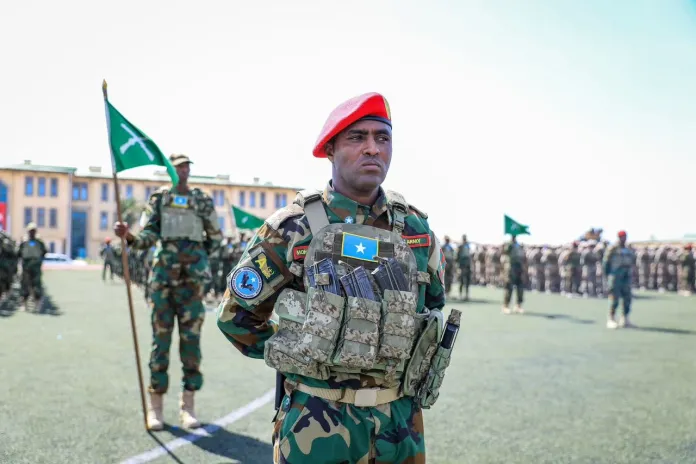


The Federal Government of Somalia has deployed additional troops from the elite Gorgor units to strategic locations in the Lower Shabelle region as part of efforts to strengthen the Somali National Army’s presence and prepare local forces to assume greater responsibility for national security.
The reinforcements have reportedly been sent to Awdheegle, Mubaarak and Shalanbod, areas considered important to military operations and security arrangements in the region.
The deployment comes as the African Union Support and Stabilization Mission in Somalia (AUSSOM) reviews its operational presence and the government works towards gradually transferring security responsibilities to Somali forces.
Under the proposed adjustments to AUSSOM, African Union troops are expected to concentrate their presence in designated military bases, while Somali forces progressively take over responsibility for other locations.
The changes are part of the broader transition towards greater Somali control over security operations, following years of international military support.
The deployment of additional Gorgor troops is therefore significant as the government seeks to strengthen its military footprint in areas where foreign forces may reduce or reorganise their presence.
However, the success of the transition will depend not only on troop numbers but also on the army’s ability to maintain positions, secure supply routes and respond effectively to attacks.
Military cooperation between Somalia and Türkiye remains an important part of efforts to develop the capabilities of the Somali National Army.
Türkiye has provided training, equipment and institutional support to Somali forces, particularly the Gorgor units, which have been deployed in several military operations.
The partnership includes training at the TURKSOM military facility in Mogadishu and broader assistance aimed at improving the operational capacity of Somalia’s armed forces.
Gorgor troops have become an important component of the country’s specialised military formations.
Reports concerning new equipment intended for the 22nd Gorgor Brigade and the expected completion of its training on November 7 require further official confirmation.
Without a formal announcement, the details of the reported supplies and training schedule remain unclear.
Transferring security responsibilities from international forces to Somali troops could give the Federal Government greater control over military operations and reduce long-term dependence on foreign deployments.
It could also strengthen the role of national institutions in protecting strategic towns, roads and military installations.
However, the transition requires sustained investment in logistics, weapons, vehicles, intelligence, troop salaries and coordination between different security units.
Forces deployed to newly transferred positions must also receive regular supplies and have the capacity to defend them against coordinated attacks.
Any weaknesses in these arrangements could leave security gaps that Al-Shabaab may seek to exploit.
The militant group has previously taken advantage of poorly defended positions and disruptions in military coordination to launch attacks and regain influence in contested areas.
Somalia’s ability to assume greater responsibility for security will ultimately depend on whether troop deployments are matched by adequate resources, effective command structures and long-term operational planning.
Strengthening the Gorgor units is one part of that effort, but a successful transition will require a broader and sustainable strategy for the entire national security sector.