




MOGADISHU (KAAB TV) – Somalia remains one of the most hazardous regions in the world for civil aviation operations. Ongoing militant activity, limited central government control, and a fragile security environment have created significant threats to both civilians and aircraft operating in or near Somali airspace.
The Federal Government of Somalia exercises minimal authority over key urban centers, ports, and airports. Militant groups, particularly Al-Shabaab, continue to carry out attacks against government targets, civilians, and aviation-related infrastructure.
The most serious danger involves aircraft flying below Flight Level 260 (FL260). Several extremist groups are believed to possess anti-aircraft weaponry, including MANPADS (man-portable air defense systems), capable of striking low-flying aircraft.
As a result, the U.S. Federal Aviation Administration (FAA) and several international aviation authorities have implemented or renewed flight prohibitions and restrictions within the HCSM/Mogadishu FIR.
Prohibits all U.S. civil aviation operations in Somali airspace below FL260.
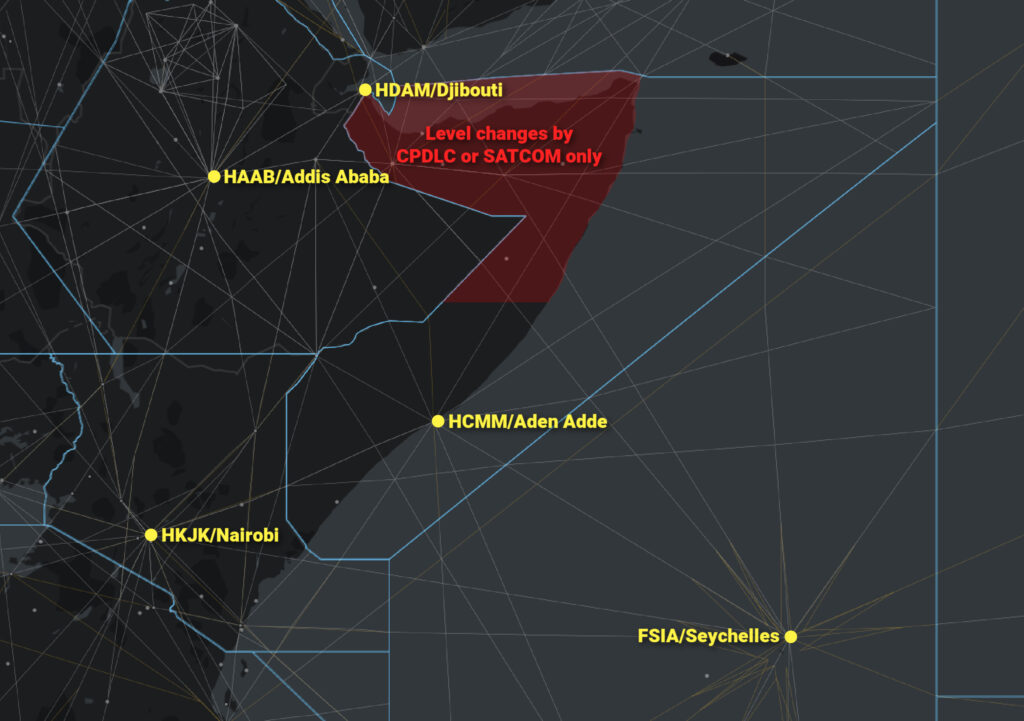
Exceptions apply to aircraft transiting between HDAM/Djibouti Ambouli Airport and Ethiopian airspace (HAAA/Addis Ababa FIR), provided operations remain over water and under Air Traffic Control (ATC) direction.
The FAA extended this rule’s validity until January 7, 2027, due to continuing extremist threats.
Level 2 Security Warning (Recommendation): Canadian operators are advised to maintain FL260 or higher in the HCSM FIR.
Threats stem from potential use of anti-aircraft weapons and uncoordinated military activity.
EASA advises no flights below FL260 within Somali airspace.
Risk of attack from militant groups equipped with MANPADS remains high.
German operators must not enter HCSM/Mogadishu FIR below FL260, except via UR401 corridor (SUHIL–AXINA).
UK air operators should avoid HCSM FIR below 25,000 feet AGL due to the risk of anti-aircraft fire and ongoing military operations.
A second critical risk involves unauthorized or “fake” ATC transmissions.
The OPSGROUP has reported multiple incidents in which aircraft operating within the Mogadishu FIR received conflicting or false instructions from unknown radio sources posing as air traffic controllers.
Such interference poses a severe risk to flight safety, especially in a region with limited radar coverage and communication reliability.
Somalia itself issued NOTAM HCMM A0035/18 (13 April 2018), stating that armed conflict and insufficient flight information services pose a direct threat to aircraft safety and security.
Operators are required to conduct critical threat assessments (CTN) before any operations into or out of Mogadishu (HCMM).
Due to the presence of armed groups, active militant operations, and limited governmental oversight, the risk of operating below FL260 within Somali airspace remains high.
Although controlled airspace and overwater routes near Djibouti are considered lower risk, operators must remain under positive ATC control and adhere strictly to published instrument procedures.
Avoid flight below FL260 in the HCSM/Mogadishu FIR, except for overwater routes to/from Djibouti (HDAM).
Maintain direct communication with verified Mogadishu Control frequencies only.
Conduct pre-flight risk assessments in accordance with ICAO Annex 17 and local security advisories.
Monitor NOTAMs continuously for updated restrictions.
Avoid unscheduled landings or diversions within Somalia except in life-threatening emergencies.
Somalia’s airspace remains highly insecure due to armed conflict, terrorism, and limited state control. International aviation authorities — including the FAA, EASA, Transport Canada, and UK CAA — unanimously advise against flight operations below FL260 in the Mogadishu FIR (HCSM).
While overwater transit to Djibouti may be considered lower risk under strict ATC guidance, the overall security environment is volatile. Operators are urged to remain vigilant and comply with all published restrictions and advisories.