


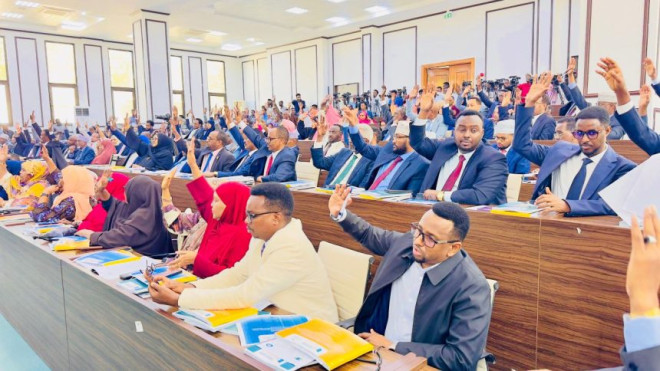


Mogadishu (Kaab TV) — Somalia’s federal parliament on Wednesday approved a revised constitution, formally ending more than a decade under the provisional charter adopted during the country’s fragile post-conflict transition.
In a joint sitting of the House of the People and the Upper House, 223 lawmakers voted in favor of the amended constitution, including 186 members of the lower house and 37 senators. No votes were recorded against the measure, although many opposition lawmakers boycotted the session.
Speaker of the House of the People, Sheikh Adan Mohamed Nur Madobe, declared the constitution officially adopted and in force nationwide. “The Official Constitution of the Federal Republic of Somalia has been legally adopted and will now take effect across the country,” he told the chamber.
The approval concludes a review process covering Chapters 1 through 13 of the constitution. Lawmakers said the revisions clarify the division of powers between federal and state authorities, strengthen institutional mandates, and define the country’s federal governance structure.
Government officials described the move as a landmark moment in Somalia’s long-running state-building process. Ali Mohamed Omar, the state minister for foreign affairs and a member of parliament, called it “a historic step for Somalia.” He said the revised constitution represents major progress in strengthening democratic institutions, clarifying the federal system, and moving the country beyond the long-standing provisional framework.
Hussein Idow, chair of the Joint Constitutional Review and Monitoring Committee, said the 11th parliament had fulfilled a key mandate by finalizing the document.
Somalia first adopted its provisional constitution in 2012, marking the end of the Transitional Federal Government and the creation of permanent federal institutions. However, several key provisions remained unresolved, and leaders repeatedly promised a comprehensive review that was delayed by years of political disputes.
Wednesday’s vote took place amid deepening political divisions. Lawmakers aligned with Puntland and Jubbaland, as well as those associated with the opposition Somali Future Council, did not attend the session.
In recent weeks, parliamentary debates over the amendments were marked by heated exchanges and procedural disputes, forcing several sittings to be postponed.
Opposition figures argue that fundamental changes to the federal structure require broad national consensus and inclusive consultation. They have accused the government of accelerating the process without sufficient agreement among federal member states and political stakeholders.
The federal government, however, has defended the amendments as lawful and necessary to provide constitutional clarity ahead of planned electoral reforms, including a proposed transition to a one-person, one-vote system.