

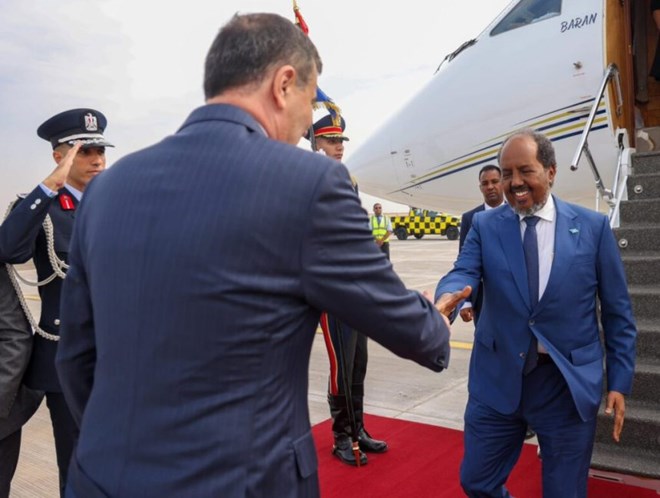

Cairo (KAAB TV) – In a landmark event for Egypt’s cultural diplomacy and heritage tourism, Somali President Hassan Sheikh Mohamud on Saturday attended the grand opening ceremony of the Grand Egyptian Museum (GEM), the world’s largest archaeological museum dedicated exclusively to a single civilization.
The inauguration was held at the foot of the Giza Plateau, on the edge of the famed Pyramids of Giza complex.
The ceremony was led by Egyptian President Abdel Fattah el‑Sisi and saw participation from delegations from 79 countries, including 39 represented by heads of state, princes or crown-princes, and government chiefs.
Among the highlights was a musical performance staged in one of the open courtyards of the museum, with the iconic pyramids serving as an atmospheric backdrop to the event.
During his visit, President Mohamud is expected to underscore the longstanding historic and cultural ties between Somalia and Egypt, and to emphasize the growing imperative of reinforcing bilateral relations in the fields of cultural heritage, tourism, education and broader diplomatic cooperation.
The vision for the Grand Egyptian Museum traces back to the early 1990s, when then-Culture Minister Farouk Hosni proposed a new open-museum complex that would link the pyramids, the Sphinx and surrounding temples into a unified cultural campus.
The formal laying of the foundation stone took place in 2002 under then-President Hosni Mubarak, with major site preparation beginning in 2005.
Construction experienced delays during the intervening years but was revived in earnest from 2014 onward under President el-Sisi’s oversight.
Between 2017 and 2023 key segments — including exhibition design, digital infrastructure, and support facilities — were completed, paving the way for trial operations beginning in October 2024.
Located just about 2 km from the Giza Pyramids, the museum complex spans approximately 500,000 m² (≈ 5.4 million sq ft) and is widely regarded as the largest museum in the world dedicated to a single civilisation.
Its façade features a dramatic, five-storey glass wall aligned with the height of the Great Pyramid, allowing dramatic views of the plateau beyond.
The museum houses more than 100,000 artifacts spanning from pre-dynastic through Greco-Roman periods of Egyptian history. Among its most prized collections is the complete treasure trove of Tutankhamun — some 5,000 + items — displayed in a dedicated gallery for the first time.
In addition to its galleries, the museum includes a major conservation and restoration centre (one of the largest in the Middle East), dedicated children’s museum and educational spaces, theatres, commercial and hospitality amenities, and outdoor gardens.
The total cost of the project is commonly cited at around US $1 billion, with significant financial backing coming from Japanese ¥ loans (approximately US $800 million) alongside Egyptian government contributions, donations and international partnerships.
Over and above its role as a museum, GEM is a strategic cornerstone in Egypt’s efforts to revitalise its tourism sector, enhance cultural diplomacy, and reaffirm its position as guardian of an ancient civilisation that has lasting global fascination.