


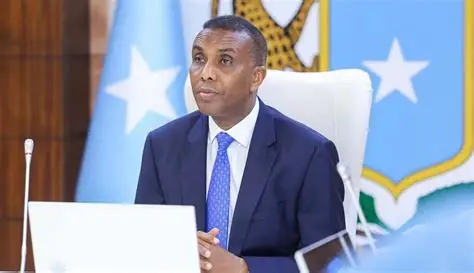


Somalia’s caretaker Prime Minister, Hamza Abdi Barre, is facing growing political, economic, and social pressure as debate intensifies over several government policies and major development initiatives.
Issues ranging from support for military orphans and land disputes in Mogadishu to plans for a new seaport and international airport have become the focus of public and political discussion.
The debates come at a sensitive time for Somalia, as the federal government seeks to advance governance, economic development, and security reforms while facing increasing scrutiny from political stakeholders and sections of the public.
One of the recent political developments was the election of Abdulkadir Mohamed Nur Jama as Speaker of the House of the People.
Since assuming office, Jama has held meetings with senior government officials, including Prime Minister Hamza, to discuss cooperation between state institutions and the acceleration of national priorities.
The relationship between Parliament and the executive remains a key issue in Somalia’s political landscape. Parliament holds legislative and oversight powers, while the government is responsible for implementing national policies and programs.
Some political commentators have suggested that Hamza has come under increased pressure following Jama’s election, describing the development as a setback for the government.
However, such characterizations remain political interpretations rather than official positions adopted by Parliament or any state institution.
Social media has also circulated claims attributed to the Prime Minister concerning Southwest State leader Abdiaziz Hassan Mohamed Laftagareen and issues related to the JSP political card.
However, no official statement, audio recording, or verified document has been presented to independently confirm those remarks.
Meanwhile, the welfare of military families has emerged as one of the most widely discussed public issues.
Thousands of Somali soldiers have lost their lives in the country’s long-running conflict against Al-Shabaab, leaving behind families that rely on government assistance for education, healthcare, and basic living expenses.
The federal government previously established mechanisms aimed at supporting military orphans, wounded soldiers, and retired members of the armed forces.
However, reports that financial assistance to some military orphans was reduced have sparked public concern and raised questions about the future of the program.
There have also been reports suggesting the government may reconsider the reduction and review the support system. So far, however, no official statement has confirmed whether the cuts have been reversed or whether previous payment levels will be restored.
The issue remains particularly sensitive because it directly affects children whose parents were killed while serving the country. Families have called for greater transparency regarding any changes to support payments and the reasons behind them.
At the same time, the government’s plans for Mogadishu’s port infrastructure have generated considerable discussion..
The Port of Mogadishu remains one of Somalia’s most important economic assets, and authorities have been pursuing modernization and expansion efforts aimed at improving trade and cargo handling capacity.
Among the projects under discussion is the proposed New Mogadishu Maritime Port, a large-scale development intended to expand the city’s ability to accommodate growing commercial activity and international shipping.
Türkiye continues to play a significant role in Somalia’s economic and infrastructure sectors. The two countries maintain close cooperation in security, education, healthcare, trade, and development projects.
Reports have suggested that Türkiye could play a major role in the development or management of a future port project in Mogadishu.
However, no publicly available agreement has confirmed the exact nature of Türkiye’s involvement. Questions remain regarding whether any future role would involve financing, construction, management, or a concession arrangement.
Similar discussions surround plans for a new international airport in Mogadishu. Somali authorities have long explored the possibility of constructing a larger airport capable of handling increased passenger traffic and cargo operations.
Qatar has been mentioned as a potential partner in future infrastructure investments, reflecting the strong political and economic ties between Mogadishu and Doha.
Nevertheless, no official agreement has been publicly announced confirming Qatari financing or management of a new airport project.
Land disputes in Mogadishu have also become a major source of public concern. Residents continue to raise complaints regarding property ownership, demolitions, and competing claims over land and housing.
The issue is complicated by overlapping ownership documents, claims involving public and private land, and, in some cases, court rulings that are contested by different parties.
The challenge becomes even more difficult when multiple individuals claim ownership of the same property.
Reports have also circulated alleging that Prime Minister Hamza acknowledged widespread forced evictions and land disputes in the capital. Those reports have generated significant debate among residents, particularly among families affected by property disputes.
Legal experts argue that resolving such disputes requires credible institutions capable of verifying ownership records, enforcing court decisions, and ensuring that any public projects affecting private property follow transparent legal procedures.
As Mogadishu continues to expand, demand for land for roads, ports, airports, government facilities, and commercial developments is increasing. This has made the issue of property rights one of the most sensitive governance challenges facing the capital.
Taken together, these issues illustrate the range of pressures currently confronting the caretaker government.
Politically, the administration must manage relations with Parliament and federal member states. Socially, it faces questions over support for military families.
Economically, it is pursuing ambitious infrastructure projects. At the same time, it must address persistent land disputes that affect thousands of residents.
Observers say public confidence will depend largely on the government’s ability to provide clear information and transparency regarding these matters.
Many citizens are seeking answers about military orphan payments, the details of future port and airport projects, and the mechanisms that will be used to resolve land ownership disputes.
Major infrastructure developments such as a new seaport and airport could play a significant role in Somalia’s economic future.
However, analysts argue that transparency, accountability, and public access to information regarding financing, ownership, and management arrangements will be essential to ensuring public trust and long-term success.