


Between April 21 and May 2, 2026, a sequence of incidents marked the clearest reactivation of Somali Pirate Action Group activity since expensive suppression efforts brought the threat to low levels over a decade ago.
During this 2-week period alone, six maritime security incidents appeared and four confirmed hijackings (three commercial vessels and at least one dhow), plus one armed boarding attempt deterred by embarked security, and at least two suspicious skiff approaches inside the Maritime Security Transit Corridor (MSTC).
Three of the four hijacked commercial vessels remain under pirate control as of mid-May 2026. Ransom demands on Eureka alone are reported to have escalated from $3 million to $10 million.
A further attempted approach was reported approximately 500 NM east of Mogadishu on April 28, in which a tanker was approached by a suspected pirates employing a larger wooden vessel as a mothership and two smaller skiffs, the operational signature of an extended-range PAG deployment we have seen in the past extending their reach well withing the Indian Ocean and Red Sea passage.
The operational signature is consistent: small skiffs deployed from coastal launch points or from a recently seized dhow, targeting transiting vessels in already a window of 100+ NM from the coast, with rapid redirection toward Puntland anchorages on successful boarding.
History around the Somali coast is repeating itself with lack of national stability and a divided international community fuelling the unrest within the country.
Since the Kampala Accord were signed in 2011, providing the agreed roadmap towards a functioning Somali State, limited progress was achieved towards establishing stable and united national or regional governments. Divisions between the federal government and opposition groups – including Puntland, Somaliland and Jubaland federal (member) state leaders and the opposition Somali Salvation Forum coalition led by former president Sharif Sheikh Ahmed – have undermined current election preparations.
None of this is new to Somalia’s political scene. The same issues arose among the same actors during the election that brought Mohamud to power in 2022 or President Mohamed Abdullahi Mohamed before him. The conflict between opposing sides is powered and maintained by various ME and Asian States supporting different players who suit their local interests best. The EU’s approach is also not very consistent. While EU advocating the sponsorship of a ‘one-nation’ solution, many of their aid and training programs are directly via regional State Governments, undermining he national powers of the Mogadishu Officials.
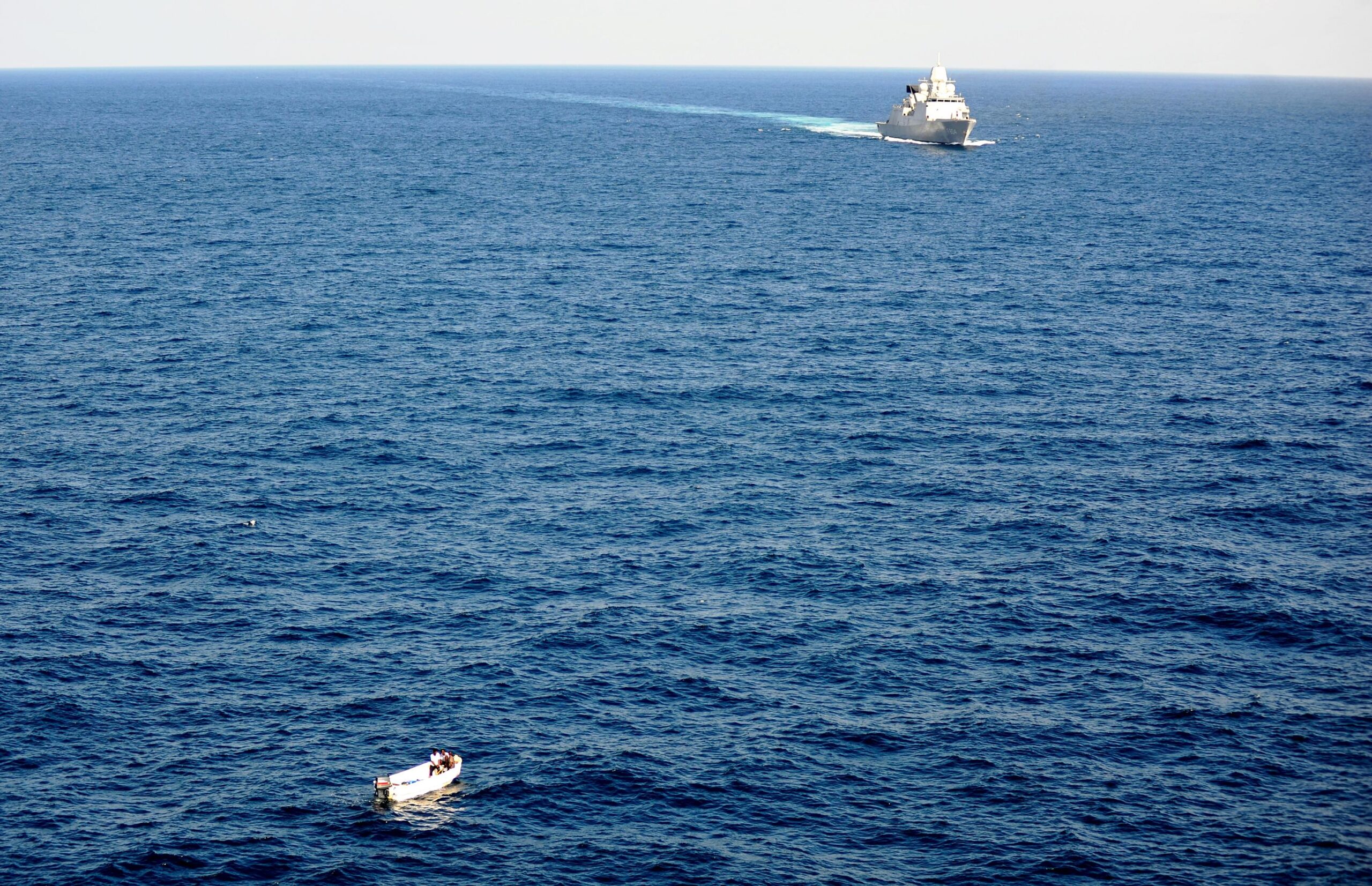
Again, like over a decade ago, voices are raised to pour money and resources into suppressing the occurrence of Piracy through sailing an expensive navy fleet through the area. However, although such actions proved to temporarily supress the symptoms, such use of navy equipment, designed to be effective war machines, are fully inadequate for a policing task. For me the picture tells it all. A billion-dollar piece of marine equipment to launch a RIB (designed for beaching and not for 24/7 open ocean operations) to intercept a small skiff in non-existing perfect weather conditions.
Bringing the rule of law along the (Somali-)coast requires an effective maritime law enforcement capability, supporting both coast guard vessels designed for policing tasks and able to operate at the high-seas, as well as establishing the task force that can operate within the agreed rules of engagement.
Regretfully, with circumstances lacking tangible improvements over the last two decades and international players powering opposing Somali sides, the increasing threats to ships using the Red Sea and Indian Ocean passage will not disappear and should get the attention it deserves.
__
Willem H. van der Kooi Company Owner AMO / Strategist Blue Economy