


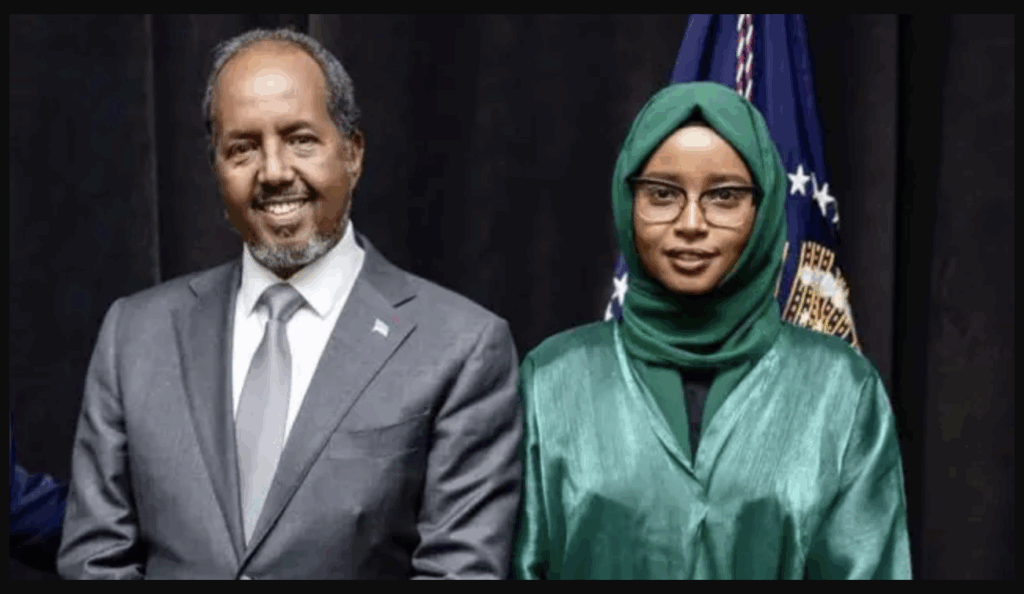


NAIROBI, Kenya (Kaab TV) – A leaked list of the Somali Federal Government’s official delegation to the 80th session of the United Nations General Assembly (UNGA), scheduled for September, has sparked widespread concern over its size, composition, and potential misuse.
According to documents submitted to the U.S. Embassy in Nairobi on August 16 for visa applications, the Somali government plans to send a 32-member delegation.
Among those listed are President Hassan Sheikh Mohamud, his daughter, and his son.
Equally striking is the presence of four individuals who are married couples, raising suspicions that family ties rather than official responsibilities dictated their inclusion.
The itinerary further shows the delegation will spend 15 days in New York—an extended stay in one of the world’s most expensive cities, funded by a government that relies almost entirely on international aid.
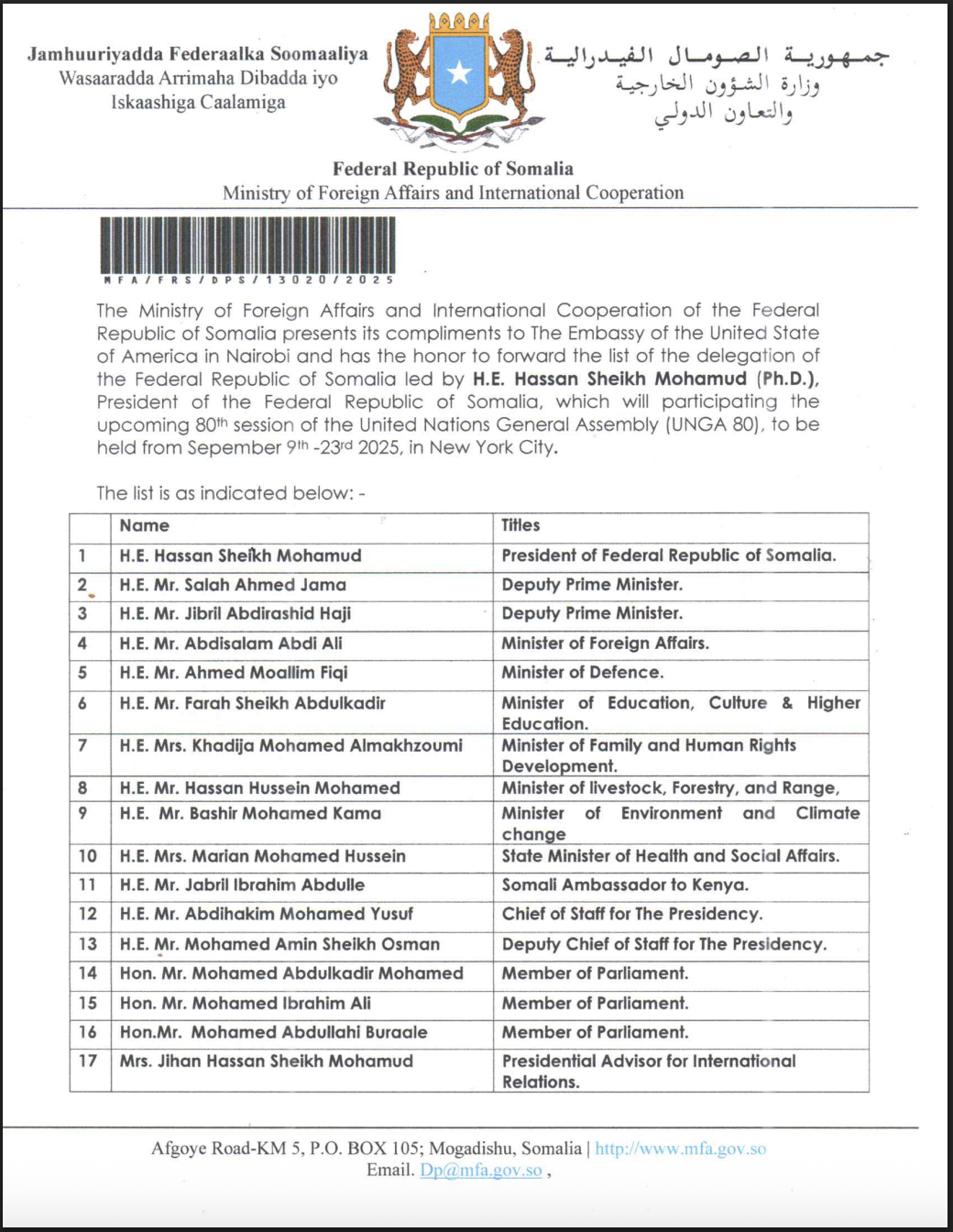
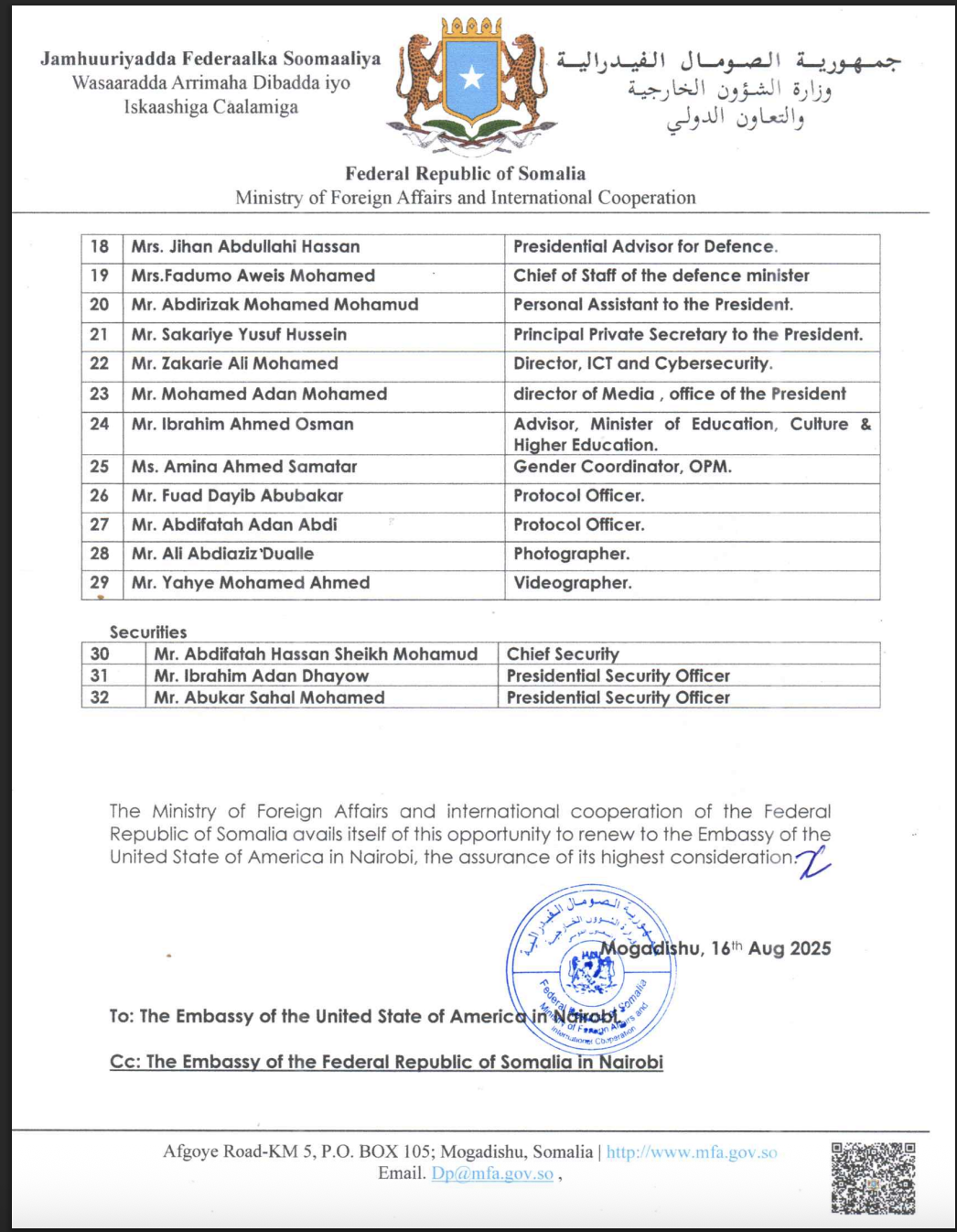
Also on the list are two deputy prime ministers, the husband of the president’s chief of protocol (himself a sitting MP), and a number of government employees with no apparent role in the UN Assembly’s proceedings.
The makeup of the delegation has fueled criticism that the trip serves more as a taxpayer-funded excursion for political insiders and relatives than as a focused diplomatic mission.
Beyond the question of cost, new concerns are emerging that some individuals on the list may not return to Somalia after the trip.
Observers including opposition MPs warn that such practices risk facilitating irregular migration or even human trafficking under the cover of official delegations—a phenomenon that has been reported in other fragile states where oversight is weak.
This controversy comes at a sensitive time. Somalia remains unable to consistently pay the salaries of its civil servants, soldiers, and teachers.
Yet it is preparing to cover the travel, accommodation, and allowances of more than 30 individuals in New York for two weeks.
Adding to the irony, the U.S. government has recently reimposed visa restrictions on Somalia under President Donald Trump’s new immigration laws—measures that make travel more difficult for ordinary Somali citizens, but which political elites appear able to sidestep with relative ease.
Somalia also continues to rank as one of the most corrupt countries in the world, where accountability for financial crimes, money laundering, and abuse of power is virtually nonexistent.
To critics, the UNGA delegation list is not an isolated misstep but a telling symptom of a deeper governance crisis—one where public resources are exploited for personal gain while the population is left to shoulder the consequences.