

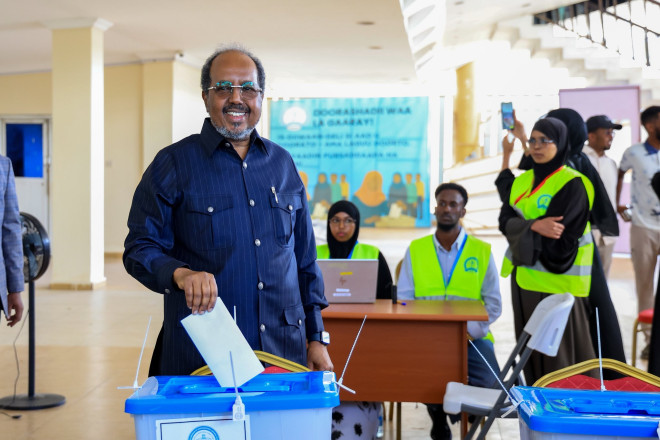

Mogadishu (Kaab TV) — The Somali parliament whose term ended in April said on Friday it would proceed with one-person, one-vote elections, declaring that the country had entered a new democratic phase after three days of talks with opposition leaders failed.
In a statement, the Ministry of Information said the government was fulfilling its constitutional obligation to hold free and fair elections that allow citizens to vote and run for office.
The statement followed negotiations held in Mogadishu from May 13 to 15 between the government and opposition figures, which failed to resolve disagreements over elections, constitutional amendments, and the country’s political transition.
The previous government headed by Hassan Sheikh said it had recently consulted with political stakeholders and various sectors of society to gather views on the electoral process. It accused some opposition members of taking positions that undermine citizens’ fundamental right to choose their leaders and seek elected office.
“Some members of the opposition have brought to the table views contrary to the fundamental right of the Somali citizen to choose and be elected,” the ministry of information said.
The government reiterated that Somalia would hold one-person, one-vote elections in accordance with the constitution, national laws, and the administration’s political program. It added that the door remained open for dialogue and consultation with all political actors.
The failed talks, held with support from international partners, have deepened the political standoff between President Hassan Sheikh Mohamud’s administration and opposition leaders over Somalia’s electoral framework.
Meanwhile, the opposition-aligned Somali Future Council issued a separate statement claiming that Mohamud’s term officially ended on May 15. The council argued that there was no political or constitutional agreement to extend his rule beyond that date.
The council said it would now refer to Mohamud as a “former president” and called on security forces to uphold their constitutional responsibilities and refrain from taking “executive orders” from him.
The opposition accused the federal government of failing to build an inclusive political agreement, warning that Somalia had entered a sensitive political phase requiring broad national consultation and a legitimate process to manage the transition.
The council also announced that it was forming a “political platform” aimed at safeguarding Somalia’s sovereignty and unity during the transition period. It thanked international partners for supporting political dialogue efforts.
Mohamud’s four-year term was originally due to end on May 15, 2026. However, Somalia’s parliament approved constitutional amendments extending the presidential term from four years to five and prolonging the mandates of federal institutions by one year — a move strongly rejected by major opposition figures.
The dispute over the president’s mandate is expected to intensify tensions in Mogadishu, where opposition groups have accused the government of pushing through electoral and constitutional changes without broad consensus.
Federal officials argue that direct elections are necessary to move Somalia away from the indirect voting system and give citizens a greater role in choosing their leaders. Opposition groups, however, insist that the process cannot be considered legitimate without a broader political agreement involving federal member states and key political stakeholders.