

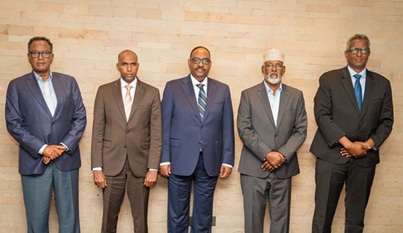

Nairobi (KAAB TV) – A new political front, the Somali Future Council, has been launched in Nairobi by regional leaders and opposition figures, aiming to provide a unified voice during Somalia’s complex political transition.
Formation and Key Players
The Somali Future Council brings together:
-
Presidents of the federal member states of Jubaland (Ahmed Mohamed Islam “Madobe”) and Puntland (Said Abdullahi Deni).
-
Prominent opposition leaders including former Prime Ministers Hassan Ali Khaire and Abdi Farah Shirdon, and MP Abdirahman Abdishakur Warsame from the Somali Salvation Forum.
The Council was announced following meetings held on October 2, 2025, in Nairobi.
Purpose, Goals and Agenda
The main declared aims of the Somali Future Council are:
- To coordinate positions on Somalia’s political transition, especially as the mandate of incumbent leadership winds down.
- To finalize its structure and operational modalities through a follow-up national conference to be held inside Somalia.
- To emphasize national unity, stability and to challenge any processes or decisions deemed threatening to Somalia’s cohesion.
Political Context and Implications
The formation of this bloc takes place amid increasing friction between the federal government in Mogadishu and regional authorities, with Jubaland and Puntland historically pushing for greater autonomy.
Opposition figures have repeatedly expressed concerns about the direction of constitutional amendments, the electoral roadmap, and what they see as centralized decision‑making without sufficient consultation.
Federal government reaction has been cautious. Some federal officials have raised concerns over the legitimacy of agreements made outside Somalia’s borders.
The Somali Defence Minister, for example, criticized the Nairobi meeting, warning that political decisions regarding national transition should be made within the country to preserve sovereignty
The Somali Future Council will face several hurdles:
Legitimacy and recognition: To be effective, it must earn credibility among clans, regional leaders, and the wider population. That includes whether its resolutions will be accepted by the federal government.
Structure and decision‑making power: While the Nairobi meeting set the intention, there is ambiguity over how much actual power the Council will hold, what its legal or constitutional status will be, and how binding its decisions may be.
Security environment: With Al‑Shabab insurgency still active and areas of instability, the political transition is inseparable from security concerns. Any platform attempting to shape elections or governance must address these challenges.
Timing: Somalia is on a tight timeline. The country is nearing an election cycle, and delays or perceived stalling can exacerbate tensions. How the Somali Future Council times its internal structuring and its outward moves will matter.
What to Watch Next
-
When and where the promised national conference will be held inside Somalia. This event could formalize the Council’s structure and define its agenda in more concrete terms.
-
How the federal government will respond: Will it engage with the Council, ignore it, or oppose it outright? Its posture could determine whether this becomes a major force in Somali politics or remains more symbolic.
-
The reaction of other regional states, and non‑aligned opposition actors. Their participation or dissent will influence how inclusive and representative the Council can become.
- Whether international actors (Kenya, IGAD, the African Union, donor nations) will lend support or act as mediators. Given that Nairobi hosted the initial meeting, external stakeholders may be important in bridging divides.
The Somali Future Council embodies a fresh attempt by regional leaders and opposition figures to shape Somalia’s next political chapter. Its emergence underscores growing dissatisfaction with existing power structures and the desire for a more inclusive, negotiated transition. Whether it can translate its declarations into effective political leverage remains to be seen — but its formation adds a new dimension to Somalia’s often turbulent politics.