


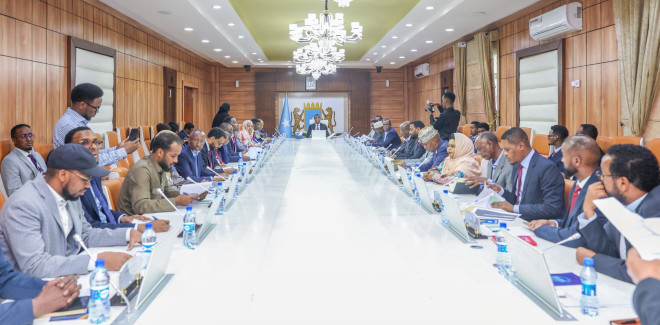


Mogadishu (Kaab TV) — Somalia’s Council of Ministers on Sunday reviewed a plan to implement the country’s new federal constitution between 2026 and 2029, as the government pushed ahead with political reforms opposed by major opposition leaders.
The meeting, chaired by Prime Minister Hamza Abdi Barre in Mogadishu, focused on constitutional implementation, one-person, one-vote elections, government regulations, international agreements, and the approval of national policies.
The Ministry of Justice and Constitutional Affairs presented the Constitution Implementation Plan, outlining how constitutional provisions will be enforced over the next three years. The ministry said the plan takes into account Somalia’s political situation and the institutional needs of the federal government.
The proposal also identifies priority tasks for the next 12 months, including the establishment and operationalization of key institutions such as the Judicial Service Commission and the National Revenue Agency.
Barre said the constitution formally entered into force after it was signed by President Hassan Sheikh Mohamud and published in the official gazette. However, he noted that its technical implementation would require time and strong institutions, particularly in public administration and service delivery.
The Cabinet was asked to adopt a resolution outlining the constitutional priorities to be completed over the next year.
The meeting also heard a report on one-person, one-vote elections recently held in several districts of South West State, as well as the role of national media in public awareness campaigns. Ministers were also briefed on political dialogue efforts led by the president ahead of the elections.
The constitutional rollout comes amid a widening political conflict over Somalia’s transition.
Mohamud’s four-year term was due to end on May 15, 2026, but parliament approved constitutional amendments extending federal institutions by one year and changing the presidential term from four years to five.
Opposition leaders have rejected the changes, arguing that there is no valid political agreement extending Mohamud’s mandate. The president has maintained that the mandate of federal institutions now runs until May 15, 2027, under the amended constitution and was not extended through a personal decision.
The Cabinet also approved the promotion of Mohamed Rabi Yusuf to deputy ambassador to the United Nations.
Ministers approved several additional measures, including the National Policy for the Development of Sports in Somalia, regulations on the reintegration and unification of social insurance, an investment cooperation agreement between Somalia and Saudi Arabia, the renewal of an education agreement between Somalia and Turkey, and a law governing the administration of district councils in the Banadir region.
The decisions reflect the federal government’s efforts to advance institutional reforms despite continued opposition concerns over political consensus, electoral legitimacy, and the country’s ongoing political transition.