


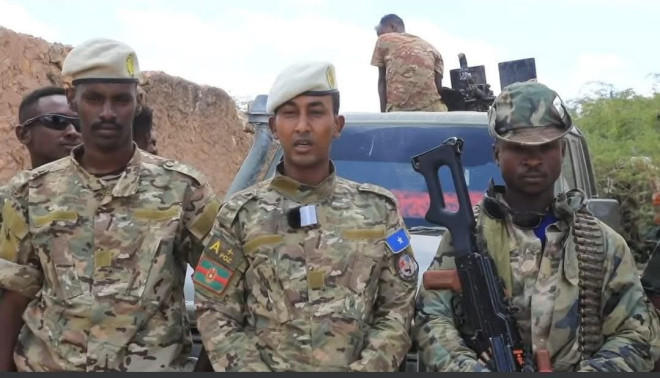


The commander of the Somali National Army’s 27th Division, Colonel Ali Ahmed Hashi, widely known as Ali Cagey, has issued a strong warning against attempts to fragment the national military, particularly units deployed in Hiiraan region, amid growing concerns over divisions within the security forces.
In a statement published on his Facebook page, Ali Cagey said the destruction of the national army would not be tolerated, especially at a time when the government continues to emphasise efforts to strengthen and professionalise the Somali National Army.
The commander condemned what he described as attempts to humiliate soldiers, break up military units or draw the armed forces into political rivalries and disputes between different groups.
He warned that some individuals could exploit public grievances to weaken government forces and undermine their operational capacity.
Ali Cagey argued that political disagreements and dissatisfaction with the government should not be used as justification for dismantling national security institutions or disrupting the military chain of command.
“The Somali National Army cannot be deliberately undermined while people continue to talk about rebuilding it. Grievances cannot be used as a pretext for bringing down the government or breaking up the military. Anyone who comes forward will be exposed, including those they are serving, and evidence will be submitted to the relevant authorities,” he said.
He further warned that he would not remain silent about individuals he suspects of cooperating with the country’s enemies while concealing their activities behind the grievances of local communities.
His remarks come amid growing political and military tensions in Hiiraan, where disagreements over regional administration and political representation have increasingly affected relations between local communities and government security forces.
The latest developments follow an appeal by Hawadle traditional leader Ugaas Yusuf Ugaas Hassan Ugaas Khalif, who called on military personnel originating from Hiiraan to return to the region and respond to the situation there.
Following the appeal, reports emerged that Somali National Army soldiers from different parts of the country had gathered at the Ugaas’s residence.
The number of troops reportedly arriving was estimated at approximately 450, raising questions about their origins, current military status and whether their movement had been authorised through the army’s command structure.
The reported gathering has also intensified debate over the relationship between traditional leadership, the national armed forces and the Hirshabelle administration.
It has raised concerns about the potential influence of clan and political loyalties on soldiers whose responsibilities are supposed to be governed by national military institutions.
Ali Cagey’s warning comes as questions grow over the cohesion of units trained inside Somalia and their ability to remain united amid political disagreements and local grievances.
The central challenge facing the Federal Government and military leadership is to address legitimate complaints among soldiers and communities without allowing political disputes or external influence to undermine military discipline.
If the concerns affecting troops in Hiiraan are not addressed through dialogue, clear command arrangements and effective leadership, maintaining unity within the armed forces could become increasingly difficult.
The military’s ability to defend communities and sustain operations against Al-Shabaab ultimately depends on a disciplined national force operating under a unified command.