


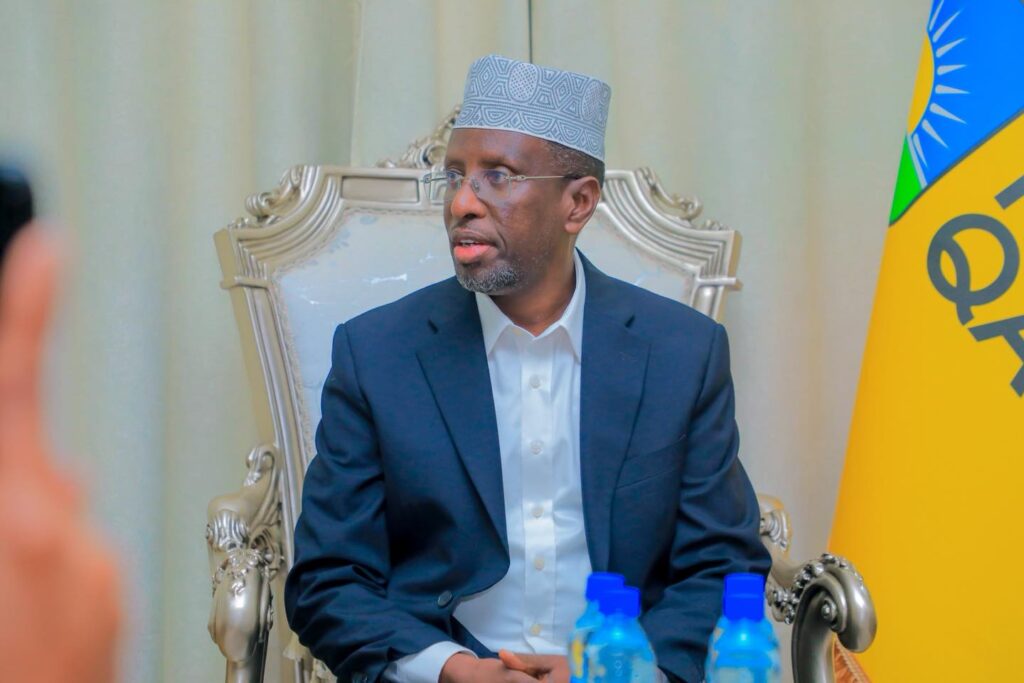


Mogadishu (Kaab TV) — Former Somali President Sharif Sheikh Ahmed has emerged as a leading critic of the federal government’s plan to hold direct, one‑person‑one‑vote elections — a major shift away from the long‑standing clan‑based system — warning that the country is not ready and that the process threatens political stability and security.
Sharif, now a prominent opposition leader, rejects the government’s direct election initiative on multiple grounds, arguing that it lacks broad legal and political consensus, sufficient security safeguards, and a credible institutional foundation. His concerns reflect deepening divisions among Somali political elites as preparations accelerate for what would be the nation’s first direct elections in more than five decades.
At the heart of Sharif’s opposition is the belief that the electoral process has been driven unilaterally by the federal government without genuine agreement from key stakeholders, including federal member states and opposition parties.
He has repeatedly stressed that “a credible election cannot proceed without a broad‑based consensus”, a view shared by allied political actors who argue that the government’s approach risks sidelining regional voices and key actors in the electoral architecture.
Sharif has also criticized the appointment of the national electoral commission, calling it partisan and illegitimate because it was established without cross‑party approval — undermining public confidence in the body responsible for overseeing the vote.
Another central pillar of Sharif’s objection lies in legal and constitutional matters. He contends that key electoral laws and constitutional amendments underpinning the direct election model were passed without full parliamentary participation and that essential legal groundwork remains incomplete.
According to Sharif, the lack of a legally sound and consensually agreed framework could weaken the legitimacy of the election and fuel further political instability.
Opposition leaders have warned that actions taken outside agreed constitutional processes — including changes to election laws — may violate Somalia’s fragile legal foundations.
Security remains a deeply contested issue in Somalia, where Al‑Shabaab attacks and fragile public safety continue to undermine state authority in many regions. Sharif has stressed that Somalia is not yet secure enough to hold nationwide direct elections, particularly in areas beset by insurgent activity and weak government control.
He argues that without stable security conditions, the electoral process could be easily manipulated or disrupted by militant groups or local spoilers.
Related reports from opposition sources allege the use of security forces to influence voter registration and exert pressure on citizens in Mogadishu — claims the federal government denies — further fueling Sharif’s security concerns.
Sharif and his allies insist they support the concept of universal suffrage in principle, but not the current rushed or fragmented implementation that they say bypasses inclusive dialogue and consensus‑building.
He has repeatedly called for renewed negotiations on a roadmap that would ensure constitutional clarity, balanced political participation, and more robust preparations before any direct vote is held.
The disagreement over direct elections underscores broader tensions between Somalia’s federal government and opposition blocs, which have also clashed over constitutional reform, power sharing, and governance approaches in recent months.
As the political calendar advances toward potential polls, Sharif’s stance is likely to remain a defining element of Somalia’s tumultuous electoral debate — highlighting the challenges of balancing democratic aspirations with on‑the‑ground realities in one of the Horn of Africa’s most fragile states.