


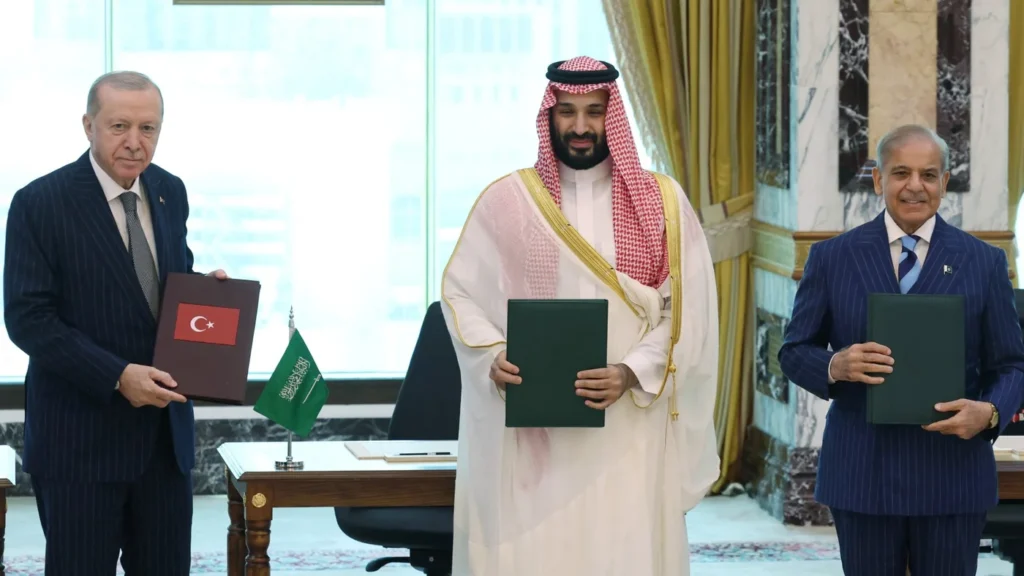


Saudi Arabia has opposed efforts to bring Egypt into a new mutual defense agreement signed with Turkey and Pakistan, despite Ankara’s push for Cairo to become part of the arrangement, according to three Saudi sources cited by Middle East Eye.
The disagreement points to growing differences between Riyadh and Cairo, two countries that have traditionally been regarded as key pillars of Arab security cooperation.
The sources told Middle East Eye that Saudi Arabia does not want Egypt to join the alliance “at least for now,” citing growing frustration with the government of President Abdel Fattah al-Sisi and doubts over what Egypt could contribute to the pact strategically and militarily.
The dispute centers on the Makkah Mutual Defense Agreement, signed on August 7 by Saudi Crown Prince Mohammed bin Salman, Turkish President Recep Tayyip Erdoğan and Pakistani Prime Minister Shehbaz Sharif.
Under the agreement, an armed attack against any one of the three signatories would be considered an attack against all three, creating a collective-defense mechanism broadly comparable to Article 5 of NATO.
However, the agreement does not clearly specify what type of military assistance members would be required to provide if one of the countries came under attack.
Turkish Foreign Minister Hakan Fidan said the three countries would consult with one another before deciding how to respond to a security crisis, leaving the exact nature of any military response open to interpretation.
Saudi Arabia’s Growing Frustration With Egypt
The disagreement over Egypt’s potential membership appears to reflect broader concerns in Riyadh about Cairo’s role in regional security rather than simply a disagreement over the structure of the new alliance.
According to Saudi sources, officials in Riyadh have become increasingly frustrated by what they see as Egypt’s limited contribution to several security issues considered important to Saudi Arabia, despite years of significant Saudi financial assistance to the Egyptian government.
Saudi Arabia became one of Cairo’s most important financial and political supporters after Egypt’s military removed President Mohamed Morsi from power in 2013. Riyadh subsequently provided billions of dollars in financial support to help stabilize Egypt’s struggling economy.
However, Saudi officials have increasingly questioned whether Cairo’s security commitments have matched the scale of the support it has received.
One former senior Saudi adviser described Egypt’s contribution during Saudi Arabia’s prolonged conflict with the Houthi movement in Yemen as limited and unreliable.
Egypt joined the Saudi-led military intervention in Yemen in 2015 and contributed naval and air capabilities, but it stopped short of deploying the large ground force that some Gulf states had expected.
Saudi concerns also reportedly intensified during the more recent conflict involving the United States, Israel and Iran, with Riyadh examining how regional partners responded to the changing security environment.
Riyadh and Abu Dhabi’s Rivalry Adds Another Layer
Another source of tension is Egypt’s increasingly close relationship with the United Arab Emirates, which has become one of Cairo’s major economic supporters through investments and other forms of financial assistance.
At the same time, Saudi Arabia and the UAE have increasingly developed different positions on several regional issues. Their rivalry, which became particularly visible in Yemen, has also extended to Sudan and the Horn of Africa.
Saudi sources reportedly pointed to the UAE’s policies toward Sudan, Ethiopia and Somaliland as examples of areas where Abu Dhabi’s interests do not always coincide with those of Riyadh or Cairo.
The growing closeness between Cairo and Abu Dhabi has therefore raised concerns in Riyadh about whether Egypt would always align itself with Saudi strategic priorities if it joined a broader regional defense arrangement.
A former senior Saudi adviser was particularly critical of Egypt’s reliance on foreign financial assistance.
“Egypt has always depended on us and the United States, and it gives nothing back,” the former adviser said, arguing that Egypt “just takes and takes without giving anything back.”
Turkey Wanted Egypt to Join
Turkey, however, has taken a significantly more positive position toward Egyptian participation in the new defense framework.
Foreign Minister Hakan Fidan described Egypt as a “natural partner” and suggested that there was no fundamental obstacle preventing Cairo from joining once technical matters were resolved.
“I believe that in the next stage, Egypt will also join us as an ally,” Fidan said.
Turkish sources told Middle East Eye that Ankara made considerable efforts to secure Egypt’s participation and formally proposed that Cairo be included in the agreement.
Saudi sources, however, rejected suggestions that Egypt itself had decided not to join, indicating that the opposition came from Riyadh rather than Cairo.
The former Saudi adviser described the possibility of Egypt joining as understandable, particularly because such an agreement could potentially provide Cairo with economic and strategic benefits.
“Decision-makers have genuine concerns about Sisi’s loyalty,” the adviser said.
He added:
“We understand that Turkey wanted Egypt to be included, and we understand why. Perhaps in the future, if we see a change or progress.”
Turkey, Pakistan Offer Significant Military Capabilities
The disagreement also highlights the different military capabilities that Turkey and Pakistan would bring to the new security arrangement.
Turkey has NATO’s second-largest military and a rapidly expanding domestic defense industry that produces drones, armored vehicles, naval platforms, missiles and other military systems.
Pakistan, meanwhile, has a large standing military, an established defense industry and is the only nuclear-armed Muslim-majority country.
Saudi sources contrasted these capabilities with Egypt’s defense industry, arguing that Cairo needs to modernize its military production capabilities and focus more heavily on advanced defense technologies.
The comparison underscores why Turkey and Pakistan may be viewed as particularly valuable partners within the new arrangement: both possess substantial military capabilities that could contribute to collective defense beyond financial or diplomatic support.
A Shift in Regional Alliances
The dispute comes at a time when Saudi Arabia is seeking to strengthen its regional security partnerships following attacks and threats involving Iran and the Houthis that have affected Saudi infrastructure and shipping routes in the Red Sea.
The new Saudi-Turkish-Pakistani agreement could therefore represent an attempt to build a more structured regional security network at a time when traditional alliances are being reassessed.
For Egypt, joining such an arrangement could strengthen its strategic relationship with Turkey and Pakistan while giving Cairo a greater role in emerging regional security structures.
For Saudi Arabia, however, allowing Egypt to join could raise concerns over Cairo’s reliability and its close relationships with other regional powers.
The disagreement also demonstrates that although Saudi Arabia and Egypt remain important partners, their interests are not always identical.
Their differing approaches toward Yemen, Sudan, the UAE and broader regional security issues could increasingly influence the way new alliances are formed.
Meanwhile, the relationship between Turkey and Egypt has significantly improved after years of political hostility following Morsi’s removal in 2013. Erdoğan and Sisi have restored diplomatic relations at ambassadorial level and expanded cooperation in trade, energy and defense.
The question of whether Egypt eventually joins the new defense arrangement will therefore depend not only on technical considerations but also on whether Riyadh becomes convinced that Cairo can make a meaningful and reliable contribution to the alliance.
For now, the disagreement leaves the new pact centered on Saudi Arabia, Turkey and Pakistan, while Egypt remains outside the framework despite Ankara’s apparent interest in bringing Cairo into the alliance.