





Remittance inflows to Africa rose by 86 per cent over the past decade to reach about US$124 billion in 2025, far outpacing population and migration growth and highlighting the growing importance of money sent home by migrants to families and economies across the continent, according to a new report by the International Fund for Agricultural Development (IFAD).
Africa’s population grew by 24 per cent between 2016 and 2025, while the number of emigrants increased by almost 32 per cent to nearly 46 million.
Remittances, however, grew almost three times faster than population growth, underscoring their rising role as a source of household income, resilience and investment.
The report, Sending Money Home 2026: Beyond remittances: From lifeline to resilience – one family at a time, finds that remittances to low- and middle-income countries reached US$728.6 billion in 2025—more than four times global official development assistance and greater than foreign direct investment to those countries.
Across Africa, the flows are concentrated in a handful of major receiving markets.
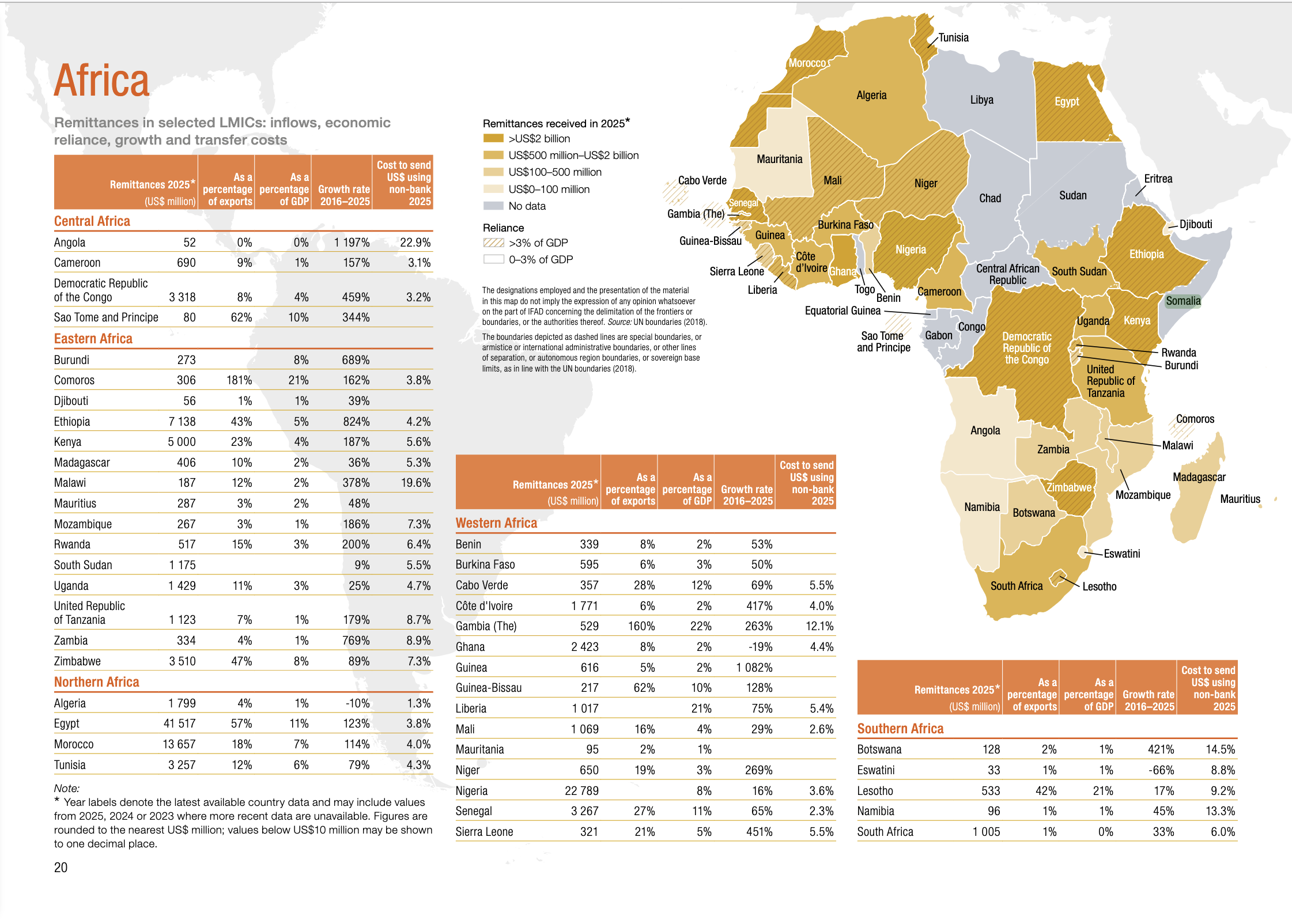
Egypt, Nigeria, Morocco, Ethiopia and Kenya received a combined US$90.1 billion in 2025, representing approximately 73 per cent of all remittances to the continent.
Egypt alone accounted for about one-third of Africa’s total.
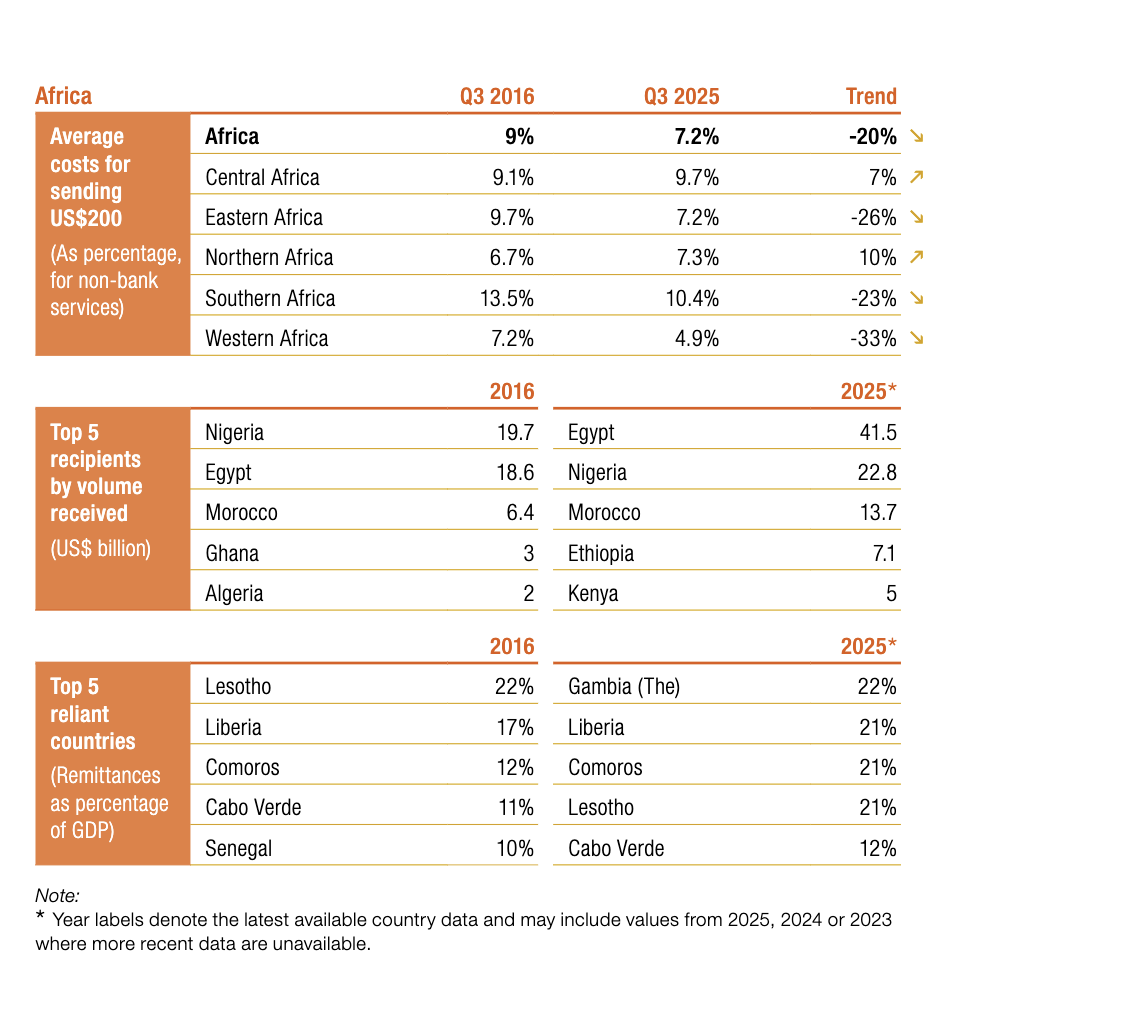

Ethiopia and Kenya entered the continent’s five largest receiving markets, replacing Ghana and Algeria, reflecting shifts in the region’s migration and remittance landscape.
“Remittances help families meet their basic needs, but they are also building financial growth and resilience to shocks,” said Alvaro Lario, President of IFAD. “Their potential benefits are greatest when families have access to affordable and trusted financial services, together with the knowledge, freedom and appropriate options to use their resources according to their own needs and aspirations.”
A largely African migration story
More than half of African emigrants live within the continent, making intra-African migration a major driver of the region’s remittance economy.
For migrants living outside Africa, Europe remains the main destination, followed by Asia and North America. Long-established migration corridors between North Africa and Europe continue to reflect geographic proximity, labour demand and historical ties, while migration to Gulf countries has also expanded.
The growth in remittances comes despite the challenges facing migrants and their families, including high transfer costs, limited access to financial services and economic and climate-related shocks.
Globally, almost one in three dollars sent home by migrants—an estimated US$233 billion—reached rural areas in 2025.
These flows can be particularly significant in places where formal employment, financial services and public infrastructure are weakest.
IFAD estimates that remittance-receiving families invest around US$22 billion annually in rural agrifood systems, supporting agricultural production, rural businesses and employment.
“The impact of remittances in rural areas extends beyond recipient households into surrounding economies, supporting local businesses, jobs and food systems,” Lario said.

For rural families, remittances can provide a first opportunity to build savings, access insurance or obtain appropriate credit.
They can also help households withstand economic and climate-related shocks and create opportunities that may make migration more of a choice than a necessity.
Digital transfers growing, but gaps remain
More than half of remittances globally now begin through a digital channel, contributing to lower transfer costs. Yet cash remains widely used in many corridors, and only 35 per cent of services measured in 2025 were fully digital at both the sending and receiving ends.
The report calls on governments, regulators, financial institutions and development partners to make remittance transfers more affordable and transparent, improve services in rural areas and strengthen financial and digital capabilities.
It also urges greater access for remittance-receiving families to savings, insurance, appropriate credit and investment opportunities.
While remittances can strengthen household resilience and contribute to local economic development, IFAD stresses that these private flows cannot substitute for public investment, social protection or climate finance.
For Africa, the findings underline the growing economic importance of migration—not simply as a movement of people, but as a financial lifeline connecting millions of households across borders and increasingly supporting the resilience and development of communities at home.