

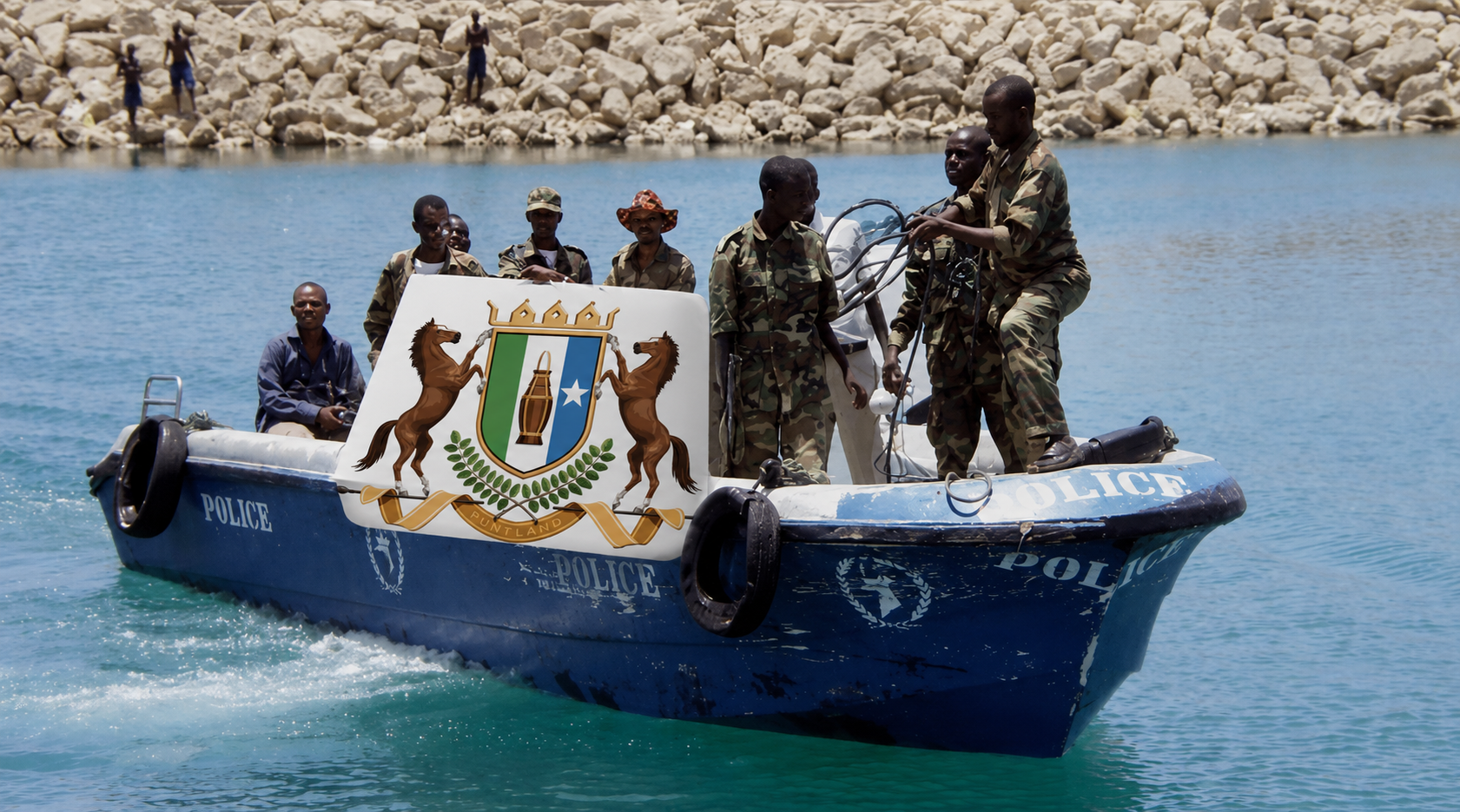

The Puntland Government has issued a strongly worded statement reaffirming its constitutional authority over the management of natural resources within its territory, declaring that no foreign government, private company, or international investor may undertake maritime, fisheries, or coastguard-related activities in Puntland without the prior approval of Puntland authorities.
In a two-page statement released on July 5, the regional administration asserted that Puntland has full constitutional and jurisdictional authority to control, manage, explore, and utilize the marine and blue economy resources located along its approximately 1,600-kilometre coastline stretching across the Indian Ocean and the Gulf of Aden.
The statement specifically warned that companies—including SOMTURK, a joint Somali-Turkish entity established under recent agreements between the Federal Government of Somalia and Türkiye—cannot legally operate in Puntland’s territorial waters without authorization from the Puntland Government.
Puntland argued that the Federal Government in Mogadishu lacks the constitutional authority to grant concessions or sign investment agreements involving Puntland’s land or maritime territory without consultation and approval from the regional administration.
According to the statement, Puntland based its position on several provisions of both the Provisional Constitution of Somalia and the Puntland Constitution, particularly Articles 44, 51, 52, 53, 54 and 142 of the Federal Constitution, which govern the sharing of powers and natural resource management between the Federal Government and Federal Member States.
The regional administration maintained that Somalia’s federal constitutional framework remains incomplete, arguing that until negotiations on the allocation of constitutional powers are finalized, Federal Member States continue exercising the authorities granted under their own constitutions.
Puntland further emphasized that Article 54 of its own constitution recognizes the people of Puntland as the owners of the region’s natural resources and assigns the Puntland Government responsibility for their management and development.
As a result, Puntland warned that any domestic or foreign entity conducting activities within its territorial waters or land without prior authorization would face legal enforcement measures under Puntland law.
Despite its firm stance, Puntland stressed that it remains committed to constructive engagement with the Federal Government of Somalia, international partners, and foreign investors. The administration said it welcomes sustainable investment and international cooperation, provided such agreements respect Somalia’s federal constitutional framework and Puntland’s constitutional rights.
The statement comes amid growing political and constitutional tensions between Puntland and the Federal Government over control of natural resources, maritime affairs, security, and federal authority. Relations between the two sides have deteriorated significantly over the past two years following disagreements over constitutional amendments, federal governance, and the distribution of powers between Mogadishu and the Federal Member States.
The dispute has intensified following Somalia’s expanding strategic partnership with Türkiye, which has become one of Mogadishu’s closest security and economic allies. Ankara has signed agreements covering maritime security, offshore resource development, naval cooperation, fisheries, and energy exploration, moves that Puntland argues directly affect resources located within its constitutional jurisdiction.
The disagreement also follows Somalia’s recent accession to 15 international maritime conventions, a move the Federal Government described as a historic step toward modernizing the country’s maritime legal framework and strengthening its role in global shipping, maritime security, environmental protection, and the blue economy. Puntland, however, maintains that any implementation of such agreements within its territory requires consultation with and approval from the regional government under Somalia’s federal system.
Political analysts say the latest declaration highlights the unresolved constitutional dispute over ownership and management of Somalia’s natural resources, an issue that has remained one of the country’s most contentious federalism debates since the adoption of the Provisional Constitution in 2012. Unless a comprehensive constitutional settlement is reached between the Federal Government and Federal Member States, observers warn that similar disputes over investment, resource-sharing, and jurisdiction are likely to continue.

