


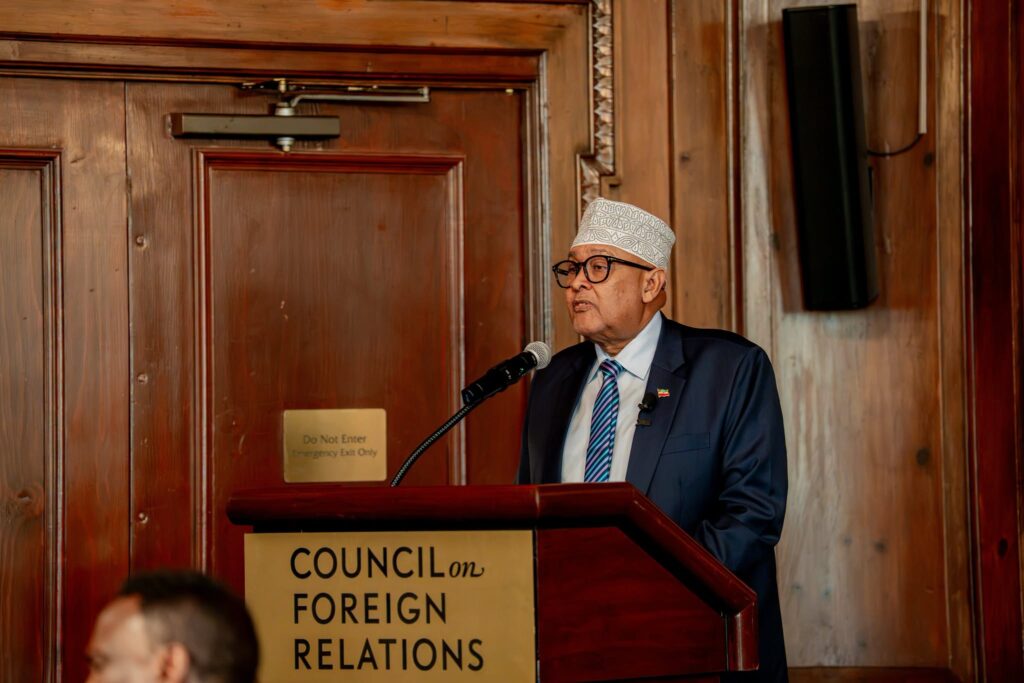


Somaliland President Abdirahman Mohamed Abdullahi “Irro” addressed the Council on Foreign Relations (CFR) in New York on September 24, 2026, where he outlined Somaliland’s push for international recognition and argued that the territory could play a significant role in the security and economic future of the Horn of Africa.
According to the CFR, the discussion focused on Somaliland’s quest for international recognition and the evolving security landscape in the region.
During the event, President Irro reiterated Hargeisa’s long-standing position that Somaliland has functioned as a self-governing entity for decades, having built its own political, security, and administrative institutions.
The appearance formed part of a broader U.S. visit during which the Somaliland leader met members of Congress, policy experts, and research institutions involved in foreign policy and security affairs.
Somaliland’s Ministry of Foreign Affairs said the trip was aimed at advancing Somaliland’s recognition campaign while strengthening ties with the United States in areas including security, trade, investment, and regional stability.
A central theme of Irro’s remarks was Somaliland’s continued pursuit of international recognition.
Somaliland declared that it had restored its independence in 1991 following the collapse of Somalia’s central government and has since maintained separate governing institutions, electoral processes, and security forces.
Hargeisa argues that Somaliland should be assessed not only through the lens of history but also based on its current governance record and potential contribution to regional stability and economic development.
The Federal Government of Somalia, however, maintains that Somaliland remains part of the Federal Republic of Somalia and considers the issue one of national unity and territorial integrity.
As a result, the dispute between Mogadishu and Hargeisa continues to revolve around two opposing positions: Somaliland’s demand for international recognition and Somalia’s insistence on preserving its territorial unity.
President Irro also sought to frame the recognition debate within a broader strategic context. Somaliland occupies a location near the Gulf of Aden and the maritime routes linking the Red Sea and the Indian Ocean.
Hargeisa views the Port of Berbera as a key strategic asset that could contribute to regional trade, logistics, and maritime security.
During his visit to Washington, Irro held discussions with several U.S.-based policy institutions, focusing on Red Sea security, freedom of navigation, trade opportunities, and investment prospects.
Somaliland’s Foreign Ministry said meetings with the Atlantic Council and the Foundation for Defense of Democracies examined security developments in the Horn of Africa and Gulf of Aden, maritime security challenges, and potential areas of cooperation between Somaliland and the United States.
The outreach reflects Somaliland’s broader effort to strengthen its international case by highlighting its geographic and strategic importance.
The visit also comes as Hargeisa intensifies engagement with policymakers and decision-makers in Washington. On September 19, President Irro met U.S. Senator Ted Cruz on Capitol Hill.
According to Somaliland officials, the discussions covered recognition, strategic cooperation, economic ties, security issues, and stability in the Horn of Africa.
Throughout the trip, the Somaliland leader also spoke with U.S. media outlets and policy organizations about what he described as Somaliland’s economic and strategic opportunities.
The Council on Foreign Relations is one of the United States’ leading foreign policy think tanks and regularly hosts heads of state, diplomats, and policymakers from around the world.
By appearing at the CFR, Somaliland gained an opportunity to present its position directly to influential figures involved in U.S. foreign policy discussions.
However, participation in a CFR event does not constitute official recognition by the United States government.
The organization serves as a forum for policy discussion and analysis rather than a decision-making body, making it important to distinguish between a speaking engagement and formal diplomatic recognition.
The New York visit also took place amid growing diplomatic engagement between Somaliland and Israel.
On September 24, President Irro met Danny Danon, Israel’s ambassador to the United Nations. Somaliland’s Foreign Ministry said the meeting focused on strengthening relations and exploring areas of cooperation between the two sides.
The relationship between Somaliland and Israel has drawn increasing attention in regional political discussions, particularly regarding Red Sea security, maritime trade, and broader geopolitical developments.
For Somalia’s federal government, however, Somaliland’s diplomatic outreach remains part of a long-running political dispute.
Mogadishu has consistently argued that Somaliland is an integral part of Somalia and that international recognition cannot be pursued independently outside Somalia’s constitutional framework.
As a result, President Irro’s diplomatic efforts in Washington and New York continue to unfold against the backdrop of a decades-long disagreement between Hargeisa and Mogadishu over Somaliland’s political future.
While the CFR event provided Somaliland with a platform to promote its vision, it also renewed debate over the next phase of its recognition campaign.
Hargeisa is increasingly presenting its case through the lenses of security, trade, investment, and Red Sea strategy, while Somalia continues to argue that the matter remains an internal issue tied to the country’s sovereignty and territorial integrity.


