

MOGADISHU (Kaab TV) – Mogadishu has once again become a political battlefield. Over the past week, Somalia’s capital has witnessed escalating rhetoric, mutual threats, and rising fears of violence as the country inches toward the scheduled May 2026 elections.
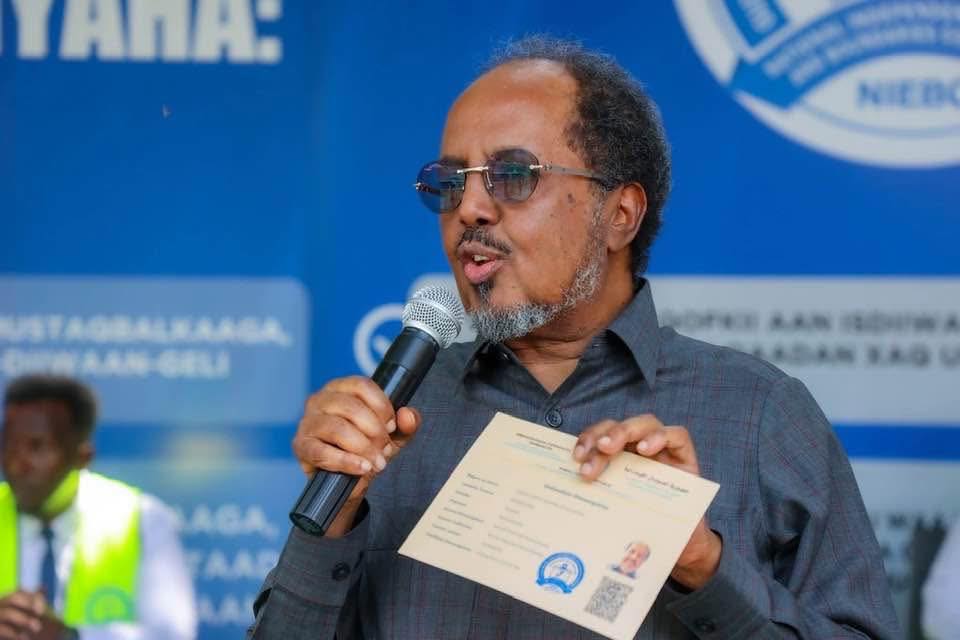
At the center of the storm is President Hassan Sheikh Mohamud, accused by opposition leaders of attempting to consolidate power through a manipulated electoral framework marketed as a shift to “one person, one vote.”
The opposition, which includes three former presidents, former prime ministers, and members of parliament, has denounced Mohamud’s plan as a dangerous power grab.
They argue that the proposed electoral model lacks constitutional grounding and risks centralizing control in the presidency at the expense of Somalia’s fragile federal arrangement.
Corruption, land grabs, and forced evictions of vulnerable communities in Mogadishu have only deepened mistrust.
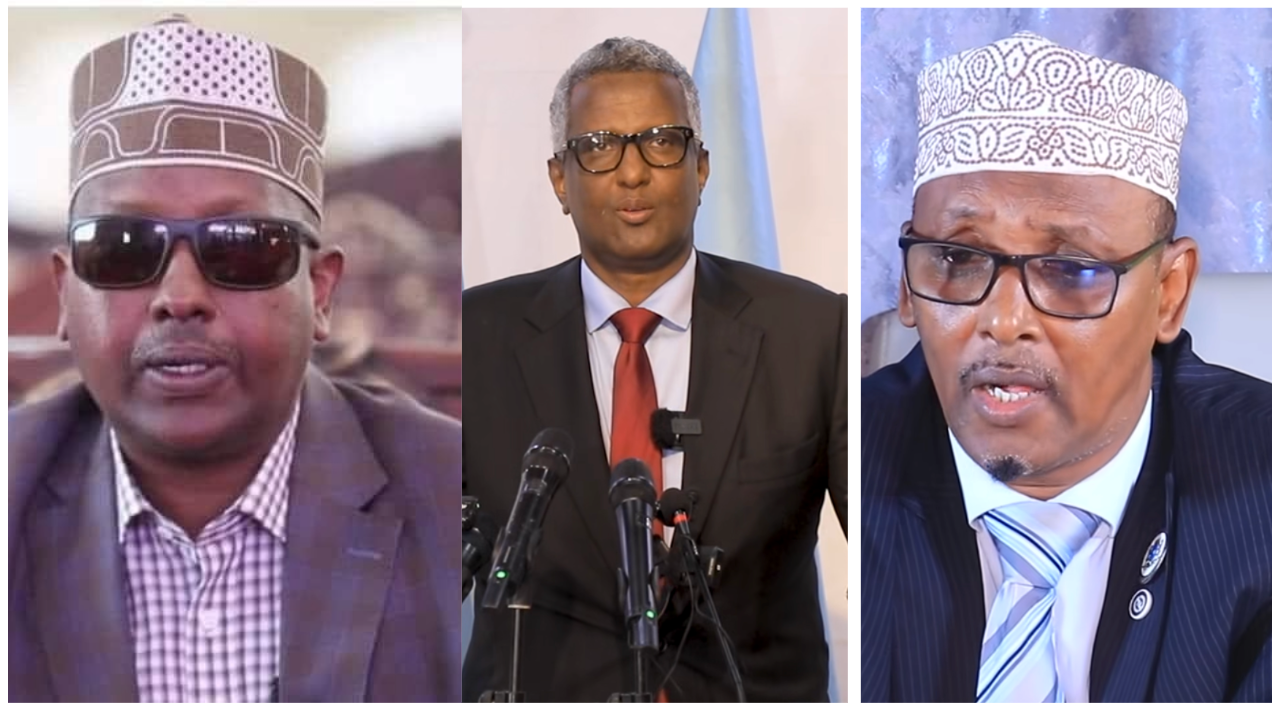
As these disputes intensified, threats of violence entered the political discourse. Defense Minister Ahmed Moalim Fiqi, speaking at a press conference in Mogadishu’s Jazeera Hotel, warned opposition figures against challenging the government with force.
“Nobody can take up a gun,” he said. “If they do so we will deal with them until they cry like Jews. They will scream ‘are you Jews?’”
The remark drew sharp condemnation. Opposition MP Abdirahman Abdishakur questioned how free and fair elections could be conducted under leaders who openly deploy anti-Semitic language to threaten rivals.
Another opposition MP, Dahir Amin Jeesow, challenged Fiqi, daring him to act on his threats.
Fiqi’s incendiary statement followed an equally troubling precedent set by Prime Minister Hamza Abdi Barre.
In October 2023, shortly after the outbreak of the Gaza war, Barre addressed a religious gathering in Mogadishu attended by prominent Islamist figures.
In his speech, he invoked a Qur’anic interpretation claiming that Jews were transformed into “pigs and monkeys” and went on to hail Hamas as a legitimate “liberation movement.”
Somali Prime Minister Hamza Barre “ Even if they were to kill us we will not reiterate their position. Hamas is a Liberation Movement, they are Mujahideen, AntiColonialists” 🇸🇴🇵🇸
— Muhsin (@Hawdist) November 2, 2023
Barre’s words were not an isolated outburst. They signaled the creeping normalization of extremist ideology within Somalia’s highest offices.
His rhetoric resonated with audiences who view political Islam as an essential identity marker but alarmed both domestic critics and international partners.
By framing Hamas in heroic terms while demonizing Jews, Barre further blurred the lines between governance and radicalism.
Extremist Roots Within the State
Concerns over extremist infiltration in Somali politics are not new. Many current leaders—including Prime Minister Barre and Defense Minister Fiqi—have long-standing associations with Islamist networks.
Educated in Yemen, Hamza Abdi Barre is widely believed to have links to Islamist movements, including affiliates of the Muslim Brotherhood, of which Hamas is a branch. His rise to premiership is viewed by critics as evidence of ideological accommodation within the federal government.
The defense minister Ahmed Moalim Fiqi is a Sudan-educated former member of Al-Itihaad al-Islami and later joined the Islamic Courts Union, which eventually splintered into Al-Shabaab, the al-Qaeda-aligned insurgency.
As the former head of Somalia’s National Intelligence and Security Agency (NISA), he has faced accusations of shielding Al-Shabaab members from his own clan. In 2023, Fiqi was alleged to have provided cash and protection to Nur Deeq, a senior Al-Shabaab figure captured during a military operation in Mudug.
Shortly after his capture, Puntland State released a list of victims killed by Nur Deeq’s brutal terrorist network and demanded justice. But to date, no trial has been held and Nur Deeq remains largely free.
Such figures straddle the ambiguous line between official authority and radical affiliation, fueling perceptions that Somalia’s governance remains hostage to Islamist currents.
Opposition Pushback
Somalia’s opposition is not remaining silent. In May 2025, opposition leaders convened a summit in Mogadishu, bringing together political veterans and civil society figures to demand an inclusive, transparent roadmap for 2026.
They warned that Mohamud’s unilateral approach—anchored by his new Justice and Solidarity Party (JSP)—undermines consensus politics and violates the spirit of Somalia’s provisional constitution.
Yet regional states like Puntland and Jubbaland have also rejected Mogadishu’s electoral plan, insisting on federal input.
The collapse of the National Consultative Council (NCC), once the central mechanism for dialogue between the federal government and the states, has further compounded Somalia’s political paralysis.
Extremism, Wealth, and Impunity
Extremist ideologies in Somalia thrive not only on religious fervor but also on economic desperation, political exclusion, and systemic impunity.
At the same time, Islamist networks with less militant profiles—such as alumni of Al-Itihaad al-Islami and affiliates of the Muslim Brotherhood—have penetrated Somalia’s politics, bureaucracy, and business sectors. By intertwining wealth, ideology, and governance, these networks perpetuate a cycle where radicalism finds sanctuary in state institutions.
International actors have often turned a blind eye. Western governments continue to partner with Somali leaders, even those implicated in extremist ties, in the name of counterterrorism and stability.
This has entrenched a culture of impunity, allowing extremist rhetoric and affiliations to coexist with international legitimacy.
As Somalia prepares for its 2026 elections, the stakes could not be higher. President Hassan Sheikh Mohamud insists that universal suffrage is necessary to move beyond clan-based politics. His critics argue that his approach is authoritarian, exclusionary, and fraught with risks of violence.
Meanwhile, the presence of extremist ideology in political discourse—manifested in anti-Semitic speeches and alliances with radical networks—casts a long shadow over Somalia’s democratic aspirations.
Without a credible, inclusive process, Somalia risks not only political implosion but also the strengthening of extremist forces that have long thrived on instability.