


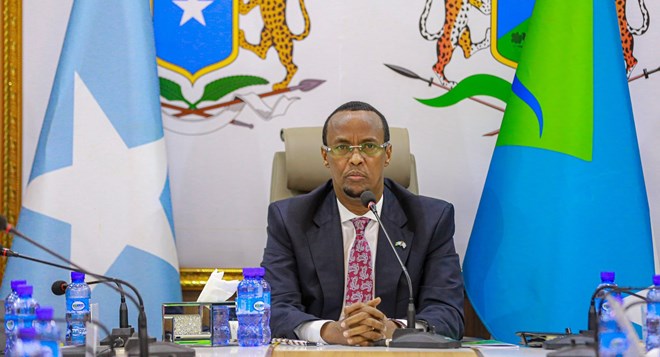


JOWHAR (KAAB TV) – In a significant political development within Somalia’s Hirshabelle State, President Ali Abdullahi Hussein Guudlawe has officially dismissed Muse Salad Wehliye from his position as Governor of the Hiraan Regional Administration.
The announcement was made through a presidential decree issued earlier today from the Office of the President in Jowhar, the administrative capital of Hirshabelle.
The decree, which was publicly explained by Mohamed Shuriye Noor, Director of Information and Community Relations at the Hirshabelle Presidency, also named Mohamed Arab Hussein Mohamed as the new governor of Hiraan.
His appointment follows a formal recommendation from Yusuf Ahmed Hagar Dabaged, the Vice President of Hirshabelle.
Background and Experience of the New Governor
Mohamed Arab Hussein Mohamed is not new to the political landscape of Hirshabelle. He previously served as the Chairman of the Electoral Committee for the Somali Federal Parliament elections in 2021, overseeing the voting process in the Hirshabelle constituencies.
His prior experience in managing critical national processes is seen as a strong asset as he steps into the governorship of one of Somalia’s most strategically significant and politically sensitive regions.
Underlying Tensions and Dispute
The dismissal of Muse Salad comes against the backdrop of escalating internal tensions within the Hirshabelle administration.
Over the past few weeks, serious disagreements had emerged between the former governor and Vice President Yusuf Dabaged. The core of their dispute centered around tax revenues collected at Ugas Khalif Airport in Baledweyne, a key city in Hiraan region.
Sources close to the administration have confirmed that the clash over the control and allocation of airport tax revenues significantly strained the working relationship between the two leaders.
The situation reportedly reached a point where effective governance was no longer tenable, prompting President Guudlawe to intervene with today’s decision.
Political Implications and Regional Autonomy Concerns
It remains unclear how the ousted governor Muse Salad will respond to the dismissal. Historically, several former governors in Somalia have resisted such decrees, often citing constitutional irregularities or the lack of sufficient federal authority in their regions.
This scenario is particularly relevant in the case of Hiraan, where Hirshabelle’s control has long been contested.
Many residents and local leaders in Hiraan, especially in Baledweyne, have expressed dissatisfaction with the Hirshabelle administration, accusing it of marginalization and limited service delivery.
As a result, the regional government’s influence in Hiraan has been tenuous at best, and political appointments from Jowhar are often met with skepticism or outright opposition.
With these dynamics in play, the future cooperation between the new governor and local stakeholders remains uncertain.
President Guudlawe’s decision reflects a broader effort to stabilize internal governance within Hirshabelle, but it also risks deepening regional divisions if not managed carefully.
The new governor, Mohamed Arab, will have to navigate a complex political terrain, balancing his loyalty to the central Hirshabelle administration with the demands of Hiraan’s increasingly vocal local leadership and community.
As of now, no official statement has been released by Muse Salad regarding his removal, but political observers are closely watching for his next move, which could influence the region’s fragile stability in the days ahead.