

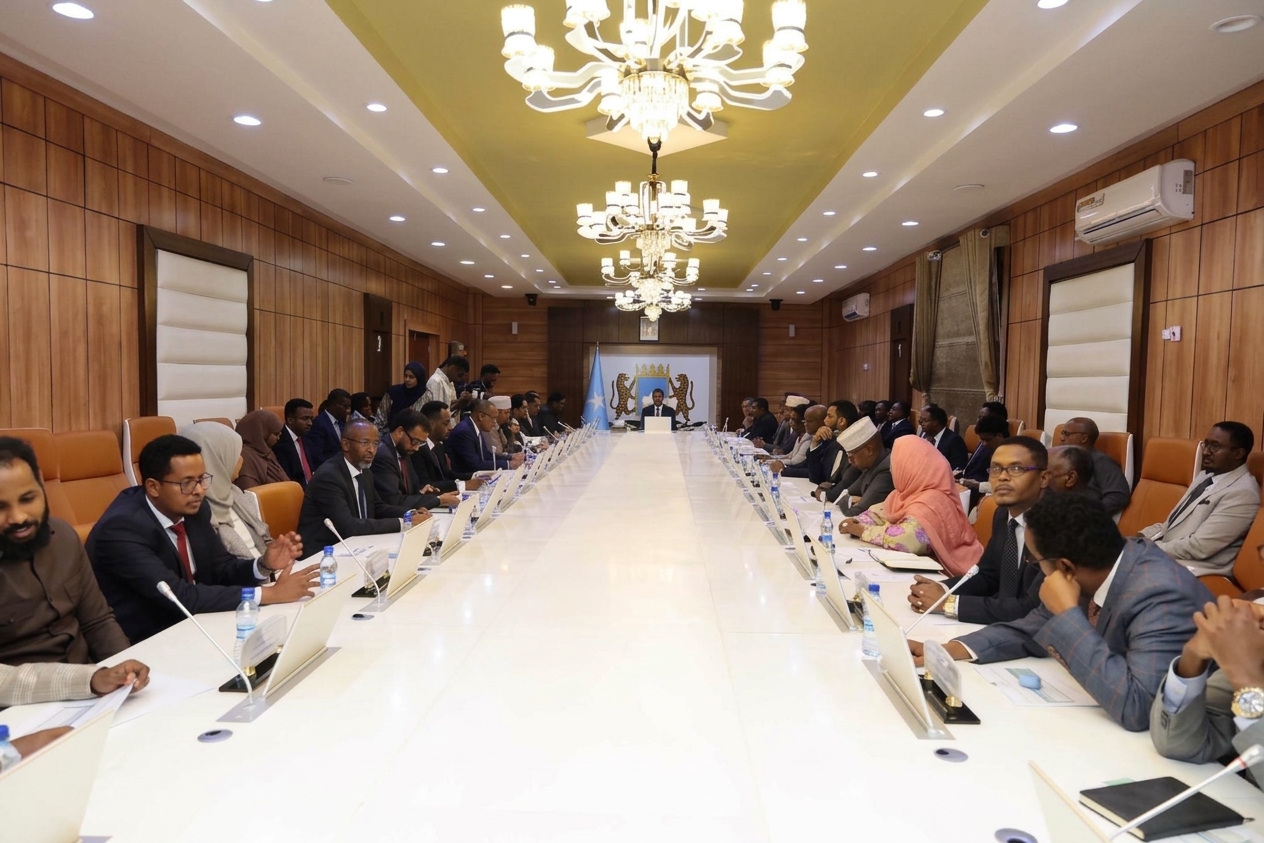

Somalia’s caretaker Prime Minister, Hamza Abdi Barre, insisted that the Federal Government of Somalia is working toward holding a one-person, one-vote election, stating that the electoral plan is set to proceed according to the schedule announced by the electoral commission and will not be contingent upon the influence of the Federal Member States.
The caretaker Prime Minister’s remarks came during last night’s Cabinet meeting, which approved amendments to the electoral law as well as procedures governing the election and the selection process for members of parliament.
The meeting formed part of the government’s efforts to accelerate the implementation of a one-person, one-vote electoral system—an issue that has recently sparked political disputes among the Federal Government, the opposition, and several Federal Member States.
Hamza Abdi Barre stated that his administration wants the country’s elections to take place through a one-person, one-vote model, arguing that the system affords citizens the opportunity to directly elect their leaders and representatives.
Clause Requiring Ministers to Resign Removed from Electoral Law
The amendments to the electoral law passed by the Cabinet include a provision concerning sitting government officials who intend to run for parliamentary seats.
A previous clause in the law, which required cabinet ministers to resign if they chose to run for parliament, has reportedly been removed from the new legislation, limiting the mandatory resignation requirement strictly to civil servants, the judiciary, and members of the armed forces.
This move is sparking debate over who should be permitted to hold public office during the election campaign and how to ensure a level playing field in the electoral race.
Political observers may view this change as allowing ministers to retain their cabinet positions while contesting the election—a development that could trigger political controversy in the absence of regulations guaranteeing fair competition.
The amendments to the electoral law also come amid an ongoing political dispute surrounding the amended constitution and the consensus required from Somali political stakeholders regarding the electoral framework.
The political opposition and several Federal Member States have previously opposed the Federal Government’s moves to amend the constitution and implement a one-person, one-vote system, arguing that major political changes require an inclusive agreement.
On the government’s side, officials maintain that the one-person, one-vote system is the mechanism through which the country will transition away from the previous indirect election model and build a system in which citizens directly participate in voting.
However, disputes over the constitution, the division of powers between the Federal Government and the Federal Member States, and the electoral timetable remain the primary obstacles preventing political stakeholders from agreeing on the electoral process.
Hamza Abdi Barre stated that the government is adhering to the electoral schedule announced by the electoral commission and emphasized the importance of the administration accelerating preparations and implementation for the vote.
Hamza maintained that the election will be held before May 2027, adding that the government will serve in a caretaker capacity throughout the preparation and execution of the election.
The Prime Minister’s remarks indicate that the Federal Government is pressing ahead with its electoral roadmap despite ongoing political disagreements over legitimacy, consensus, and the voting process.
The electoral timeline has previously been a subject of intense debate among Somali political actors, with the opposition calling for a political agreement before any electoral steps are undertaken.
The electoral process scheduled for 2027 is shaping up to be one of the most consequential issues in Somali politics and is expected to impact relations among the Federal Government, Federal Member States, the opposition, and politicians seeking to compete for national leadership.
The Cabinet’s passage of the electoral law amendments and the Prime Minister’s statements demonstrate that the government is continuing its preparations for a one-person, one-vote election, though the central question remains how this plan can secure broad political consensus.
Until an agreement is reached on constitutional disputes, political powers, and the electoral framework, the election timetable and the government’s actions are likely to remain points of contention among Somalia’s political stakeholders.