


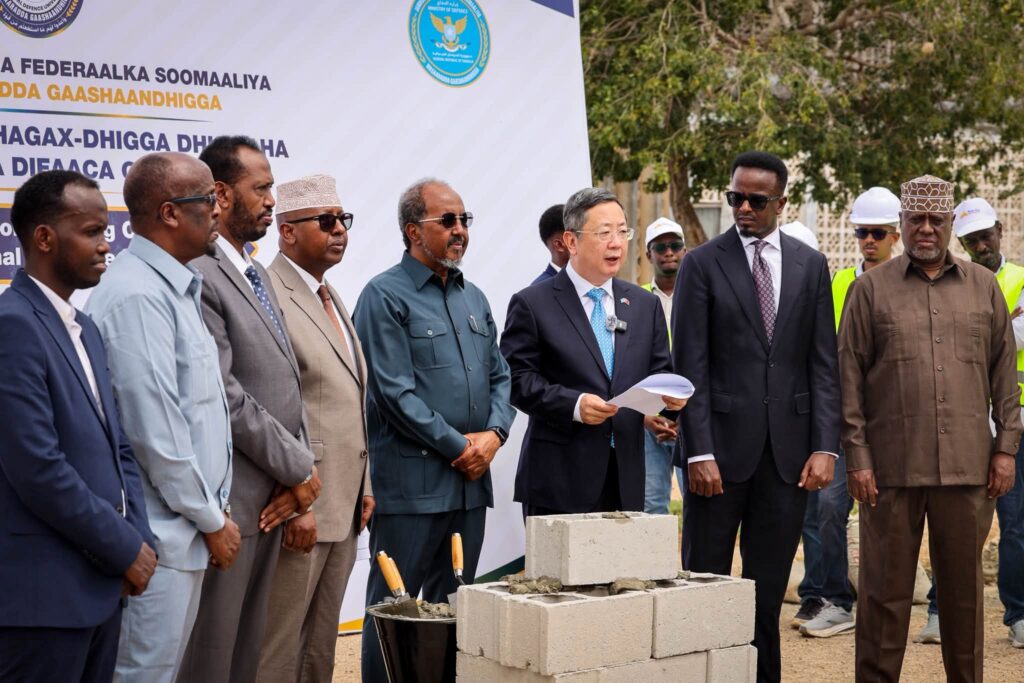


Somalia’s outgoing President, Hassan Sheikh Mohamud, appears to be signalling a possible strategic shift towards Beijing, as China continues to deepen its political, diplomatic and security influence in Mogadishu.
Speaking at the foundation laying event of a new Chinese-funded National Defence University in Mogadishu, Mohamud openly praised Beijing’s support for Somalia while describing Taiwan and Israel as “threats to the country’s national security, sovereignty and statehood”.
Standing alongside Mr. Wang Yu, China’s ambassador to Somalia, Mohamud said: “I would like to extend my heartfelt gratitude to the Government and the People of China. Somalia and China share many common interests, including the One-China Policy and One Somalia.”
He went further, declaring: “Taiwan and Israel are threats to the national security of Somalia.”
“Taiwan and Israel are among the countries that are a threat to our statehood and our existence,” he added.
Israel and Taiwan are among the few governments that maintain direct relations with Somaliland which declared its independence from Somalia. Israel formally recognized Somaliland as an independent country in December 2025.
The remarks represent a strong endorsement of Beijing’s foreign policy positions, particularly its One-China principle, and appear to place Somalia increasingly closer to China’s geopolitical priorities.
“China is among the friendly nations that have stood firmly alongside Somalia. I am confident that Somalia will one day reach a position where it can support and assist those who have stood by its side,” Mohamud added.
Beijing expands its influence in Somalia
Mohamud’s statements come amid growing Chinese efforts to cultivate political, diplomatic, security and media relationships in Somalia. Beijing appears increasingly determined to position itself as a major strategic partner for Mogadishu, potentially at the expense of Somalia’s traditionally close relationships with Western partners.

Recent developments have indicate China’s growing engagement with Somalia’s media sector.
China recently airlifted a group of Somali media influencers to China for a 21-day programme at the Zhejiang Normal University, a known institution linked to the Chinese Communist Party (CCP). The programme reportedly involved training on “AI, media management and combating fake news” as some attendees also said it included sessions about China’s political and media environment, raising questions about Beijing’s efforts to cultivate sympathetic voices and promote pro-China narratives within Somali public discourse.
Taken together, these initiatives suggest that China’s engagement goes beyond conventional development assistance. They point to a broader strategy of building influence through elite education, security cooperation, media engagement and political alignment.
The inauguration of the Chinese-funded defence university, alongside Mohamud’s explicit endorsement of Beijing’s position on Taiwan, provides another indication of this expanding relationship.
Mohamud also appeared to direct a warning at domestic political opponents, criticising those who leave the country to seek support from foreign governments.
“No one has ever achieved anything in the national interest by fleeing their country and seeking help from foreigners,” he said.
His remarks come amid political tensions surrounding Somalia’s leadership transition and disagreements over the country’s political direction.
While it remains unclear whether Mohamud’s statements represent a formal strategic reorientation of Somalia’s foreign policy, his increasingly public alignment with Beijing raises important questions about the future balance of Somalia’s international partnerships in a time when the country’s Supreme Court nullified Mohamud’s term extension that could possibly derail his attempt to hold a favourable election next year.
A political forum on the elections called by Mohamud failed to convene on Saturday, November 14, after the opposition coalition rejected his invitation.
These developments come as African Union forces begin withdrawing from the country, following two decades of fighting the extremist group al-Shabaab and protecting the fragile federal government in Mogadishu.