


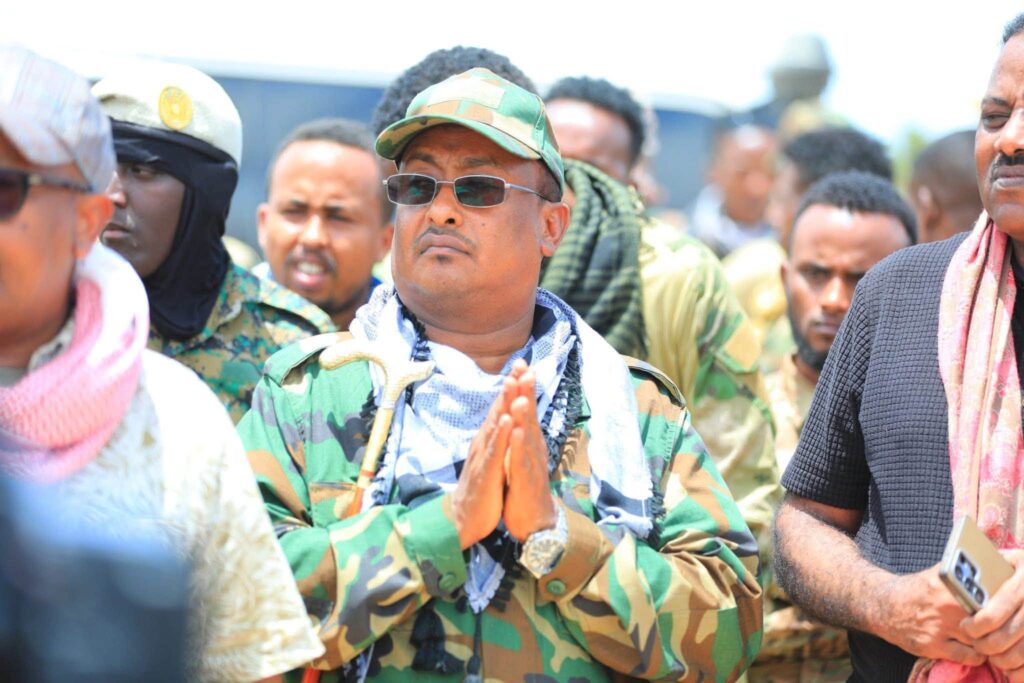


Mogadishu Mayor and Banadir Regional Administration Chairman Hassan Mohamed Hussein Muungaab has recently attracted attention over his growing involvement with government and community forces operating in Somalia’s Middle Shabelle region, amid unverified reports that troops are being assembled in areas under Warsheekh district.
In recent months, Muungaab has made several visits to frontline locations in Middle Shabelle, where units of the Somali National Army (SNA) and local community fighters are engaged in operations against Al-Shabaab.
His visits have been described by officials as efforts to boost troop morale, assess security conditions, and support ongoing military operations.
One of his notable visits was to the Qorilow military camp in Middle Shabelle, where he met senior officers and soldiers and received briefings on the security situation and ongoing operations.
He has also previously visited forces undergoing preparations in areas around Warsheekh district.
These engagements have highlighted Muungaab’s visible interest in security affairs in Middle Shabelle, particularly in areas located near Mogadishu.
Warsheekh, a coastal district along the Indian Ocean, occupies a strategically important position for regional security, commerce, and transportation links between the capital and surrounding areas.
The district and its neighboring communities have been among the areas where Somali government forces and allied local fighters have conducted operations against Al-Shabaab, making military activity there especially significant to the broader security situation.
Local community forces in Middle Shabelle have played a role alongside government troops in anti-Al-Shabaab operations, often leveraging their knowledge of the terrain and local conditions.
Muungaab has repeatedly emphasized the importance of supporting troops deployed on the frontlines.
At the same time, allegations have emerged claiming that Muungaab may be involved in organizing a separate force and that some of the personnel reportedly being gathered around Warsheekh have close ties to his clan.
However, these claims remain unverified, and no official evidence has been presented to confirm that the forces in question are clan-based units under his command.
There is also no independently verified information showing that troops in Warsheekh are being assembled for any future political confrontation.
Reports circulating on social media and in some political circles have not been supported by official documentation or government statements.
Separate claims have suggested that some members of the Banadir Regional Administration’s municipal security units receive training in Mogadishu before being deployed to areas in Middle Shabelle.
However, available information does not confirm that Banadir municipal forces have been permanently transferred to Warsheekh or elsewhere in the region.
Analysts note that it is important to distinguish between nationally recognized security forces operating under state institutions and any unofficial armed groups that may be organized outside the formal chain of command.
Muungaab has long-standing personal and regional ties to Warsheekh and surrounding communities, and he has frequently spoken about local security and development issues.
While these connections may explain his regular presence in the area, they do not, on their own, constitute evidence that he commands a separate armed force.
Meanwhile, the Banadir administration continues to face criticism over public services, infrastructure, land disputes, sanitation, and urban management in Mogadishu.
Residents have called on local authorities to focus more heavily on addressing everyday challenges facing the capital’s growing population.
Questions also persist regarding land ownership disputes, an issue that has generated significant public concern in recent years.
If reports of troop mobilization around Warsheekh are eventually confirmed, key questions will likely center on who is overseeing the forces, under what authority they are operating, and what mission they are being prepared to undertake.
If the personnel are part of official government security structures, authorities would be expected to clarify their command structure and future deployment plans.
If they fall outside state institutions, further explanations regarding their legal status and oversight would be required.
For now, the available information shows that Muungaab has maintained a visible relationship with government and community forces in Middle Shabelle and has conducted multiple visits to military positions in locations including Qorilow and the wider Warsheekh area.
However, claims that he is assembling a separate force remain unconfirmed and have not been substantiated by independent evidence.