

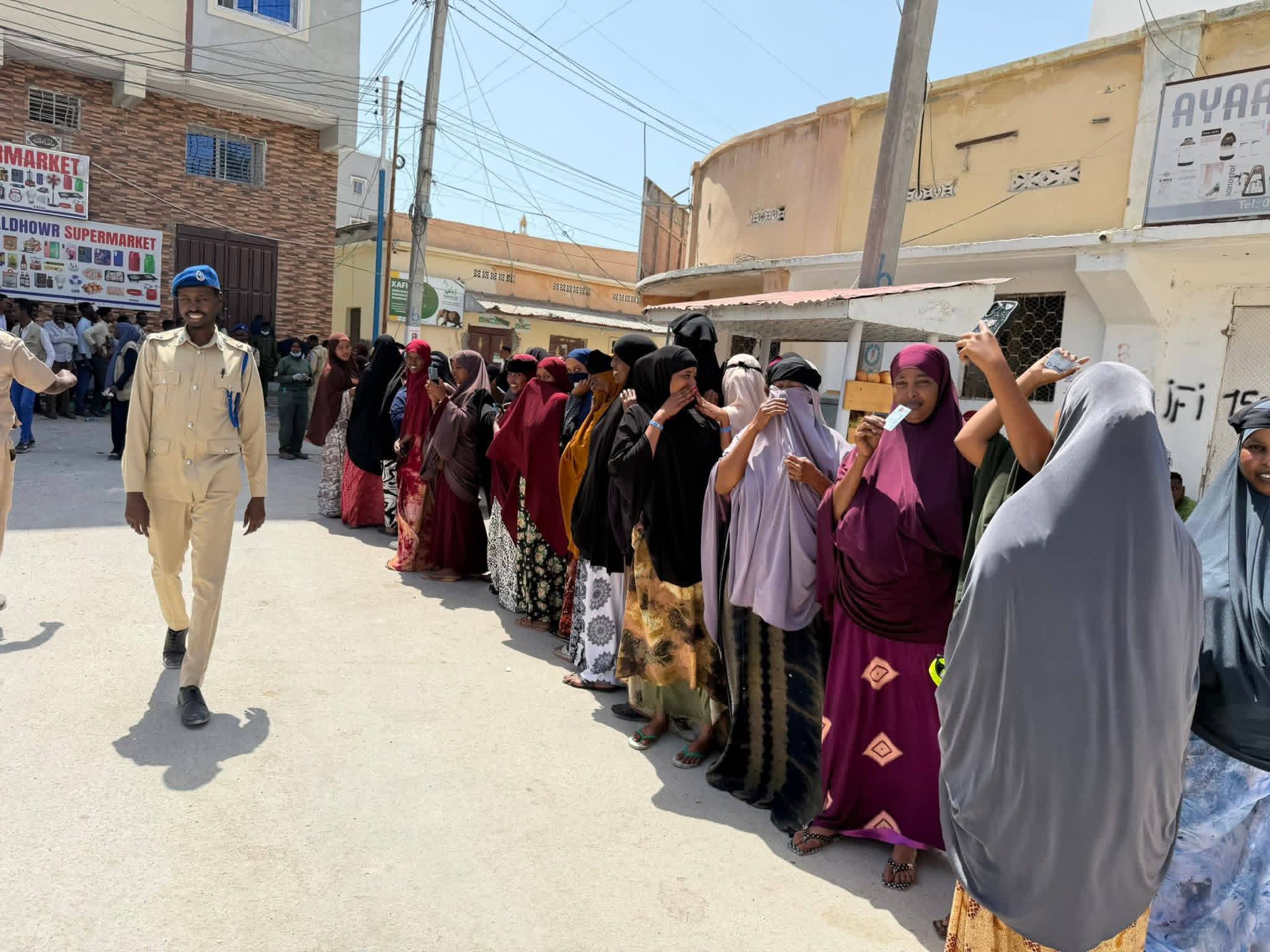
LONDON (Kaab TV) – Today, as announced by the disputed electoral committee, local election were scheduled to take place in 16 districts of Mogadishu, Somalia’s capital.
The disputed body claimed that more than 503,000 people had collected voter registration cards.
But did those registered voters actually turn out? And how was the voting process conducted?
This report is based on data collection, interviews, and direct observation from selected polling stations, including testimonies from journalists who accessed polling sites, others who were denied entry, individuals close to the disputed committee, government employees, and officials based in Mogadishu.
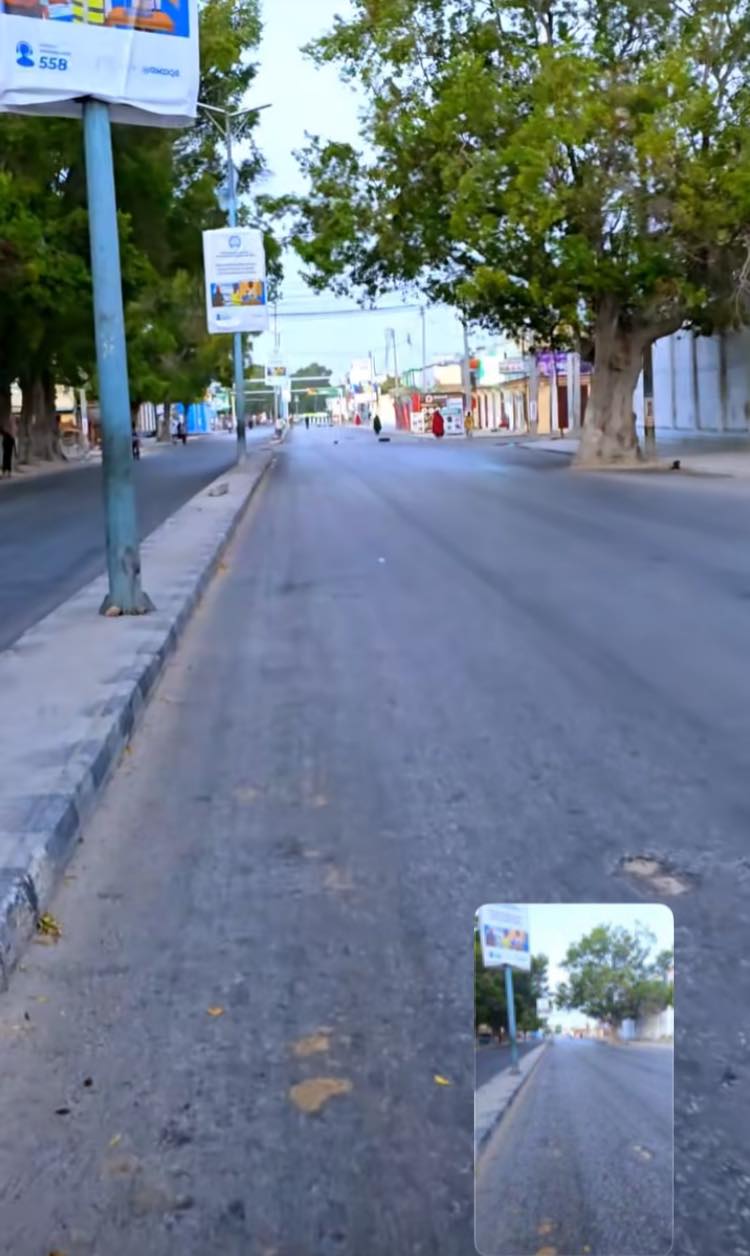
Throughout the day, Mogadishu was placed under a complete lockdown. Civilian movement and private transport were restricted, all businesses and markets were closed, and Aden Adde International Airport was shut down, suspending all domestic and international flights.
The lockdown severely disrupted daily life. Many residents were unable to access basic food supplies, particularly affecting poor and vulnerable communities. The restrictions also paralyzed economic activity, resulting in millions of dollars in losses during the single day exercise.
The shutdown of movement prevented many potential voters from reaching polling stations and effectively blocked independent media from freely covering the vote.
Media Access Denied, Influencers Promoted
Independent journalists were systematically barred from reporting at designated polling stations. Journalists we interviewed said that once they were identified as critical of President Hassan Sheikh Mohamud’s administration, they were denied election media accreditation.
Mogadishu-based journalist Hussein Mohamed wrote on X (formerly Twitter): “People are lining up at a polling station in Hodan district to cast their votes in an election that has been denounced by key opposition leaders. Journalists, including myself, were denied access to polling stations for unclear reasons.”
In the days leading up to the vote, we received multiple reports from local journalists alleging that the disputed electoral body offered bribes to media executives in exchange for positive coverage and to silence or suppress criticism during the election period.
These allegations deepen concerns about media manipulation, lack of transparency, and deliberate exclusion of independent journalism, severely undermining the credibility of the process and the public’s right to impartial information.
Instead of independent reporting, social media platforms were flooded with government-aligned influencers carrying badges labeled “media,” actively promoting the election on TikTok, Facebook, and YouTube.
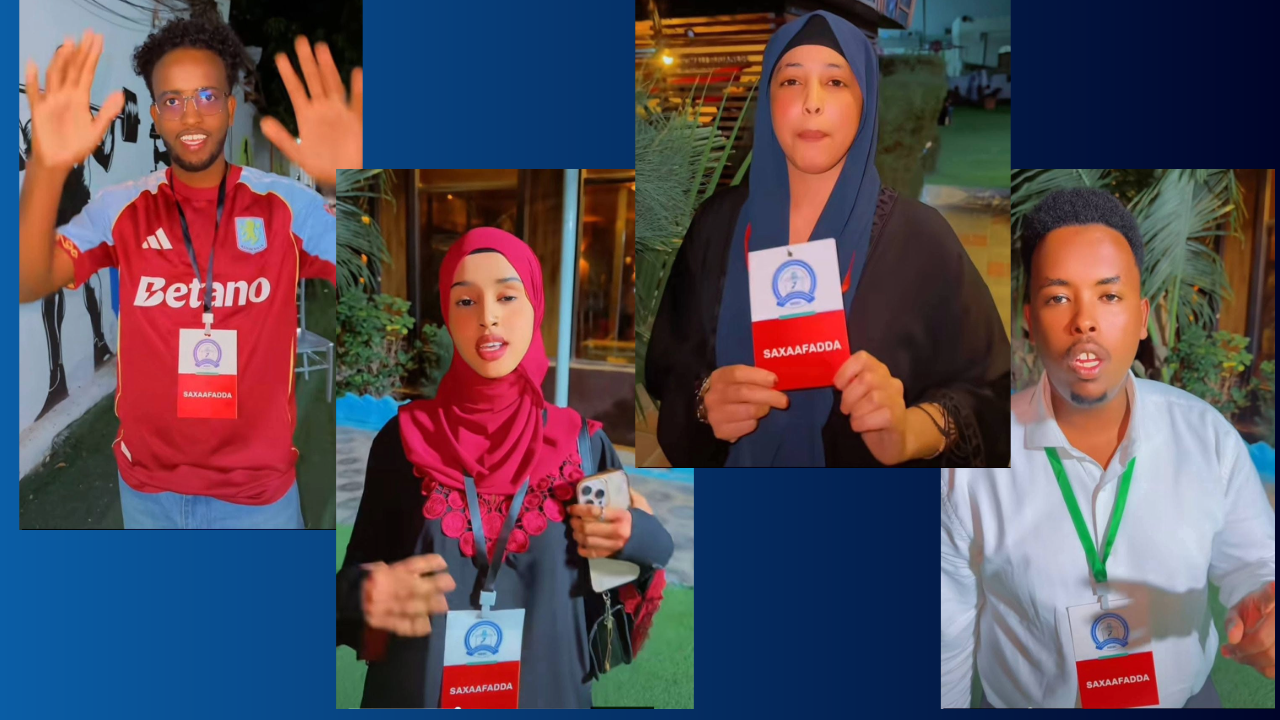
This practice weakens the role of professional journalism and media oversight—assuming the election was genuinely inclusive—and deprives the public of diverse and critical perspectives. The impact of state-sponsored influencers replacing independent media as information gatekeepers is now clearly evident.
A Widely Contested Process
This election is widely recognized as disputed. Opposition groups, along with the Puntland and Jubaland regional administrations, issued a statement from Kismayo on 20 December, declaring that any unilateral or incomplete election would not be recognized.
The Somali Future Council alliance announced that on 20 January 2026, it would begin preparations for an alternative electoral process to select members of the 2026 Parliament, directly contradicting the election conducted today in Mogadishu under President Hassan Sheikh Mohamud.
Although elections were planned in 16 districts, turnout was extremely low in most designated polling stations, with participation largely limited to district headquarters.
Districts including Shangani, Shibis, Karaan, Wadajir, Hawlwadaag, Wardhiigley, Dharkeenley, and Dayniile recorded voting at only a handful of locations.
The Hassan Sheikh administration, which strongly pushed for the vote, compelled government employees to participate. Staff from the Banadir Regional Administration, as well as officers from the National Intelligence and Security Agency (NISA) and the police, were seen lining up while presenting themselves as ordinary civilian voters.
Reported figures include:
- Shangani District: 120 voters; the polling station closed around 2:00 p.m. local time.
- Dayniile District: No voters at the Gurmadac center. At Al-Amal School, Ilays, Barwaaqo, Al-Marwaas, Daaru Salaam, and Daaru Xikma combined, only 24 people voted.
- Wadajir District: Approximately 100 voters.
- Shibis District: 54 voters, including 12 members of the Yemeni community and 42 district administration staff.
- The National Theatre: Recorded the highest turnout, largely due to its location near the presidential palace. It was frequented by government employees, intelligence officers, and police. The government used images from this site to inflate overall turnout figures.
Legal and Political Contradictions
Prime Minister Hamza Abdi Barre stated that he did not vote because he is from Kismayo, and Mogadishu is not his electoral constituency.
However, Deputy Prime Minister Salah Jama, originally from Hargeisa, and Interior Minister Ali Yusuf Hoosh, from Garowe, were both seen voting in Mogadishu.
This raises serious legal questions: If the Prime Minister declined to vote on constituency grounds, how does election law permit his ministers to do so?
Election law also requires that local government elections be prepared at least three months in advance. In this case, the entire process was organized in less than two weeks, in clear violation of legal provisions.
There was no election campaign and no open competition. The opposition rejected the process outright.
Although the disputed committee claimed that 20 political organizations participated, political analysts argue that 19 of them have no identifiable public figures, electoral base, or track record, and are effectively aligned with the ruling Justice and Solidarity Party (JSP).
Notably, all Mogadishu district commissioners are government appointees, yet the same individuals are contesting their own positions. No credible alternative candidates emerged, meaning that even if voting occurred, no meaningful change was possible. Furthermore, the Mayor of Mogadishu is not subject to election at this time.
The disputed electoral committee has not provided answers to the media questions regarding these issues.
Forced Voting and Public Distrust
Interviews conducted for this report—including with individuals who voted—indicate deep public skepticism. Many respondents do not believe a credible election took place and express little hope that a legitimate election can occur under current conditions, citing systematic legal violations and entrenched abuse of power.
A small number of media outlets that managed to report from outside polling stations documented cases of elderly people being forcibly brought to vote. One elderly man from Xamar Weyne said:
“I was on my way to the fish market in Xamar Weyne when I was forced at gunpoint. I have been sitting here since yesterday morning. I haven’t even been given a cup of tea. I don’t know what I’m voting for, because there was no choice given to me.”
Additionally, secretly obtained footage shows groups of internally displaced people being rounded up onto buses and threatened into compliance. The bus driver was heard saying, “This bus was hired by the government,” widely understood as a reference to the ruling Justice and Solidarity Party (JSP).
Today’s events in Mogadishu do more than deepen political divisions. They further erode public trust in elections and reinforce the perception that electoral processes are acts of deception rather than democratic choice.
Mogadishu citizens witnessed an election conducted without a campaign, without consensus, under lockdown, and carried out unilaterally by a single political group that already knew the outcome—leaving little doubt, in their view, about the credibility of the process.