


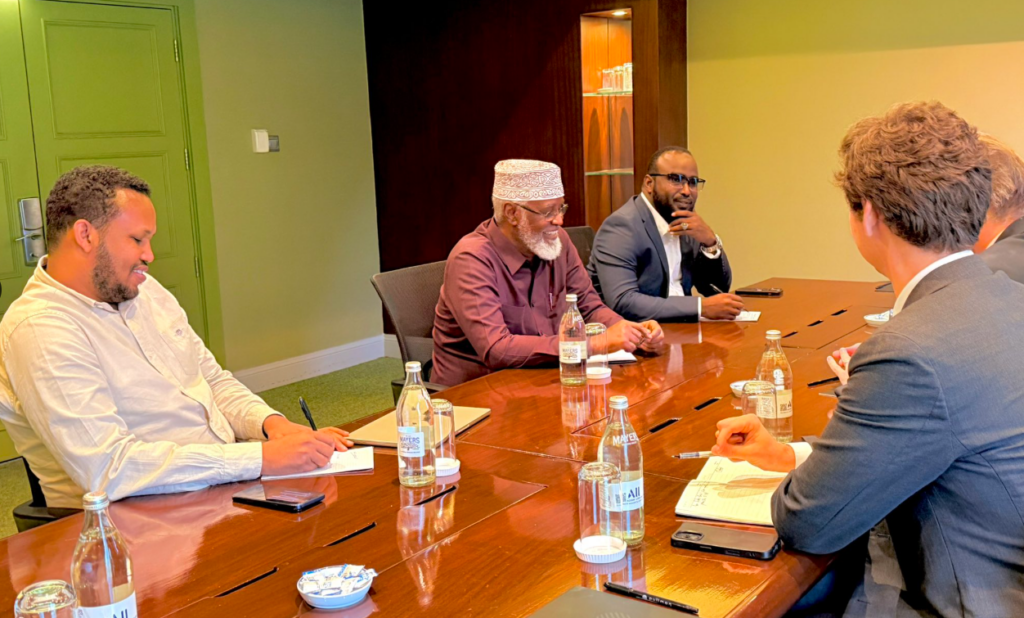


Jubbaland President Ahmed Mohamed Islam held talks with France’s Ambassador to Somalia and Kenya, Arnaud Suquet, focusing on security, counterterrorism, the humanitarian situation and efforts to strengthen stability in Jubbaland.
The meeting comes as Jubbaland remains one of the key areas in Somalia’s campaign against Al-Shabaab.
Large parts of southern Somalia continue to face an insurgency by the militant group, while Jubbaland forces and Somali federal troops have been involved in military operations aimed at pushing Al-Shabaab out of areas under its control.
The region’s strategic location along Somalia’s southern border with Kenya also makes security cooperation particularly important for both Somalia and its international partners.
According to the Jubbaland administration, the discussions with the French envoy covered ways to strengthen security cooperation and accelerate counterterrorism efforts.
The two sides also discussed the provision of basic public services, humanitarian assistance and the need for greater international support for stabilization and development.
President Ahmed Madobe was accompanied by Jubbaland Minister of Planning, Investment and International Cooperation Abdirahman Abdi Ahmed.
The meeting was held against a wider backdrop of concerns over the future of international security assistance to Somalia, particularly the financial difficulties facing the African Union Support and Stabilisation Mission in Somalia (AUSSOM).
The discussions come at a particularly sensitive time for Somalia’s security sector.
AUSSOM, which replaced the former African Union Transition Mission in Somalia (ATMIS) in January 2025, remains heavily dependent on international financial and logistical assistance to sustain its operations.
The mission has nearly 12,000 personnel and provides support to Somali security forces in the fight against Al-Shabaab.
The funding situation became more uncertain in July after the United States informed the African Union that it would no longer support the UN Support Office in Somalia (UNSOS) beyond the end of 2026.
UNSOS provides critical logistical assistance to AUSSOM, including food, fuel, medical services and transportation.
Washington said it would not oppose renewing AUSSOM itself but would oppose continued UN logistical and operational support after this year.
The decision has raised concerns within the African Union about the mission’s ability to remain operational without an alternative financing mechanism.
The AU Commission has called for stronger support for AUSSOM and urged the acceleration of alternative financing mechanisms, including greater contributions from member states and the operationalization of the AU Peace Fund.
The European Union has also continued supporting AUSSOM.
In April, the EU approved an additional €75 million through the European Peace Facility, with the funding intended largely to support troop allowances, non-lethal equipment and related services.
For Jubbaland, the funding crisis could have particularly important consequences because the region remains a major front in the fight against Al-Shabaab.
Any reduction in international logistical or military support could place greater pressure on Somali federal and Jubbaland forces to maintain operations, supply troops and hold territory recovered from the militant group.
The meeting between President Ahmed Madobe and Ambassador Suquet therefore comes at a time when Jubbaland is seeking continued international engagement while confronting both security and political challenges.
International assistance has traditionally played an important role in strengthening Somali security institutions, providing training and supporting operations against Al-Shabaab.
Jubbaland’s forces have been involved in military campaigns against Al-Shabaab in southern Somalia, including operations around strategically important areas of the Lower Juba region.
The continued presence of Al-Shabaab in parts of the region means that any disruption to security assistance could affect the pace of military operations and efforts to stabilize newly recovered areas.
The funding crisis also comes amid broader debates over Somalia’s ability to gradually assume full responsibility for its own security.
The African Union has emphasized the need for a sustainable transition in which Somali forces increasingly take over security responsibilities, while international partners continue providing support during the transition.
Beyond military operations, the reduction of international security support could have wider humanitarian consequences.
Areas affected by conflict often require security before humanitarian organizations can safely operate, while local administrations need resources to restore schools, health facilities, roads and other basic services after territory changes hands.
Against this backdrop, the meeting with the French ambassador provided an opportunity for Jubbaland to emphasize the need for continued international engagement in both security and development.
France, as one of Somalia’s international partners, is also part of the broader European effort to support stabilization and counterterrorism efforts in the country.
The talks therefore come at a critical moment for Jubbaland.
While the immediate focus remains on countering Al-Shabaab and strengthening regional security, the future of international funding for AUSSOM could significantly influence Somalia’s ability to sustain military operations and transfer greater responsibility to its own security forces.
For Jubbaland, maintaining international partnerships while strengthening its own security institutions will be particularly important as the region seeks to prevent Al-Shabaab from regaining territory and to translate military gains into longer-term stability and development.


