


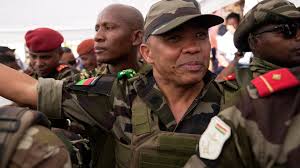


Antananarivo (KAAB TV) – Colonel Michael Randrianirina, who led Madagascar’s recent coup, announced he will soon be sworn in as president, prompting the African Union to suspend the country over the unconstitutional power shift.
Power shift in Antananarivo
On Tuesday, an elite military unit known as CAPSAT seized control of the presidential palace and state institutions, following a parliamentary vote to impeach President Andry Rajoelina. Rajoelina, who earlier accused the military of attempting a coup, subsequently fled the country.
Soon after the takeover, Madagascar’s High Constitutional Court invited Randrianirina to assume the presidency in an interim capacity.
In a statement released via state television, the military announced that Randrianirina “will be sworn in as President of the Refoundation of the Republic of Madagascar” during a solemn session held by the court on 17 October.
The term refoundation suggests the new regime intends to overhaul Madagascar’s constitutional and institutional framework.
In public remarks, Randrianirina defended the seizure of power as an urgent intervention to prevent national collapse, saying, “We took responsibility yesterday.”
He also pledged a transitional period of 18 to 24 months, during which elections would be organized and institutions restructured under a military‑led oversight committee.
To consolidate control, the military regime has suspended multiple national institutions, including the Senate, the High Constitutional Court, the national electoral commission, and certain judicial bodies. The National Assembly is the only major institution allowed to continue operating.
African Union response and regional implications
The African Union (AU) reacted swiftly to the developments. At a meeting of its Peace and Security Council, the AU Commission suspended Madagascar “with immediate effect” in response to what it deemed an unconstitutional change of government.
Commission Chairperson Mahmoud Ali Youssouf emphasized that “the rule of law must prevail over the rule of force.”
The suspension bars Madagascar’s new leadership from participation in AU summits and denies it legitimacy in continental affairs.
International reactions have ranged from caution to condemnation. The United Nations said it is “deeply concerned” about the coup.
France called for the immediate reinstatement of democratic norms, warning against the suppression of fundamental freedoms.
Russia, while describing the matter as internal, urged restraint and a peaceful resolution.
Madagascar’s suspension adds it to a growing list of African nations temporarily expelled from continental bodies after coups in recent years, including Mali, Burkina Faso, Niger, Gabon, and Guinea.
Uncertain future, clamoring voices
Analysts warn that while the new regime pledges a return to civilian rule, military-led transitions in Africa often overstay their professed timelines.
The success of Randrianirina’s promises will depend heavily on how power is shared, how institutions are rebuilt, and whether genuine elections are held.
Public sentiment—particularly among the youth who have driven widespread protests—remains ambivalent. Some see the coup as a last resort to end chronic corruption, poor governance, and infrastructure failures.
Others fear that new authoritarian structures may simply replace old ones under a different banner.
As Madagascar prepares for Randrianirina’s inauguration, the path ahead is fraught with risks: internal resistance, international isolation, legitimacy challenges, and tensions over the balance of military versus civilian power. The next weeks and months will be critical in determining whether the “refoundation” is rhetorical or real.