


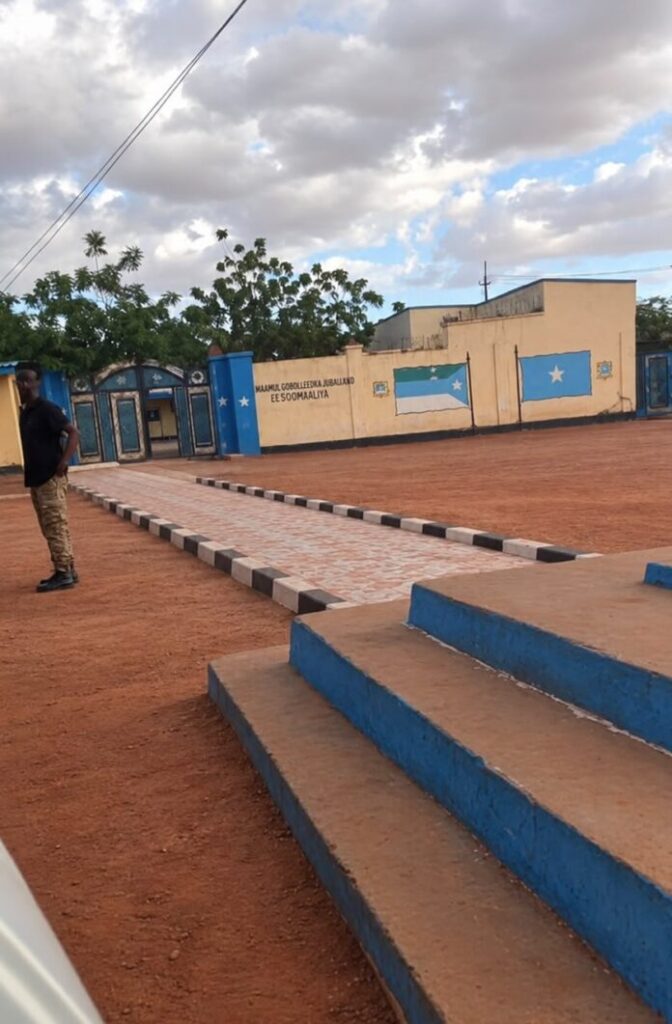


Jubaland administration forces have reportedly taken control of Federal Government facilities in the town of Beled-Hawo, Gedo region, following the defection of local Federal Intelligence and Security forces stationed in the city to Jubaland.
This development is poised to alter the administrative and security landscape of Beled-Hawo, a key municipality in the Gedo region that has experienced prolonged political disputes concerning governance structures and federal military presence.
Field dispatches indicate that the realignment of federal intelligence personnel facilitated Jubaland forces in assuming operational control over critical federal installations in the city, including the local Immigration and Citizenship Agency headquarters.
Jubaland forces directly took charge of federal institutions across Beled-Hawo after resident NISA intelligence units switched their allegiance.
The Immigration and Citizenship Agency facility is highlighted among the key installations secured by Jubaland personnel.
This facility is central to civil processing, cross-border transit logistics, and identity documentation; thus, the administrative shift stands to impact the routine delivery of public services.
The takeover of these state installations carries major security and governance implications, signaling a decisive shift in operational authority over local governmental bodies in the city.
The primary catalyst underlying this structural shift remains the defection of the federal NISA forces stationed in Beled-Hawo to the Jubaland state administration.
According to reported intelligence, this alignment enabled Jubaland forces to secure the federal installations without any reported armed clashes surrounding the transfer of those facilities.
This development followed diplomatic and reconciliation efforts reportedly spearheaded by the Jubaland State administration, aimed at restoring governance, public security, and institutional order across the town of Beled-Hawo.
These peaceful negotiation tracks remain critical for de-escalating local friction, particularly across sectors characterized by political divides and administrative power struggles.
Beled-Hawo occupies a strategic geographic position in the Gedo region—a territory vital to both the Jubaland State administration and the Federal Government of Somalia.
Consequently, any operational shift in force presence or institutional authority carries far-reaching political and security ramifications.
Beled-Hawo is a pivotal urban hub within Gedo, serving as a key center for regional administration, security coordination, cross-border transit, and international commerce.
Stability in the town is essential for local communities, commercial traders, and public sector institutions responsible for delivering social services.
Any shift in operational control over state installations inevitably impacts administrative continuity and inter-agency coordination.
Given its positioning along the tri-border zone, the town serves as a key transit artery for civilian movement and commercial freight, making sustained security stability imperative for local livelihoods and cross-border trade.
It is therefore critical that any administrative transition governing state installations be executed smoothly to prevent service disruptions or civilian hardship.
Jubaland’s assumption of control over federal facilities in Beled-Hawo could usher in a broader administrative realignment across local public institutions, particularly pending formal announcements regarding the future operational structure.
It is critical to clarify which authority will hold ultimate responsibility for the seized installations, how administrative personnel will be managed, and whether public service delivery will proceed uninterrupted.
On the security front, maintaining urban stability and avoiding actions that could incite kinetic clashes or renewed tensions remain top priorities.
The residents of Beled-Hawo require a secure environment and uninterrupted public institutional services.
Furthermore, relevant stakeholders must provide official dispatches regarding the status of the town and outlining planned subsequent actions.
Given that the affected installations include facilities operated by the Federal Government, Villa Somalia’s response and official details regarding this shift will prove vital to understanding the emerging strategic reality.