

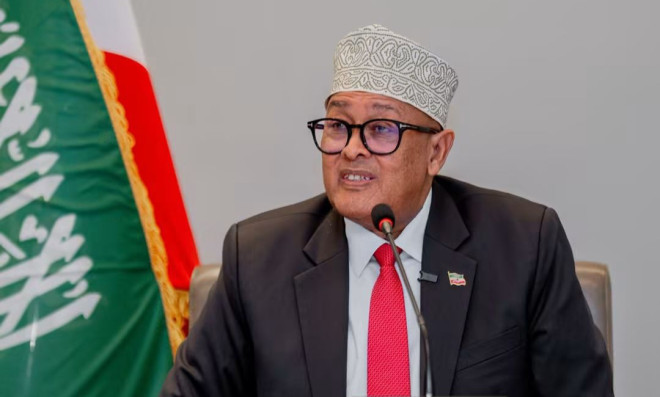

Somaliland President Abdirahman Mohamed Abdullahi Irro used a speech at the Hudson Institute in Washington, D.C., to promote Somaliland’s case for international recognition, criticize Somalia’s federal government, and present Somaliland as a potential contributor to security and stability in the Horn of Africa.
Addressing policymakers and analysts at the U.S.-based think tank, Irro focused on the long-running dispute between Hargeisa and Mogadishu over Somaliland’s political status.
He argued that Somalia’s federal government lacks effective authority beyond Mogadishu and accused it of contributing to instability across the region.
“The Somali government lacks the legitimacy and capacity to govern beyond Mogadishu and has become a source of instability in the Horn of Africa,” Irro said during the event.
The Somaliland leader also accused Mogadishu of using its internationally recognized status to block Somaliland’s efforts to secure diplomatic recognition.
His remarks come amid renewed diplomatic outreach by Somaliland, which has intensified efforts to engage policymakers in Washington and other international capitals.
Somaliland declared independence from Somalia in 1991 following the collapse of the Somali central government. Since then, it has built its own governing institutions, security forces, and electoral system.
However, no country has formally recognized Somaliland as an independent state, and the Federal Government of Somalia continues to regard the territory as an integral part of the Somali Republic.
Irro reiterated a long-standing Somaliland argument that its claim to statehood is based on the restoration of borders that existed before its 1960 union with Somalia rather than the creation of new borders.
“Somaliland does not seek to alter colonial borders; it seeks to restore the borders it possessed before the union,” he said.
The president highlighted Somaliland’s record of holding elections and conducting peaceful transfers of power, presenting those achievements as evidence of political stability and institutional development over more than three decades of self-rule.
He also pointed to Somaliland’s internal security record, arguing that the territory has maintained relative stability and avoided major terrorist attacks for many years.
A significant portion of the speech focused on regional security.
Irro emphasized Somaliland’s strategic location along the Gulf of Aden and near one of the world’s busiest maritime corridors, arguing that Somaliland could serve as a reliable partner in safeguarding trade routes and strengthening security in the Horn of Africa.
The speech underscored three key themes central to Somaliland’s diplomatic campaign: its pursuit of international recognition, criticism of Somalia’s federal government, and its claim that Somaliland can play a larger role in regional security and stability.
The status of Somaliland remains one of the most contentious political issues in the Horn of Africa.
While Somaliland continues to seek international recognition, Somalia maintains that preserving the country’s sovereignty and territorial integrity requires Somaliland to remain part of the Somali state.
Irro’s appearance in Washington brought that debate back into the spotlight, as Somaliland continues to lobby international policymakers and institutions for greater support for its statehood aspirations.
The speech reflects Hargeisa’s ongoing effort to strengthen its diplomatic presence abroad and shape international discussions about the future of Somalia, Somaliland, and the wider Horn of Africa.