

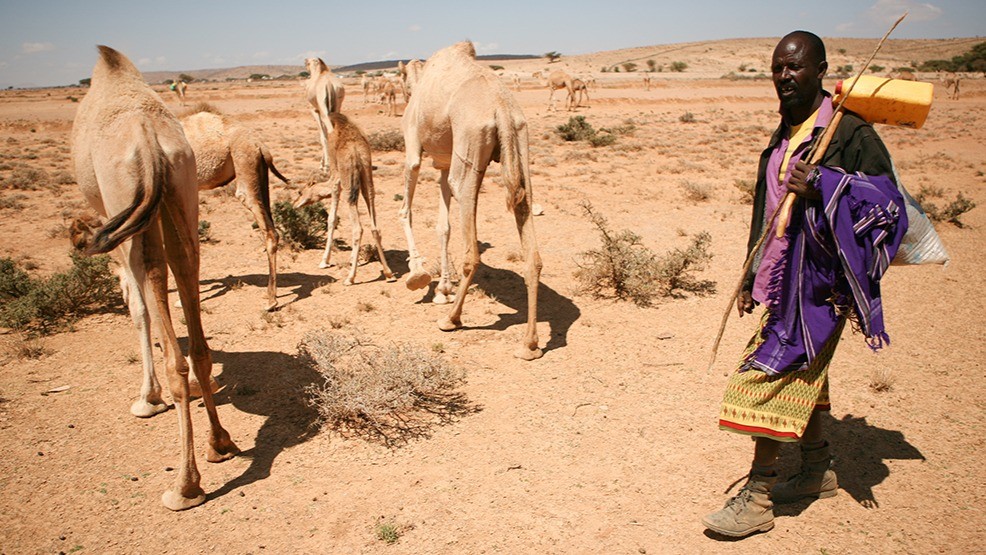

Mogadishu, Somalia — The old rhythms no longer hold.
For generations, pastoralists across the Horn of Africa could read the sky with remarkable precision. They knew when the rains would arrive, when grasslands would recover and when it was time to move.
Mobility was not disorder. It was a sophisticated survival system, refined over centuries in one of the world’s most unforgiving environments.
Today, those rhythms are breaking down.
Across Somalia, Ethiopia, Kenya and parts of Djibouti, communities that once adapted to climatic uncertainty are confronting something fundamentally different: not a single drought, not a single flood, but a persistent state of environmental disruption in which recovery periods are becoming shorter, shocks more frequent and livelihoods increasingly fragile.
The Horn of Africa has always lived at the mercy of climatic extremes. Drought and flood are woven into its history.
What is unprecedented is the speed with which these shocks now arrive, their growing intensity and the inability of societies to recover before the next crisis begins.
Multiple compounding weather extremes have triggered a massive regional crisis of climate-induced displacement, decimating livestock and stripping communities of their primary means of economic independence.
Environmental emergencies that once appeared as episodic disasters have become permanent features of political life.
Recent studies show that deeply entrenched power dynamics and institutional failures frequently override technical gains, as state interventions often restrict traditional pastoralist mobility rather than protecting it.
Climate change, in other words, is no longer simply an environmental story. It is a story about governance.
The Collapse of Old Rhythms
As governments prepare for another uncertain June-to-September season, meteorological agencies have warned of below-average rainfall across significant parts of the Greater Horn. Such forecasts once concerned farmers, pastoralists and aid organizations.
Today they provoke anxiety in presidential palaces, finance ministries and military headquarters.
Because another failed rainy season no longer means only smaller harvests. It means fresh waves of displacement into already crowded urban centers. It means new competition over shrinking water sources and grazing corridors. It means another test of whether governments can persuade citizens that the state remains capable of protecting them.
The scale of the challenge is staggering.
According to assessments by the Food Security Information Network and the Global Network Against Food Crises, more than 96 million people across crisis-affected regions face acute food insecurity.
That figure is not merely humanitarian. It is political.
It represents millions of citizens measuring the promises of the state against the realities of survival.
Across East Africa, temperatures have risen significantly above historical averages. Rainfall patterns have become increasingly erratic. Longer dry periods exhaust crops and livestock before sudden cloudbursts unleash destructive floods that wash away homes, roads and fertile topsoil.
Even years of “normal” rainfall can conceal disaster. The problem is no longer simply how much rain falls. It is when it falls, where it falls and whether communities have the resilience to absorb its consequences.
The result is not a cycle of disaster and recovery.
It is a cycle of attrition. The traditional distinction between drought and flood has itself begun to collapse. Communities increasingly experience both. Often within the same year.
Scientists describe these events as compound climate extremes. Citizens experience them more simply.
First the rains fail. Then they destroy. Few groups understand this transformation more intimately than pastoralists.
For centuries, mobility functioned as a form of insurance. Families moved livestock across vast territories according to negotiated social arrangements that distributed risk and protected communities during difficult seasons. Flexibility was resilience.
But shrinking pasturelands, declining vegetation cover and accelerating desertification have steadily eroded those traditional systems.
The devastating drought that gripped much of the Horn between 2020 and 2022 exposed just how fragile they had become.
Entire herds vanished.
For pastoral households, livestock are not merely economic assets. They are savings accounts, social status, marriage prospects, inheritance and future security combined into one.
When herds disappear, livelihoods disappear with them. And when livelihoods disappear repeatedly, people stop migrating seasonally. They relocate permanently.
The Horn’s cities have become repositories for environmental distress.
When Environmental Stress Becomes Political
Mogadishu. Baidoa. Addis Ababa. Nairobi, are increasingly absorbing populations displaced not by a single catastrophe but by the cumulative collapse of rural livelihoods.
Urban growth has accelerated faster than infrastructure can keep pace. Water systems strain under rising demand. Schools become overcrowded. Health services weaken.
Informal settlements spread outward faster than roads, drainage systems or municipal authorities can reach them.
These neighborhoods are not devoid of governance. But governance there is often improvised. Clan elders mediate disputes. Religious leaders coordinate assistance. Community committees organize security.
In some areas particularly in Somalia, non-state actors provide services and protection that governments struggle to deliver.
The state’s retreat is rarely dramatic. More often, it is administrative. It becomes visible through quiet substitution. People increasingly rely on alternative structures not because they reject the state, but because those structures function when formal institutions do not.
That reality points toward the deeper challenge confronting governments across the region.
The crisis is not simply environmental. It is one of legitimacy. Political authority ultimately depends upon practical performance.
Citizens may disagree with governments, criticize leaders or contest policies. But states derive legitimacy from their ability to provide a minimum level of security, predictability and economic opportunity.
Climate shocks undermine all three.
Repeated crop failures weaken economic confidence. Competition over resources strains social cohesion. Displacement complicates service delivery and political representation. Every failed response widens the gap between state promises and lived reality.
Research increasingly suggests that climate change alone does not determine political outcomes. Countries with stronger institutions, more responsive governance systems and sustained investment in agriculture and infrastructure tend to absorb environmental shocks more effectively.
The Future of Power in a Warming Horn
The implication is straightforward.
Climate change does not automatically produce instability. Poor governance does.
A farmer whose harvest fails repeatedly begins asking what citizenship guarantees. A pastoralist denied access to water through formal mechanisms turns toward kinship networks instead. Communities under pressure narrow their circles of trust.
Local loyalties become more important than national institutions. The social contract frays from the margins inward. For decades, humanitarian assistance helped cushion these pressures.
Aid evolved beyond emergency relief. In many fragile states, such as Somalia – it effectively became an external subsidy for governance systems unable to meet rising demands.
Food distributions prevented famine. Cash-transfer programs sustained vulnerable households.
Donor financing filled gaps that governments could not. That model is now under strain.
Global crises have multiplied. International aid budgets face increasing pressure. Donor fatigue has become increasingly visible.
Meanwhile, climate disruption has ceased to be temporary.
Safety-net systems designed for occasional emergencies are confronting populations living through continuous uncertainty.
With millions of people facing structural, protracted crises globally, hyper-prioritization has forced a restrictive retreat toward only the narrowest definitions of “life-saving” aid, leaving millions exposed to continuous instability
The gap between need and capacity continues to widen. As formal support weakens, alternative economies emerge. Charcoal production expands across increasingly fragile landscapes.
Control over productive wells acquires strategic value, experts say. Scarcity becomes monetized. Environmental stress becomes revenue. Water itself becomes power.
Yet much of the region’s security architecture remains organized around traditional threats.
Counterterrorism in a Warming World
Counterterrorism continues to dominate policy discussions, security budgets and diplomatic engagement.
Those concerns remain important. But the emerging threat landscape is broader. The frameworks designed to govern war were never built to govern environmental collapse.
Military operations can disrupt insurgent networks. They cannot restore rainfall. They cannot regenerate pasturelands. They cannot rebuild trust when citizens conclude that institutions are unable to shield them from preventable suffering.
The Horn of Africa is therefore not experiencing an endless succession of unrelated emergencies. It is entering a new political era.
From the devastating floods of 2019 that contributed to locust infestations, to the record-breaking drought between 2020 and 2022, to the El Niño floods that followed, and now renewed warnings of rainfall deficits, each crisis has layered upon the last.
The cumulative effect is transforming the relationship between citizens and the state. Disaster has ceased to be exceptional. It has become structural.
The central question confronting governments across the Horn is no longer how to survive the next climate emergency.
It is whether they can govern societies increasingly shaped by the certainty that another one is always approaching.
In the Horn of Africa, the climate crisis is becoming a crisis of political authority itself.
And in the decades ahead, the legitimacy of governments may depend less on the wars they wage than on whether they can help their citizens endure the weather.
Abdi Guled is a Horn of Africa analyst and journalist focusing on political risk, armed groups and geostrategic competition in the region.