

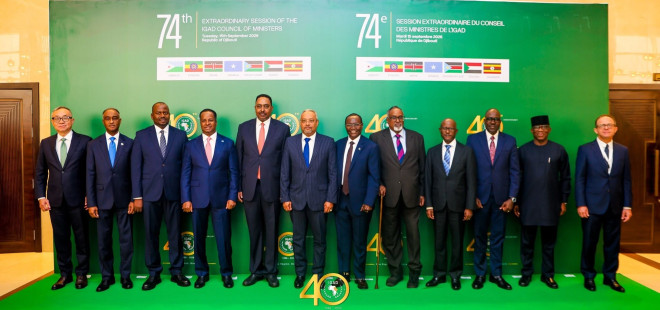

The Intergovernmental Authority on Development (IGAD) has called on Somalia’s political stakeholders to strengthen dialogue and build consensus on the country’s electoral process, stressing the need for an inclusive approach to reduce political tensions and ensure broad participation in future elections.
The appeal was issued following the 74th Extraordinary Session of the IGAD Council of Ministers, held in Djibouti on September 15, 2026.
The meeting brought together representatives from member states, including Somalia’s Minister of Foreign Affairs and International Cooperation, Abdisalam Abdi Ali.
In its final communiqué, IGAD reaffirmed its support for Somalia’s ongoing democratization efforts and welcomed initiatives aimed at expanding political participation and strengthening the country’s electoral system.
The regional bloc emphasized that Somalia’s political transition and electoral process should be guided by consultation, inclusivity, and consensus among all relevant stakeholders.
The statement comes at a time when Somalia remains divided over the path toward future elections.
The Federal Government has been pushing for a transition to a one-person, one-vote electoral system, while some regional administrations and opposition figures have expressed differing views regarding the electoral framework, timeline, and the political agreements needed to implement reforms.
These differences have fueled political debate in recent months, prompting repeated calls from domestic and international actors for broader dialogue between the federal government, federal member states, and opposition groups.
IGAD’s latest intervention underscores the regional organization’s view that political disputes should be resolved through negotiation and consensus-building rather than confrontation.
The Council of Ministers also reaffirmed IGAD’s longstanding support for Somalia’s sovereignty, unity, territorial integrity, and political independence.
The organization said these principles remain central to efforts aimed at promoting peace, stability, and state-building in the country and the wider Horn of Africa.
On security, IGAD reiterated its support for Somalia’s fight against terrorism and commended the efforts of Somali security forces and countries contributing to the African Union Support and Stabilization Mission in Somalia (AUSSOM).
The bloc called on the United Nations Security Council and international partners to ensure that AUSSOM receives adequate, predictable, and sustainable funding to carry out its mandate effectively.
According to the communiqué, long-term financial support for AUSSOM is essential to maintaining security gains and assisting Somalia’s efforts to gradually strengthen its own security institutions and assume greater responsibility for national security.
IGAD described Somalia as a country of strategic importance to the stability of the Horn of Africa, noting that developments in Somalia have direct implications for the security of neighboring states.
The organization also expressed concern over security challenges in the Red Sea and Gulf of Aden, particularly threats to commercial shipping and critical maritime trade routes.
The statement stressed that the safety and freedom of navigation in the Red Sea and Gulf of Aden are vital to regional peace, security, and economic development.
While IGAD did not prescribe a specific electoral model for Somalia, it strongly encouraged all political actors to pursue an inclusive dialogue process capable of producing a broadly accepted political agreement.
The organization argued that consensus-based solutions offer the best chance of reducing tensions and ensuring a credible electoral transition.
The regional bloc has played a significant role in Somalia’s political and peace processes over the years, and its latest appeal highlights continued regional concern over the country’s political trajectory.
As debates over electoral reforms and governance continue, IGAD’s message from Djibouti was clear: sustainable progress will require dialogue, compromise, and broad political agreement among Somalia’s competing stakeholders.