

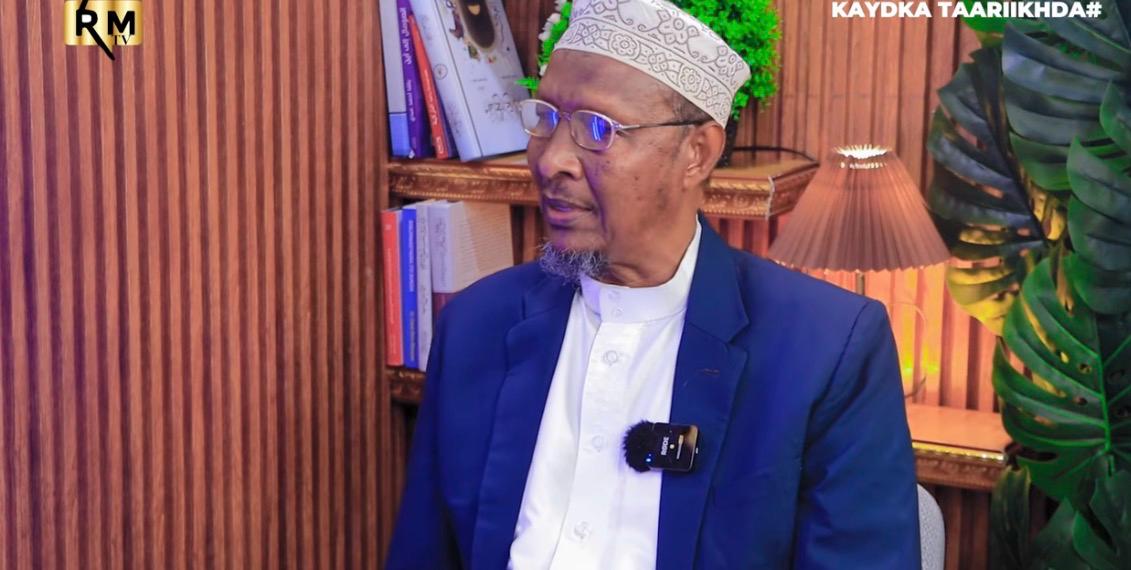
Mogadishu (Kaab TV) – Sheikh Abdiwaahid Haashi gave a multi-part interview to the RM Somali YouTube channel. This article focuses specifically on the first and second parts of that interview.
The Sheikh spoke about his early life, explaining that he was born in 1954 in a rural area south of Laasaanood. In 1963, he was brought to Mogadishu, where his brother was living. He completed his primary, intermediate, and secondary education in Mogadishu. One of the schools he attended before secondary school was Ma’allin Jaam’a School.
Sheikh Abdiwahid stated that Ma’llin Jam’a Bilal had served as secretary to King Osman. This account differs significantly from information previously shared by Abdullahi Abdirahman Adan (Enlay) in an interview given to the same channel nearly two years earlier. Enlay, a writer and diplomat, said that in the 1940s he attended a school where Ma’llin Jam’a was a teacher. According to Enlay, several graduates of that school later held prominent positions in Somalia, including Huseen Nur Cilmi, who in 1972 served as Somalia’s representative to the United Nations.
Enlay also added that the Somali Youth League (SYL) had brought Ma’lin Jaama’ Bilal from the city of Aden in the early 1940s. At the time, Aden was known as the “Crown Colony.”
Sheikh Abdiwaahid also mentioned the clan affiliation of Ma’llin Jam’a. However, when commemorating Teachers’ Day on November 21, Ma’llin Jam’a is widely referred to as the “Father of Somali Education.” As such, there is no need to attribute him to a particular clan.
On another note, the Sheikh described European colonial powers as “Crusaders.” Historically, the Crusaders were medieval European Christian forces who fought Muslims in the region now known as the Levant and in other territories more than 600 years ago. The term “colonialism” has a broader meaning and corresponds to the Arabic word isti‘maar (occupation or settlement).
The Sheikh further stated that colonial expansion intensified after the collapse of the “Islamic Caliphate” in 1922. In Somali secondary school history textbooks used before 1991, the term “Ottoman Empire” was commonly used, while Western history books refer to it as “The Ottoman Empire.”
In Saudi Arabia, however, school curricula often present the Ottoman Empire as a power that imposed control over Arab lands by force, reflecting the country’s emphasis on nationalism. Each government tends to interpret historical events according to its own perspective.
For example, the Revolutionary Government in Somalia referred to the administration it overthrew as “the corrupt government,” whereas much of the rest of the world called it “the civilian government.”
It would have been preferable for Sheikh Abdiwahid to clarify that much of the information he shared—especially regarding other individuals—was based largely on personal memory and secondhand accounts.
Likewise, it is generally inappropriate to mention the clan background of someone who made meaningful contributions to the Somali people and the nation. Stating the city a person came from, such as Aden, would be sufficient.