


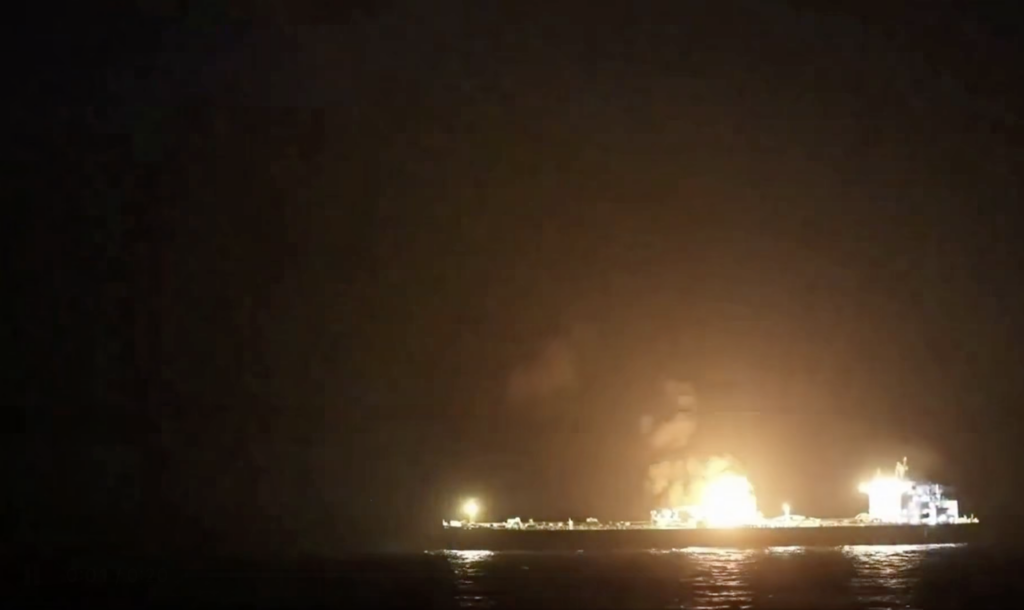


Yemen’s Iran-backed Houthi movement has claimed responsibility for attacking two Saudi oil tankers in the Red Sea, marking a significant escalation in the ongoing maritime security crisis that has disrupted one of the world’s busiest shipping routes.
Houthi military spokesperson Yahya Saree announced on Wednesday that the group targeted the Saudi-owned tankers Encelia and Layla, accusing the vessels of violating a naval blockade the Houthis recently declared in the Bab al-Mandeb Strait.
According to Saree, the attacks were carried out using ballistic missiles, cruise missiles, and drones, alleging that both ships caught fire during the operation.
Saudi Arabia’s state news agency (SPA), citing an official from the Kingdom’s General Authority for Transport, confirmed that the tanker Encelia had come under attack while transiting the Red Sea.
The official said all crew members were safely accounted for and no casualties were reported.
SPA condemned the attack as a violation of international laws and conventions that guarantee the safety of commercial shipping and maritime navigation.
However, Saudi authorities did not provide additional details regarding the reported attack on the Layla.
The United Kingdom Maritime Trade Operations (UKMTO) also reported that a Saudi-owned oil tanker caught fire after an alleged Houthi attack while sailing approximately 70 kilometers north of Yemen’s coastline.
The vessel had departed from Saudi Arabia’s Red Sea port of Yanbu before the incident.
Following the reported strikes, the Houthis announced the start of what they described as “large-scale military operations,” raising concerns that the group could intensify attacks on commercial shipping in the Red Sea and the Bab al-Mandeb Strait.
The latest developments also rattled global energy markets, with Brent crude oil prices climbing above $94 per barrel, their highest level in six weeks, as investors reacted to growing concerns over the security of one of the world’s most critical maritime trade corridors and the potential impact on global oil supplies.