


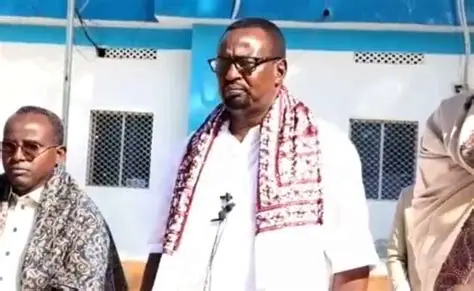


Hirshabelle Vice President Yusuf Ahmed Hagar launched a sharp criticism of both Hassan Sheikh Mohamud and Hirshabelle President Ali Gudlaawe, accusing them of using political power in a way that disadvantages other communities within the state.
Speaking amid escalating political tensions in Hirshabelle, Dabageed claimed that the two leaders have consolidated authority and are using their influence to dominate political decision-making.
“Hassan Sheikh and Ali Gudlaawe are two cousins who have combined their power and decided to use the authority of the pen they hold to harm other people of Hirshabelle,” Dabageed said.
His remarks come as Hirshabelle faces growing disputes over the electoral process, voter registration, and the political standoff in Beledweyne, the capital of the Hiraan region.
The city has become the focal point of tensions surrounding plans for elections and the management of voter registration, with disagreements emerging between local political actors, community leaders, and state authorities.
Dabageed’s comments reflect widening divisions within Hirshabelle’s political leadership at a time when debate over the electoral process has intensified.
He argued that communities across the state deserve to be consulted and that decisions affecting their future should be based on dialogue, consensus, and political agreement rather than unilateral action.
The vice president’s criticism highlights broader concerns among some politicians and community representatives in Hiraan, who have voiced opposition to the way the election process is being conducted.
Critics argue that local concerns have not been adequately addressed, while supporters of the process insist that preparations for the vote must continue in accordance with plans laid out by Hirshabelle and the Federal Government.
The dispute has become increasingly visible in Beledweyne, where voter registration activities have faced resistance and political tensions have risen in recent weeks.
The disagreement has fueled concerns that the electoral process could deepen existing divisions if a political compromise is not reached.
Dabageed’s reference to leaders using “the pen they hold” was widely interpreted as a criticism of the political authority exercised through appointments, administrative decisions, and policies that shape governance within Hirshabelle.
He suggested that such powers should be used to promote fairness and representation rather than political exclusion.
His comments also add to a broader debate over the relationship between the Federal Government and Somalia’s federal member states.
Opponents of Hassan Sheikh and Ali Gudlaawe argue that Hirshabelle’s political direction is increasingly aligned with federal interests, while supporters maintain that close cooperation between Mogadishu and Hirshabelle is essential for security, governance, and state-building efforts.
Political observers say the latest remarks could increase pressure on both the Hirshabelle leadership and the Federal Government as they seek to manage the growing crisis in Hiraan.
The response from Ali Gudlaawe’s administration and federal authorities is now being closely watched.
Many local leaders and analysts continue to call for dialogue involving the Federal Government, the Hirshabelle administration, politicians from Hiraan, traditional elders, and civil society groups.
They argue that a negotiated settlement remains the most effective way to address concerns over elections, representation, and governance while preventing the dispute from escalating into a broader security crisis.
As tensions continue to rise, the political future of Beledweyne and the wider Hiraan region remains uncertain, with the success or failure of ongoing dialogue efforts likely to shape the next phase of the electoral process in Hirshabelle.