


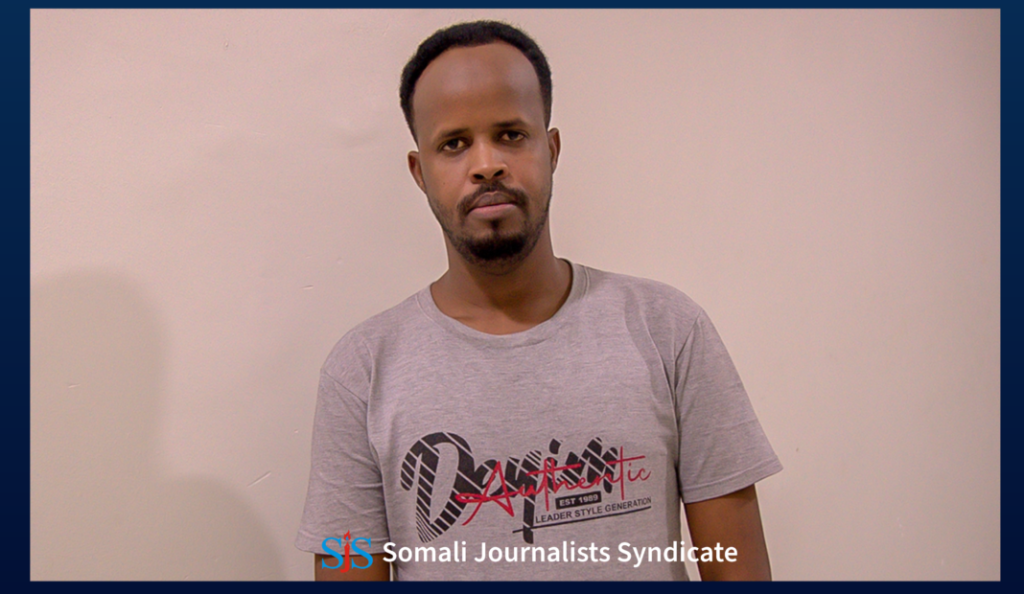


MOGADISHU, Somalia 22 October 2026 – The Somali Journalists Syndicate (SJS) welcomes the release of journalist Khadar Abdirahim Ibrahim of Himilo Media, who was abducted by the National Intelligence and Security Agency (NISA) on Sunday, 11 October 2026, in Mogadishu, Somalia.
On Monday, 19 October, Khadar was released after nine days of incommunicado detention at the notorious underground torture and interrogation facility known as Godka Jila’ow, where he had been held since his abduction.
Khadar told SJS that he became ill while being held at the underground torture facility run by NISA.
Khadar’s family told SJS that a member of the Somali Parliament intervened in his case and pressured NISA to release him.
Khadar was not brought before a court and was not allowed to see his family or a lawyer during his detention, he told SJS.
Just hours before his abduction, on 11 October, he reported for Himilo Media on a tense standoff in Mogadishu following reports that former President Sharif Sheikh Ahmed had accused NISA and President Hassan Sheikh Mohamud of plotting to attack his residence, as per media reports. Sharif warned that “if he is attacked, he will defend himself.”
On the same day, Khadar also interviewed MP Yusuf Hussein Gama’diid, the secretary of Sharif’s Himilo Qaran party, who accused President Mohamud of “provocation.”
On the day of his abduction, plainclothes NISA officers seized Khadar from a local restaurant in Mogadishu’s Wadajir district, where he was taking his lunch break, as SJS reported.
A colleague who spoke to SJS said this was the last time they saw him.
Another Himilo Media colleague, cameraman Abdifatah Mohamed Hared, was also stopped and slapped by NISA officers on the same day near the media outlet’s studio in Wadajir district, the colleague told SJS.
Khadar’s wife told SJS that throughout the nine days he was held by NISA, she “was unable to contact him and did not know his whereabouts”. His phone had been switched off shortly after his abduction.
SJS subsequently issued a public statement demanding information about his whereabouts and calling for his release.
A Somali security source who spoke to SJS on condition of anonymity said that Khadar had been “held by fellow NISA officers” and was being held at Godka Jila’ow.
SJS subsequently alerted the journalist’s family, who were deeply concerned about his whereabouts.
Khadar told SJS about his ordeal at Godka Jila’ow, an underground detention facility located in close proximity to Somalia’s presidential palace.
He said he developed malaria while in detention, where hygiene and sanitary conditions for detainees were deteriorating.
“In the cell where I was held, I met about 15 other men. All of them said they had been kidnapped on allegations of being Al-Shabaab suspects, and they had never appeared before a court or been charged with any crime,” Khadar said.
At Godka Jila’ow, he said, detainees were not provided with adequate food or water.
He also heard some detainees say they were suffering from chronic illnesses and skin diseases and had never seen a doctor.
“A day after I was taken to Godka Jila’ow, I became sick and asked one of the guards if I could see a doctor. They said no,” he told SJS.
Khadar told SJS that he no longer feels safe continuing his reporting on security-related issues.
He said officers at Godka Jila’ow warned him about his future reporting. SJS has documented a pattern of journalists being forced into self-censorship following their arrest or abduction, leaving them and their families fearful for their safety.
In December 2018, the Somali federal government officially announced the closure of Godka Jila’ow because of a record of human rights abuses committed at the facility.
However, the facility remained in use after the announcement. Journalists and politicians critical of the government have been among those detained there, contributing to the facility’s reputation as a site of torture.
Suspected Al-Shabaab members have also been held at the facility.
NISA did not respond to repeated requests from SJS for comment regarding the use of Godka Jila’ow to detain journalists, including Khadar.
While SJS welcomes Khadar’s release, it remains particularly concerned about the threats and abuses he endured during his detention.
Even after his release, he no longer feels safe continuing his work, reflecting the broader climate of fear facing journalists in Mogadishu.
“We are pleased that our colleague Khadar Abdirahim Ibrahim has been freed. However, we are concerned that the threats are continuing and that he does not feel safe.
Khadar was doing his job when NISA officers abducted him and placed him in underground cells, where he became sick and was denied access to medical care,” said SJS Secretary General Abdalle Mumin.
“We demand that these violations stop. We condemn the use of Godka Jila’ow and any other torture facility to detain journalists in Somalia.
We demand a full investigation into the conduct of the officers who carried out Khadar’s abduction and violated his rights,” Mr. Mumin added.
“We also call for the protection of journalists, as Somali journalists in the country no longer feel safe doing their work and reporting on developments in the country.”