


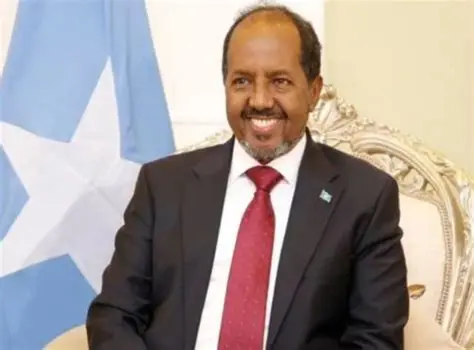


Somali President Hassan Sheikh Mohamud has reportedly agreed to hold national elections within seven months, a development that could mark a significant breakthrough in efforts to resolve a prolonged political dispute over the country’s electoral process.
The reported concession comes at a time of heightened political tensions, with the federal government, opposition groups, and some federal member states divided over the timing, structure, and administration of Somalia’s next elections.
Although no official agreement has yet been announced, political sources say the move emerged from ongoing negotiations aimed at reaching a broad-based electoral settlement and avoiding a deeper political crisis.
For months, Somalia’s electoral process has been at the center of intense debate.
The federal government has advocated for a transition toward a one-person, one-vote system, arguing that the country must move beyond the indirect clan-based electoral model that has dominated Somali politics for decades.
Under the current system, lawmakers and senior political leaders are selected through a process involving clan delegates and political agreements rather than direct voting by citizens.
President Hassan Sheikh has consistently maintained that Somalia’s long-term stability depends on giving citizens the opportunity to directly elect their leaders.
His administration has promoted electoral and constitutional reforms designed to establish universal suffrage, presenting the changes as a necessary step toward strengthening democracy and state institutions.
Opposition leaders, however, have raised concerns about both the pace and manner of the proposed reforms.
They argue that major constitutional and electoral changes should only be implemented through broad political consensus and consultation with all stakeholders, including federal member states and opposition parties.
Critics have warned that pursuing such reforms without agreement could deepen political divisions and undermine trust in the electoral process.
If the proposed seven-month timeline is formally adopted, it would provide a relatively short but crucial window for preparing the election.
Key tasks would include finalizing an electoral framework, establishing a clear timetable, registering voters, identifying and securing polling stations, training election officials, and addressing logistical challenges across the country.
Despite the reported progress, several major questions remain unresolved.
Political stakeholders have yet to reach agreement on the type of election to be held, the institution responsible for administering the vote, the voting system to be used, the role of federal member states, and the mechanisms needed to ensure that all political actors accept the outcome of the process.
The dispute over elections has strained relations between the federal government and several opposition figures, as well as some regional administrations.
The disagreements have also become intertwined with broader debates over constitutional amendments, power-sharing arrangements, and the future direction of Somalia’s federal system.
International partners have closely monitored the situation and repeatedly urged Somali leaders to resolve their differences through dialogue.
The United Nations, the African Union, and other international stakeholders have called for an inclusive political agreement that can provide a credible roadmap toward elections while avoiding instability.
The electoral issue is particularly important because it coincides with Somalia’s ongoing efforts to strengthen state institutions and continue military operations against Al-Shabaab.
Political uncertainty is widely seen as a potential distraction from security priorities and could complicate efforts to maintain momentum in the fight against the militant group.
Even if a seven-month election timeline is agreed upon, Somalia faces significant challenges in meeting such a deadline. The first challenge is political consensus.
Without a broadly accepted agreement, any electoral process risks triggering fresh disputes and questions over legitimacy.
The second challenge is security. Large parts of the country continue to face threats from Al-Shabaab, which regularly carries out attacks against government institutions, security forces, and civilian targets.
Ensuring secure conditions for voter registration, campaigning, and polling would be a major undertaking.
The third challenge is technical preparedness. Organizing a nationwide election requires extensive planning, funding, voter registration systems, election infrastructure, and trained personnel.
Many analysts have questioned whether these requirements can be fully met within a seven-month timeframe.
Coordination between the federal government and regional states will also be critical.
Previous electoral disputes in Somalia have often stemmed from disagreements between Mogadishu and federal member states over authority, representation, and election management.
If the reported seven-month proposal evolves into a formal political agreement, it could represent an important step toward reducing tensions and restoring confidence among Somalia’s political stakeholders.
A credible election accepted by both political actors and the wider public could strengthen democratic legitimacy and contribute to greater political stability.
However, observers caution that the success of any electoral roadmap will depend not only on timelines but also on the willingness of all parties to compromise and work toward a shared vision for Somalia’s political future.
For now, attention remains focused on ongoing talks between the federal government, opposition leaders, and federal member states, which will determine whether the reported seven-month timeline can be transformed into an agreed and workable election plan.