


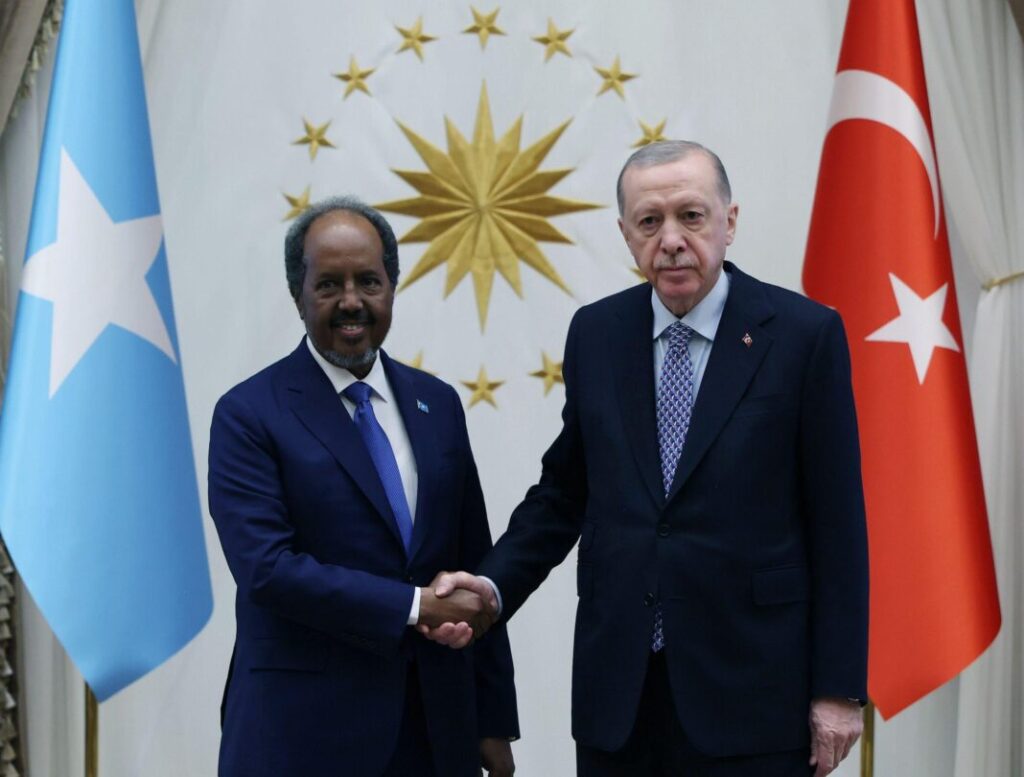


Reports and public discourse are mounting regarding an alleged plan discussed by Hassan Sheikh Mohamud’s government with Turkey concerning the deployment of foreign troops to operate in Somalia.
These forces are intended to support national security, particularly as African Union forces diminish or withdraw.
The Somali government has requested military support totaling 20,000 troops from international allies, with Turkey reported as being prepared to deploy over 15,000 troops to Somalia.
The planned force contingent is reported to include fighters who previously participated in the Syrian conflict, who are not listed on the official roster of the Turkish Armed Forces.
The reported arrangement stipulates that Turkey deploy over 15,000 troops to Somalia, with planned stationing across Mogadishu, Baraawe, Baidoa, and other locations in Southern Somalia.
The most heavily debated point concerns allegations that Turkish forces intended for Somalia may include fighters who previously fought in the Syrian wars.
This raises several critical questions:
• Are these fighters formally serving within the official Turkish Armed Forces?
• Are they private security contractors operating under specialized agreements?
• Are they former combatants drawn from Syrian battlefields?
• Who funds their salaries, and under whose command structure do they operate?
• Will their mandate be restricted to securing government installations, or will it involve direct frontline combat?
On February 8, 2024, Somalia and Turkey signed a ten-year Defense and Economic Cooperation Framework Agreement.
This agreement encompasses cooperation in national defense, maritime security, capacity-building for the Somali Navy, and territorial coastal protection.
The Somali government characterized the treaty as a strategic measure to enhance national capacity in maritime domain awareness, counter-piracy, illegal fishing interdiction, and other maritime security threats.
Official documentation from the Somali Ministry of Defense confirms the existence of this accord; however, the published text does not verify a specific operational plan to deploy 15,000 troops to Somalia.
Furthermore, on July 21, 2026, the Turkish Parliament approved a two-year extension of the Turkish Armed Forces mandate in Somalia, effective from July 27, 2026.
That parliamentary authorization permits Turkish military forces to support Somali security initiatives, counter-terrorism operations, and the protection of maritime interests.
However, that authorization makes no explicit reference to deploying 15,000 troops or Syrian auxiliary fighters to Somalia.
President Hassan Sheikh Mohamud has significantly strengthened military and economic ties between Somalia and Turkey.
Turkey supports Somalia through military training, equipment transfers, strategic advisory roles, and capacity-building for national armed forces.
The TURKSOM Military Training Base, opened in Mogadishu in 2017, serves as a vital installation for training Somali security forces, particularly elite Gorgor commandos.
On October 17, 2026, in an interview with Al Jazeera, Hassan Sheikh emphasized that TURKSOM functions as a training facility for Somali forces, denying assertions that the site constitutes a sovereign Turkish military base.
However, this does not indicate an absence of Turkish military personnel in Somalia, as the Turkish Parliament officially extended their mandate through 2028.
Another notable development occurred on November 4, 2026, during a meeting between Somali Minister of Defense Ahmed Moallim Fiqi and Brigadier General Sabahattin Kılınç of the General Staff of the Turkish Armed Forces.
Somali state media SONNA and Goobjoog English reported that discussions focused on deepening defense cooperation, Horn of Africa security dynamics, counter-Al-Shabaab operations, and ongoing Turkish support for Somali forces.
Senior officials from the Somali Ministry of Defense and TURKSOM leadership also attended the session.
While this engagement demonstrates that both governments continue to expand bilateral military cooperation, no official statement from the meeting confirmed an agreement regarding the deployment of 15,000 troops.
Why Does Turkey Seek an Expanded Military Footprint in Somalia
Several factors explain Somalia’s strategic significance to Turkey:
• **Red Sea and Indian Ocean Security:** Somalia possesses a long coastline strategically positioning it at the intersection of the Red Sea, the Gulf of Aden, and the Indian Ocean.
• **Counter-Al-Shabaab Campaign:** Turkey seeks a capable Somali security apparatus to combat armed groups, simultaneously safeguarding Turkish state interests within the country.
• **Natural Resources:** Bilateral agreements touch upon economic cooperation, petroleum, natural gas, and offshore marine resources.
• **Horn of Africa Influence:** A presence in Somalia provides Turkey with strategic leverage across the region and vital maritime chokepoints.
If reports confirm that personnel outside official Turkish military branches—specifically contracted military personnel—are deployed to Somalia, significant legal and political questions emerge.
It will be necessary to establish command authority over these forces, their legal status, accountability mechanisms for their actions, and operational protocols regarding the Somali civilian population.
Additionally, clarity is required on whether their role involves technical support, facility protection, or direct combat operations.
It remains imperative for the Federal Government to provide transparent briefings to the public and parliament regarding any agreement bringing foreign troops into the country, particularly if non-standard military contractors are involved.
A primary challenge facing Somalia is assuming full national security responsibilities while African Union forces undergo structural adjustments regarding force posture and operational funding.
Should Turkey expand its military support, it could become one of the primary partners upon which the Somali government relies.
However, the question remains whether this support fosters a self-sustained, independent Somali military force or heightens reliance on foreign military contingents.
Somalia requires a unified national military operating under clear command structures responsive to the country’s constitutional institutions.