


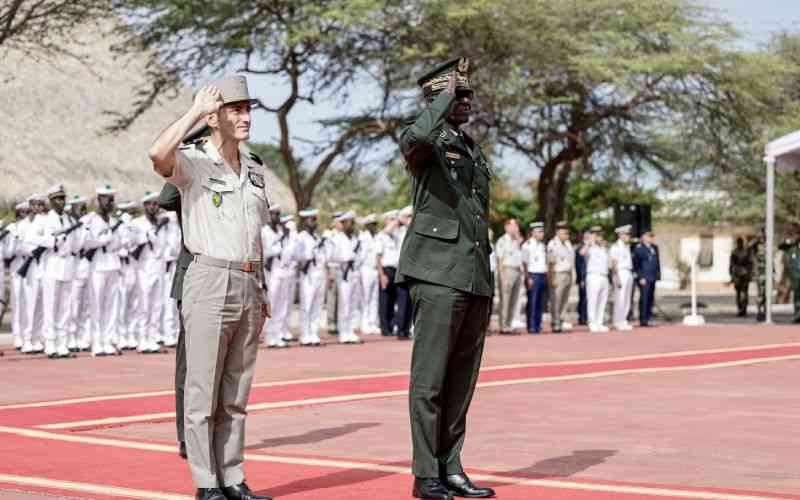


Dakar (KAAB TV) – In a historic move, France formally ended its permanent military presence in West Africa this week, handing over its final installations in Senegal after more than six decades. The transfer marks the culmination of a broader retrenchment across former colonies in the region.
On July 17, 2025, French authorities officially transferred control of Camp Geille—France’s largest military installation in Senegal—and an associated air facility at Dakar’s international airport to Senegalese officials. The ceremony was attended by Senegalese Chief of General Staff General Mbaye Cissé and General Pascal Ianni, commander of French forces in Africa.
The withdrawal capped a three‑month process involving the exit of roughly 350 French troops, which began in March 2025, including earlier transfers of facilities in the Marechal, Saint‑Exupery and Rufisque districts.
President Bassirou Diomaye Faye, elected in 2024 on a platform emphasizing Senegalese sovereignty, had vowed that by year-end 2025, no foreign military bases would remain. He declared that foreign presence was incompatible with Senegal’s independence, even as he affirmed France remained an “important partner.”
General Cissé described the handover as a turning point, saying the move reflects Senegal’s evolving defense strategy—centered on autonomous security capabilities while still contributing to regional stability. General Ianni characterized the transfer as part of a “new phase” of partnership focused on training and intelligence-sharing rather than permanent deployments.
Senegal’s exit follows similar withdrawals in Chad (January 2025), Ivory Coast (February 2025), Mali, Burkina Faso, and Niger, where rising anti-French sentiment and political shifts led governments to expel French forces—many turning to Russia for military cooperation.
With the departure from Senegal, France no longer maintains any permanent military bases in West or Central Africa. Only Djibouti—and to a lesser extent Gabon—host small French garrisons; Djibouti remains the only location with a large permanent base of around 1,500 personnel.
This final withdrawal symbolizes a shift in France’s approach to its former African empire. Officials emphasize a move away from legacy permanent presence toward flexible, demand-driven support—professional training, intelligence, and targeted interventions. In Senegal, the transition underscores a reassertion of post‑colonial sovereignty and reflects broader trends across the continent.
Looking ahead, Washington and European capitals face new geopolitical challenges in the Sahel and Gulf of Guinea. As France steps back, other powers—especially Russia and China—are solidifying their influence through military and economic partnerships with regional regimes.
As France closes this chapter in West and Central Africa, the gesture signals a strategic reinvention. What remains is not military permanence—but cooperation grounded in mutual respect, training, and new forms of security partnership. For many African nations, the transition represents not only the end of foreign bases, but also a step toward full sovereignty and self-reliance.