


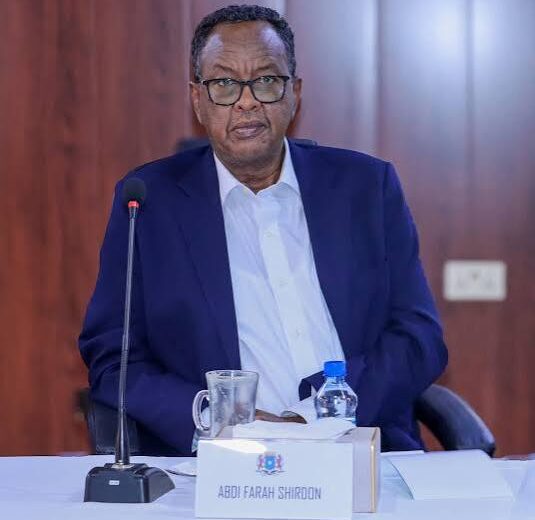


Former Somali Prime Minister Abdi Farah Shirdon, widely known as Saacid, has outlined five priorities he believes are essential to protecting Somalia’s Third Republic, warning that the country’s future depends on addressing longstanding political, security and institutional challenges.
In a statement shared on his X account, Shirdon said Somalia needs an agreed political framework, genuine national reconciliation, lasting security, national unity and transparent state institutions capable of fulfilling their responsibilities.
His remarks come as Somalia faces continuing disagreements over constitutional arrangements, the electoral process and relations between the Federal Government and federal member states.
These disputes have renewed calls for an inclusive political settlement that can restore confidence among the country’s political stakeholders.
The five priorities identified by the former prime minister address some of the fundamental obstacles that have complicated Somalia’s efforts to establish stable and effective government institutions.
The first is reaching a broad constitutional agreement. The Constitution provides the legal foundation for the country’s institutions and defines the respective powers of the presidency, parliament, cabinet and federal member states.
However, disagreements remain over constitutional provisions, the distribution of authority and the procedures for making constitutional changes.
Without a constitutional framework accepted by the main political stakeholders and the wider public, establishing a stable political system could become increasingly difficult.
Shirdon’s argument points to the need for constitutional decisions to emerge from consultation and consensus rather than becoming another source of political confrontation.
The second priority is genuine reconciliation. This, in Shirdon’s view, requires more than holding conferences or signing agreements. It involves addressing political grievances, social divisions and disputes that have remained unresolved for years.
Relations between the Federal Government and some federal member states remain strained, while communities continue to carry grievances arising from past conflicts and political disagreements.
Without meaningful reconciliation, rebuilding trust among political leaders and the wider population will remain a major challenge.
A sustainable reconciliation process would require all parties to have an opportunity to present their concerns, followed by efforts to negotiate lasting solutions.
The objective would be to establish a political environment in which disagreements can be managed through dialogue rather than confrontation.
Security is the third pillar. Despite efforts to strengthen the national armed forces and combat militant groups, parts of Somalia continue to experience attacks and armed conflict.
Achieving lasting security, however, requires more than increasing troop numbers or acquiring weapons. It depends on professional and effective security institutions, a unified national force, a functioning justice system and public confidence in government authorities.
The former prime minister’s position also raises the importance of keeping national security institutions separate from political rivalries. The armed forces should serve the country and its constitutional institutions rather than become divided along political lines.
The fourth pillar is national unity, which Shirdon presents as essential to Somalia’s continued stability. He argues that unity must be built on fairness, consultation and equal treatment of citizens.
Political disputes, tensions between federal and regional administrations and unresolved community grievances have periodically weakened national cohesion.
Addressing these divisions requires a system in which all Somalis feel represented in national decision-making and have a fair opportunity to benefit from public resources.
National unity, therefore, cannot be secured through political statements alone. It requires respect for citizens’ rights, equitable governance and institutions that do not leave particular communities or regions feeling excluded from the country’s political and economic life.
The fifth priority is building transparent and effective government institutions. Shirdon stressed the need for public bodies to operate according to the law, with clear procedures and accountability, rather than depending on individual interests or political influence.
Parliament, the judiciary, the executive and other state institutions must be able to carry out their constitutional responsibilities while protecting citizens’ rights.
Combating corruption and ensuring that public appointments are based on competence are also important steps towards creating institutions capable of serving the population effectively.
The wider political significance
The five priorities closely reflect the major political debates currently facing Somalia, particularly disagreements over the Constitution, elections and the relationship between the Federal Government and federal member states.
The country’s political challenge extends beyond determining who leads the government.
It also concerns how national authority is exercised, how constitutional institutions function and whether competing political groups can agree on rules that command broad public confidence.
If these disputes remain unresolved, public trust in state institutions could weaken further, with possible consequences for security, economic development and social cohesion.
An analytical article published by Marag Magazine on October 28, 2026, also examined disputes surrounding the Constitution, elections and federalism, calling for an inclusive political settlement.
Although Shirdon’s five pillars represent his assessment of what is needed to safeguard Somalia’s statehood, they also highlight responsibilities shared by the country’s political leadership.
The Federal Government faces calls to strengthen consultation, respect constitutional institutions and address outstanding political grievances.
Opposition groups and federal member states, meanwhile, also have a role in efforts to reach a national understanding and should avoid actions that could turn political disagreements into armed confrontation.
Ultimately, the former prime minister’s message places emphasis on the need for a political system built on consensus, accountability and institutional strength.
Whether these principles can be translated into practical reforms will depend on the willingness of Somalia’s political stakeholders to resolve their differences through dialogue and agreed constitutional processes.

