

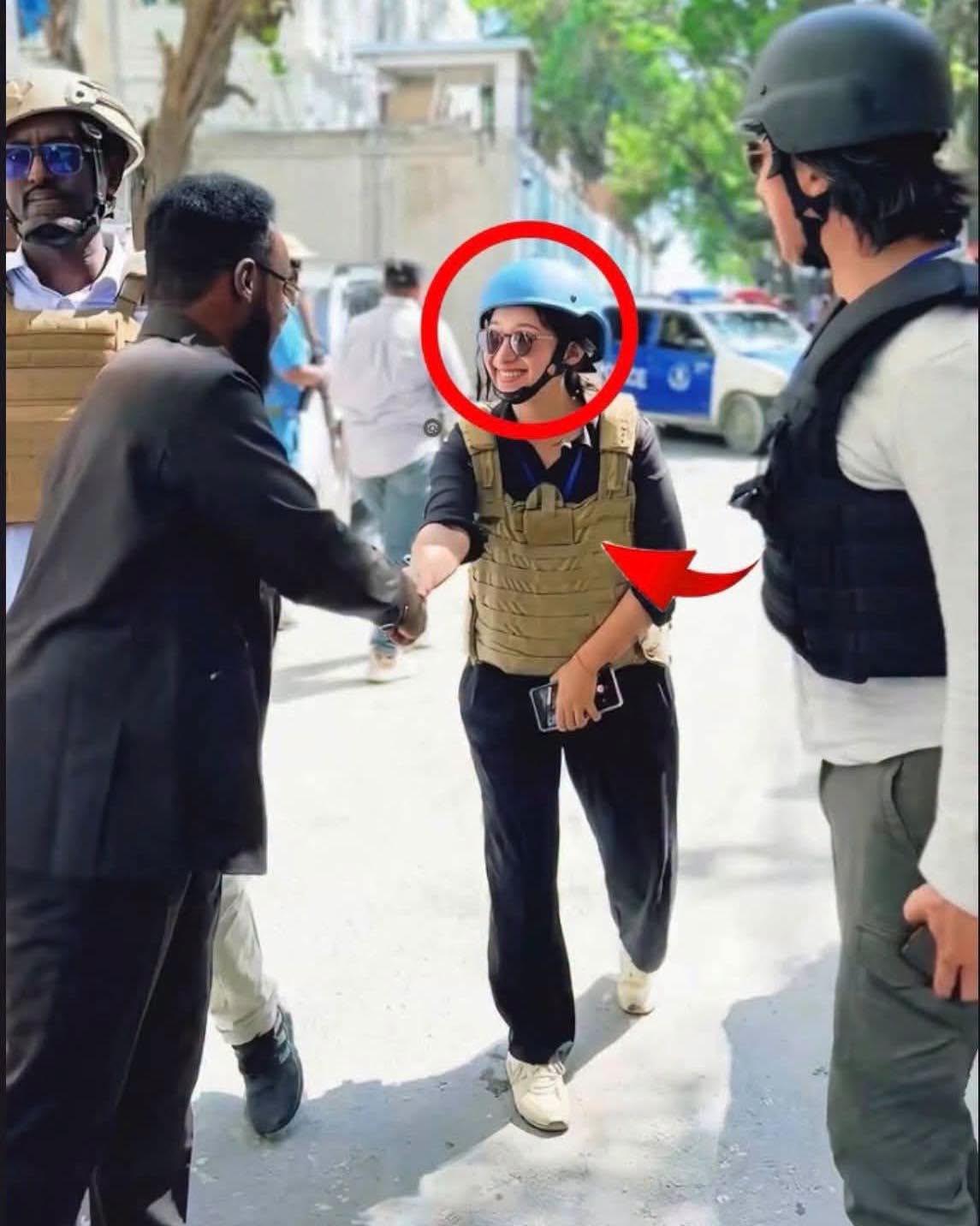

Images and videos circulating on social media showing a group of foreign visitors touring parts of Mogadishu while wearing bulletproof vests have sparked renewed debate about the security situation in Somalia’s capital and the risks facing international personnel operating in the country.
The visitors were reportedly affiliated with the Italian Embassy and the United Nations, although their identities, the purpose of their visit and the precise circumstances surrounding the footage have not been independently established.
Their use of protective equipment has nevertheless attracted attention, particularly because the Somali government has repeatedly maintained that security conditions in Mogadishu have improved following years of operations against Al-Shabaab.
While wearing bulletproof vests does not necessarily indicate that an immediate attack is expected, it highlights the security precautions commonly taken by diplomats, international organizations, journalists and humanitarian workers operating in high-risk environments.
Foreign missions and international agencies often maintain strict security protocols because their personnel can face threats ranging from roadside bombs and armed attacks to targeted assassinations and kidnappings.
The footage has also brought attention to a wider contradiction in Somalia’s security situation: although government forces have strengthened their presence in Mogadishu and improved security in several areas, the capital remains exposed to attacks by Al-Shabaab, which continues to demonstrate its ability to strike heavily protected locations and high-profile targets.
Al-Shabaab has waged an insurgency against the Somali government for more than 15 years, using suicide bombings, vehicle-borne explosives, improvised explosive devices and coordinated gun attacks.
Although the group lost control of Mogadishu in 2011, it has maintained an extensive underground network in the capital, enabling it to carry out attacks against government officials, security personnel, military installations, hotels and other civilian locations.
The group’s strategy has increasingly involved targeting locations associated with the government, international partners and foreign nationals.
Hotels hosting government officials and international visitors have been particularly vulnerable, while restaurants, security checkpoints and other public gathering places have also been targeted in previous attacks.
This persistent threat explains why foreign diplomatic missions and international organizations continue to impose strict security requirements on their personnel, even when visiting areas where government forces maintain a visible security presence.
International travel advisories also provide a different perspective on the security conditions in Mogadishu.
Finland’s Foreign Ministry, in an advisory published on November 3, 2026, maintained its warning against all travel to Somalia, describing the security environment as dangerous, particularly for Western nationals.
It specifically identified attacks in Mogadishu targeting public buildings, restaurants, hotels, checkpoints and airport facilities, while warning that international actors could also be targeted.
Canada’s updated travel advisory of October 15, 2026, similarly warned against all travel to Somalia because of terrorism and the country’s volatile security environment.
It noted that foreign nationals, humanitarian workers and other international personnel face significant risks, including kidnapping and attacks.
The advisory also highlighted the possibility of attacks against diplomatic missions, government institutions, airports, hotels, restaurants and public gathering places.
These warnings illustrate why international organizations may continue operating under heightened security restrictions despite official Somali government claims of progress.
Security improvements in certain districts do not necessarily mean that the threat has disappeared or that foreign personnel can move around the capital without protective arrangements.
Mogadishu’s security situation is also influenced by developments beyond the capital, particularly the ongoing military campaign against Al-Shabaab in southern and central Somalia.
The group continues to operate in rural areas, maintain networks in urban centres and exploit weaknesses in the security forces’ ability to hold territory after military operations.
The security debate has become more significant as Somalia prepares for changes in the deployment of international forces.
Uganda has begun withdrawing troops deployed under a bilateral security agreement with the Somali government, while the African Union is arranging for AUSSOM forces to take over several strategic positions previously supported by Ugandan troops.
According to the Associated Press, the AU mission plans to assume responsibility for four important military positions near Mogadishu: Sabiid-Anole, Bariire, Awdheegle and Buulo-Ganaad.
The move is intended to prevent Al-Shabaab from exploiting security gaps created by the departure of Ugandan forces.
However, questions remain over who will take over other positions being vacated and whether Somali forces have sufficient resources to maintain security in those areas.
The withdrawal is particularly important because Ugandan forces have played a significant role in Somalia’s security operations for years, including protecting strategic locations and supporting military campaigns against Al-Shabaab.
Any poorly coordinated reduction in their presence could create opportunities for the militant group to regain access to areas previously secured by government and allied forces.
It is also important to distinguish between Uganda’s bilateral military deployment and the broader AUSSOM mission. The withdrawal of troops serving under the bilateral agreement does not mean that the African Union mission is ending.
AUSSOM continues to operate under its separate mandate, although its future is increasingly affected by financial constraints and discussions about the gradual transfer of security responsibilities to Somali forces.
Another major challenge is Somalia’s dependence on international logistical assistance.
The United Nations Support Office in Somalia (UNSOS) continues to provide AUSSOM with essential services, including fuel, food, transportation, medical support, equipment maintenance and other operational requirements.
In a statement published on November 12, 2026, UNSOS confirmed that its acting head, Qurat-ul-Ain Sadozai, had engaged with AUSSOM personnel and military commanders in Baidoa, Jowhar and Beledweyne to review operational requirements and discuss the logistical arrangements needed for an orderly security transition.
The UN office also acknowledged the financial and operational pressures facing the mission.
This support is important because Somalia’s ability to replace foreign troops depends not only on the number of soldiers available but also on whether national forces can sustain military operations independently.
They need adequate salaries, vehicles, ammunition, intelligence, communications equipment, medical evacuation capabilities and reliable supply lines to maintain control of strategic locations.
The challenge is therefore much broader than replacing departing foreign soldiers with Somali troops.
It involves building security institutions capable of protecting cities, securing major roads, defending government installations and preventing Al-Shabaab from returning to areas recovered through military operations.
Political disagreements within Somalia have added another complication.
Disputes between the Federal Government and some federal member states over constitutional changes, power-sharing and the organization of national institutions have affected cooperation on wider security and governance matters.
A fragmented political environment can make it more difficult to coordinate military operations and establish a unified national security strategy.
For international organizations and diplomatic missions, these developments mean that security assessments must consider not only the threat of militant attacks but also political instability, the reliability of security arrangements and the possibility of sudden changes in the operating environment.
The sight of foreign visitors wearing bulletproof vests in Mogadishu should therefore not be interpreted as evidence that the capital is experiencing an immediate security emergency.
However, it serves as a reminder that the security situation remains fragile and that international personnel continue to operate under precautions shaped by the threat of terrorism and political uncertainty.
Ultimately, the issue facing Somalia is whether the security improvements achieved over recent years can be maintained as foreign forces reduce their presence and international support arrangements change.
The government’s ability to strengthen its armed forces, improve intelligence capabilities, secure strategic locations and maintain cooperation with regional and international partners will be central to that effort.
Until Somali security institutions can independently provide reliable protection across the country, Mogadishu and other major population centres are likely to remain under heightened security precautions, particularly for foreign diplomats, international organizations and visitors.