


Somali politics is once again confronting a dispute surrounding elections, the constitution, and the presidential term limit.
Today’s situation brings back memories of 2021, when the opposition at the time strongly resisted former President Mohamed Abdullahi Farmaajo after the Federal Parliament approved a two-year term extension.
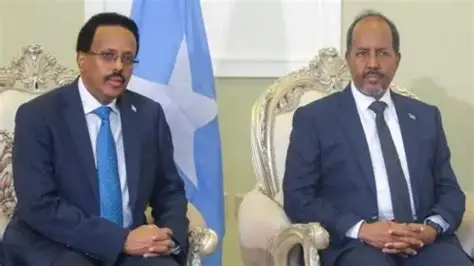
Five years later, Hassan Sheikh Mohamud, who was among the politicians who fiercely opposed Farmaajo’s extension, now faces an opposition rejecting his approach to managing elections and constitutional amendments.
This dynamic has raised critical political questions: What distinguishes the opposition of 2021 from that of 2026? Do politicians’ positions shift when they transition from the opposition to taking office? Or are the circumstances of the two periods fundamentally different?
In 2021, the primary conflict stemmed from election delays and the parliamentary decision extending Farmaajo’s tenure.
The opposition argued that the president had no right to prolong his term without reaching a political consensus. Tensions escalated to the point of armed clashes in Mogadishu, raising severe concerns over the country’s future.
Hassan Sheikh Mohamud was among the politicians who rejected that decision, maintaining that a consensus-based election was necessary and that constitutional norms had to be preserved.
Ultimately, the term extension was rescinded, and the indirect electoral process resumed, culminating in Hassan Sheikh winning the presidency in May 2022.
In 2026, the situation has assumed a different dynamic. Hassan Sheikh’s administration insists on transitioning Somalia to a party-based, one-person, one-vote election, framing it as a step toward expanding public participation.
The government maintains that this system provides citizens with the power to directly elect their representatives.
On the other hand, the opposition alongside the leaders of Puntland and Jubaland have questioned the procedure through which constitutional amendments were executed, as well as the framework established for the electoral process.
They are calling for a political consensus defining electoral rules, institutional mandates, and mechanisms to ensure all stakeholders accept the results.
Consequently, the 2026 opposition does not oppose the principle of one-person, one-vote across the board.
Some support direct elections in principle but object to the government’s execution.
Others focus their concerns on presidential term limits, constitutional legitimacy, and relations between the central government and federal member states.
The primary distinction between the two eras lies in the fact that the 2021 dispute centered directly on a two-year extension passed by Parliament, whereas the 2026 controversy takes place within a broader debate over constitutional reforms, direct suffrage, and federal power-sharing.
Nevertheless, both scenarios share a critical commonality: upon approaching the conclusion of a presidential term, Somali politics consistently sinks into disputes over who sets the electoral rules and how to ensure a lawful transition of power.
The comparison involving Farmaajo and Hassan Sheikh also impacts public trust. When a politician is in opposition, they often demand adherence to the constitution, the avoidance of non-consensual term extensions, and the implementation of mutually agreeable elections.
However, upon assuming office, it remains essential that their governance aligns with the principles they previously defended.
This does not imply that the two situations are identical or that every decision reached by the two presidents carries equal legal standing.
Each must be evaluated against the constitution, the procedures followed, and existing political agreements.
Furthermore, today’s opposition is not a monolithic bloc with unified views. Politicians aligned with Farmaajo, leaders of the Somali Future Council, and the administrations of Puntland and Jubaland may differ in their proposed solutions, even though shared points of opposition exist.
On October 16, 2026, Hassan Sheikh delivered a speech addressing the elections, opposition, and security.
He reiterated the government’s commitment to a one-person, one-vote election, while criticizing the opposition for rhetoric he claimed spreads fear among the public.
His remarks signaled that the government will not retreat from its electoral agenda, despite the ongoing political impasse.
The electoral commission announced on October 15, 2026, that elections for the two houses of Parliament are set for April 15, 2027, with the presidential election planned for May 15, 2027.
However, the announcement of the timeline alone does not clarify whether all parties have reached consensus on the voting mechanism.
If the government and opposition reach an agreement, the dispute can potentially be settled through dialogue and a mutually accepted legal framework.
In the absence of consensus, disputes concerning electoral legitimacy, regional representation, and the acceptance of results could escalate.
The fundamental challenge facing Somalia extends beyond conducting a direct election; it lies in establishing an institutional system independent of who holds the presidency—one that obligates national leaders to uphold electoral rules and constitutional limits.
The future of Somali politics will depend on whether national leaders and the opposition reach consensus on rules respected by all, ensuring the election serves as a clear mechanism for political resolution rather than becoming a catalyst for renewed political and security tension.