
Site icon Kaab TV

EU Reassigns Somalia Ambassador Amid Political Tensions

EU Reassigns Somalia Ambassador Amid Political Tensions

EU Reassigns Somalia Ambassador Amid Political Tensions

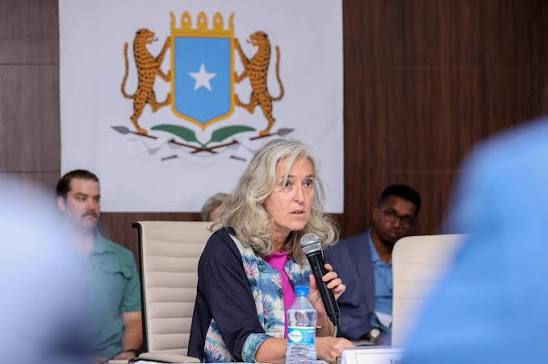
The European Union (EU) has unexpectedly replaced its Ambassador to Somalia, Francesca Di Mauro, less than a year after her appointment, in a move that has raised questions over the timing of her reassignment and its possible connection to recent diplomatic tensions between Brussels and the Somali Federal Government.

Di Mauro has been appointed as the European Union’s Director for Africa, a senior position within the EU’s diplomatic service responsible for shaping the bloc’s engagement across the African continent.

“It is an honour to be appointed Director for Africa,” Di Mauro wrote on her X account, noting that she was born and raised in Africa and describing the appointment as a significant milestone in her diplomatic career.

Her reassignment comes less than 10 months after she assumed office as the EU Ambassador to Somalia in September 2025. EU ambassadors typically serve between three and five years in their host countries, making such an early transfer highly unusual and prompting speculation over the circumstances surrounding the decision.

An Italian diplomat with extensive experience across Africa, including previous postings in Côte d’Ivoire, Di Mauro was widely known for emphasizing democratic governance, constitutional order, human rights, and institutional reform during her diplomatic career.

Diplomatic dispute with Villa Somalia

Questions surrounding her departure intensified following a diplomatic disagreement between the EU delegation and Villa Somalia earlier this year.

On May 17, 2026, Di Mauro disclosed on X that she had met Hassan Sheikh Mohamud, referring to him only by his name rather than using the title “President.” The meeting came two days after critics argued that Hassan Sheikh’s constitutional term had expired on May 15, 2026.

The omission of the presidential title was widely interpreted by political observers as a carefully worded diplomatic signal regarding the disputed constitutional status of Somalia’s leadership.
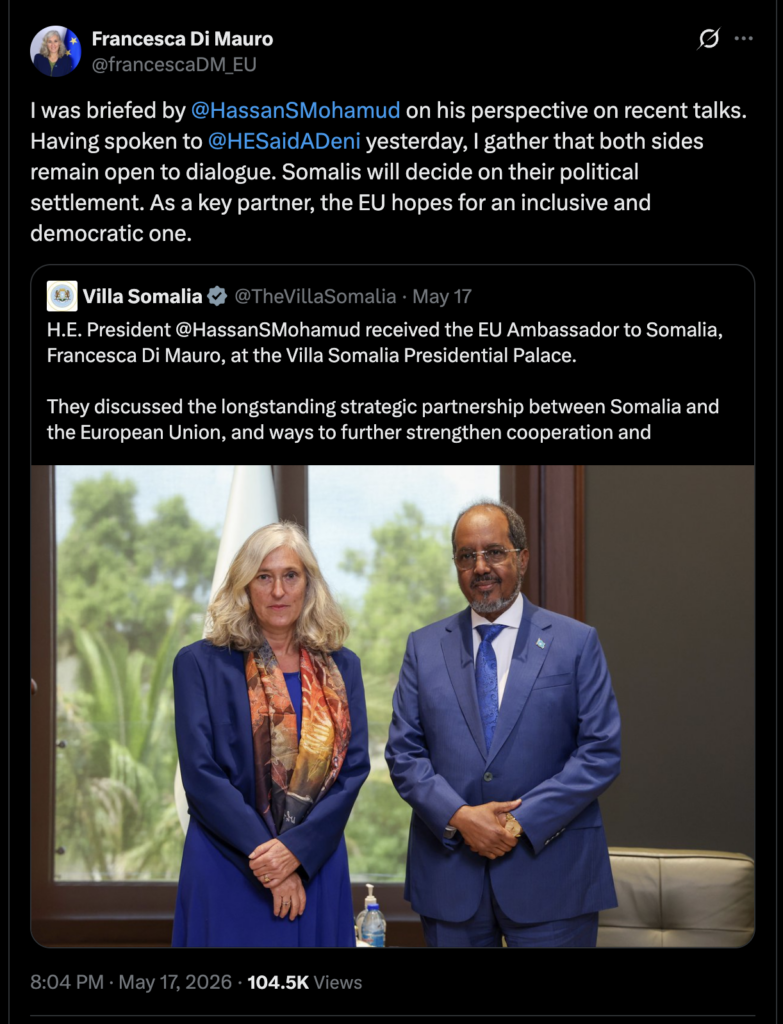
Villa Somalia reportedly viewed the wording as a challenge to Hassan Sheikh’s continued claim to the presidency and is said to have lodged formal complaints with the EU headquarters in Brussels, accusing the ambassador of breaching diplomatic protocol.

Although neither the EU nor Somali authorities publicly escalated the dispute, the incident generated widespread discussion within diplomatic circles and among Somali political actors.

Transfer comes amid constitutional crisis

The ambassador’s reassignment also comes at a time when Somalia is facing one of its most significant political crises since the 2022 elections.

Opposition leaders, former senior officials, legal experts, civil society organizations, and some federal member states argue that President Hassan Sheikh Mohamud’s constitutional mandate expired on May 15, 2026, and contend that there is no legal basis for his continued tenure without a new electoral mandate.

The Federal Government, however, maintains that it can continue administering the country until elections are held, arguing that constitutional continuity requires the existing administration to remain in office during the transition. That position has been strongly contested by opposition groups and constitutional scholars.

Political tensions have further intensified over the government’s determination to implement a one-person, one-vote electoral system without reaching a broad political agreement among key stakeholders. Opposition figures accuse Villa Somalia of using electoral reforms to extend the current administration’s hold on power, an allegation the government rejects.

The prolonged political deadlock has strained relations between Somalia and several international partners, many of whom have repeatedly urged Somali leaders to resolve their differences through dialogue, consensus-building, and respect for constitutional processes.

Visa restrictions fuel speculation

Diplomatic speculation has also been fueled by recent European measures affecting Somali passport holders.

In recent weeks, the EU introduced tighter visa procedures for Somali passport holders, including stricter measures affecting diplomatic passports. While Brussels has not officially linked those decisions to Somalia’s political crisis, the timing of the restrictions, combined with Di Mauro’s reassignment, has fueled speculation about growing diplomatic friction between the European Union and the Somali Federal Government.

Analysts caution, however, that the EU has not publicly stated that the ambassador’s transfer was connected to events in Somalia. Her promotion to Director for Africa represents a significant advancement within the EU’s diplomatic hierarchy, suggesting the reassignment may also reflect broader institutional decisions rather than solely developments in Mogadishu.

Nevertheless, the change in EU representation comes as Somalia continues to grapple with constitutional uncertainty, political divisions, disputed electoral reforms, and increasingly sensitive relations with sections of the international community, all of which are expected to shape the country’s political trajectory in the months ahead.

Exit mobile version