

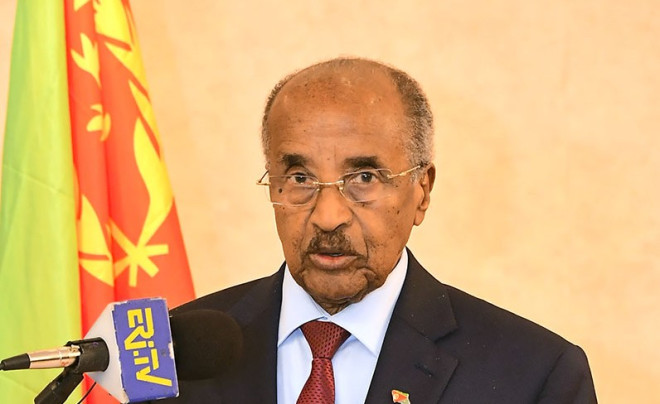

Eritrean Foreign Minister Osman Saleh has voiced concern over any potential Israeli military presence in Somaliland, questioning why Israel would seek a military foothold in the Horn of Africa and warning of the broader regional implications such a move could have.
In an interview with Middle East Eye, Saleh said Eritrea is closely monitoring developments in the region, particularly the growing relationship between Israel and the United Arab Emirates and its potential impact on the Horn of Africa.
According to Saleh, Eritrea believes the two countries have previously shared interests in Somaliland, an issue he said warrants close attention.
“They have already come together on Somaliland,” Saleh said, referring to what he described as overlapping Israeli and Emirati interests in the territory.
The Eritrean minister specifically questioned reports and discussions surrounding a possible Israeli military presence in Somaliland.
“We must ask ourselves why Israel is rushing to gain a foothold in the Horn of Africa. Why does it need a base in Somaliland?” he said.
His remarks come as the Horn of Africa and the Red Sea region continue to attract growing international attention due to their strategic importance.
The region sits along some of the world’s busiest maritime routes, connecting trade between Asia, Africa, Europe, and the Middle East.
Somaliland occupies a particularly strategic location along the Gulf of Aden near the Red Sea.
Its port city of Berbera has emerged as a major commercial hub following significant investment by Emirati companies, most notably DP World, which operates and develops the port.
Berbera’s location near critical shipping lanes has increased its geopolitical importance, drawing interest from regional and international actors seeking economic, security, and logistical influence in the area.
Saleh also claimed that some Somaliland officials have openly expressed interest in hosting an Israeli military presence, a prospect that has fueled debate about the future security architecture of the Horn of Africa and the Red Sea corridor.
Eritrea, which maintains one of the longest coastlines on the Red Sea, has closely monitored military and commercial activities in the region.
Asmara views developments around strategic ports and maritime routes as issues that extend beyond bilateral relations and affect the broader regional balance of power.
During the interview, Saleh also discussed Eritrea’s own relationship with Israel, noting that his government had previously decided not to host an Israeli embassy in Asmara.
“We decided that we do not want their embassy here. We have no hostility toward Israel, but we decided we do not want that relationship,” he said.
The foreign minister further criticized the expanding role of the United Arab Emirates in regional ports, accusing Abu Dhabi of pursuing what he described as a form of “port colonialism” across Africa.
“Why does the UAE have ports everywhere in the region?” Saleh asked, questioning whether the country’s objectives are purely commercial.
The UAE has repeatedly rejected such accusations, arguing that its investments are aimed at strengthening trade connectivity and supporting economic development.
Emirati firms, including DP World and AD Ports Group, have significantly expanded their presence in ports and logistics infrastructure across the Horn of Africa and other parts of the continent.
Analysts note that the Red Sea and Gulf of Aden have become increasingly important arenas for geopolitical competition, with regional states and global powers seeking influence over strategic maritime routes and infrastructure.
The ongoing conflict in Yemen, concerns over maritime security, and the importance of global trade corridors have further elevated the region’s significance.
The issue also carries implications for Somalia. The Federal Government of Somalia considers Somaliland part of its sovereign territory, while Somaliland maintains that it is an independent state.
As a result, any foreign security or military agreement involving Somaliland could trigger wider political and diplomatic tensions involving Mogadishu and regional actors.
Saleh’s comments highlight the growing strategic competition unfolding in the Horn of Africa, where economic investments, military interests, and geopolitical rivalries are increasingly intertwined.
Whether reports of a potential Israeli military presence in Somaliland develop into a formal agreement remains unclear, but the issue is already drawing scrutiny from governments across the region.